Etheria
A 2015 hexagonal-tile virtual world on Ethereum — widely regarded as the first true NFT project — that sat unsold for five years before selling out in the March 2021 NFT boom.
▶ Run interactive simulation animated mechanism with editable parameters
How it works onchain
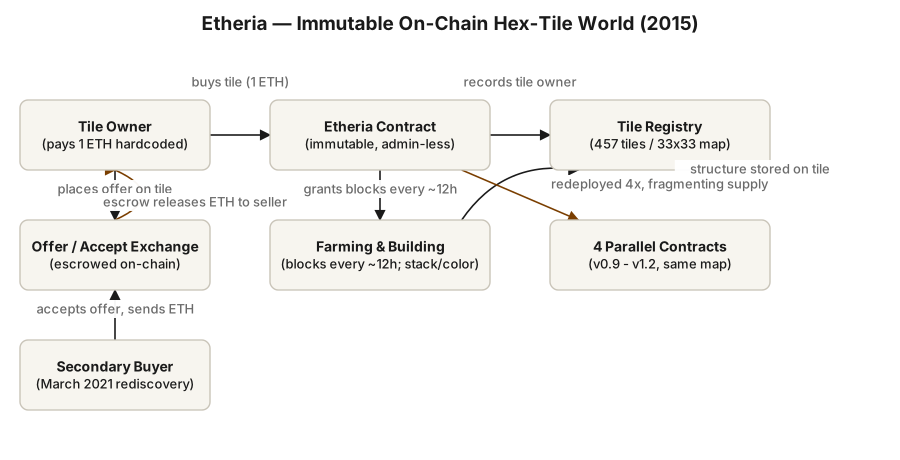 Open full-size diagram
Summary
Etheria is a decentralized virtual world of hexagonal land tiles deployed to Ethereum in October 2015 — roughly three months after mainnet genesis — by Cyrus Adkisson of Lexington, Kentucky, and demoed at DEVCON1 in London on November 13, 2015. The official site describes it as "the first project to unambiguously check all the boxes of what people consider an NFT today": each of 457 ownable tiles per map is a unique, individually owned, transferable on-chain asset, years before the ERC-721 standard existed. Four versions were deployed on the same 33x33 map layout: v0.9 (Oct 19, 2015), v1.0 (Oct 22), v1.1 (Oct 29), and v1.2 (Nov 1). Tiles were hardcoded at 1 ETH each — worth about $0.43 at deployment — and almost nobody bought them. The project sat effectively dead for five and a half years (Adkisson listed it as "defunct" on LinkedIn) until the March 2021 NFT mania, when collectors hunting "historical NFTs" rediscovered it, sold out the remaining supply, and bid individual tiles as high as 70 ETH (~$130,000). Adkisson reportedly netted about $1.4 million in ETH in a single weekend from long-dormant primary sales.
Design (Mechanism)
Each Etheria map is a 33x33 hex grid containing 457 ownable land tiles and 632 unownable ocean tiles, with tile properties such as elevation and terrain type (islands, mountains, ice, tundra). The core mechanisms, all enforced by an immutable, admin-less contract:
- Fixed-price primary sale. Any unowned tile could be bought directly from the contract for a hardcoded 1 ETH. There was no auction, no bonding curve, and no price oracle — the price never adjusted as ETH appreciated ~4-5 orders of magnitude.
- Non-fungible ownership pre-standard. Ownership of each tile is tracked per-tile-index in contract storage with transfer functions — functionally an NFT, written about two years before CryptoPunks and nearly three before ERC-721 was finalized.
- Time-gated farming. A tile can be "farmed" for 20 building blocks once every
2,500 Ethereum blocks (12 hours), a rate-limited resource faucet tied to chain time. - On-chain building. Owners spend blocks to build on their tile — moving, stacking, and coloring blocks — with the resulting structure stored on-chain. Original build operations became prohibitively gas-expensive; a 2021 workaround stores compressed build data in the tile name field, cutting costs ~95%.
- On-chain marketplace. Owners can place and withdraw offers on tiles and accept incoming bids, an escrowed peer-to-peer exchange embedded in the world contract itself.
Because the contracts predate later conventions, they carry period-specific quirks: v1.1+ use tx.origin for authorization, which breaks smart-contract (e.g., multisig or wrapper) ownership; community wrappers exist for v0.9 and v1.0, while later versions require workarounds.
Outcome
As a game and a business, Etheria failed on launch: the 1 ETH price (trivial in dollar terms in 2015, but meaningful to early ETH holders) attracted almost no buyers, and the world stayed mostly empty for over five years. As an artifact, it became a major success. In March 2021 — the week of Beeple's $69.3M Christie's sale and the MoonCats rediscovery — collectors identified Etheria as the oldest live NFT contract on Ethereum. The remaining tiles across the two externally tradeable versions (914 tiles total) were claimed at the still-hardcoded 1 ETH each, Adkisson received roughly $1.4 million in ETH, and secondary bids reached 70 ETH (~$130,781) for a single plot. The contracts remain live and functional today, tiles trade on the in-game exchange and via wrappers, and Etheria is routinely cited in NFT-history timelines as the first true NFT project.
Why it worked
- Radical immutability created provable historicity. Because the contracts were admin-less and never migrated, the 2015 deployment dates are trustlessly verifiable on-chain — exactly the property "historical NFT" collectors paid for in 2021.
- Genuinely complete mechanism design. Ownership, resource generation, building, and an exchange all lived on-chain; Etheria wasn't a pointer to off-chain content but a self-contained world, which strengthened its claim to NFT primacy.
- The hardcoded price became an accidental fair launch. Anyone in March 2021 could still mint at 1 ETH, producing an egalitarian, frenzied sellout rather than an insider allocation.
Where the design broke
- No price mechanism. A hardcoded 1 ETH price could not adapt to demand or ETH's price; in 2015 it was too expensive in opportunity-cost terms for ETH holders, and by 2021 it was an arbitrary giveaway relative to secondary value.
- Five years too early. There was no NFT vocabulary, no marketplace infrastructure, no wallet UX, and a tiny user base in 2015; the game had no discovery surface and no liquidity.
- Gas economics broke gameplay. On-chain building costs scaled with gas prices until playing the actual game was economically irrational, leaving only the speculative land layer.
- Pre-standard quirks (tx.origin, no ERC-721 interface) kept Etheria off standard marketplaces without wrappers, fragmenting liquidity across four versions and wrapped/unwrapped variants.
Lessons
- Immutability is a double-edged sword: it froze a broken price model for six years, but that same untouchability is what made the asset historically credible and valuable later.
- Hardcoded prices denominated in a volatile native asset are a design error; sales mechanisms need some adaptive component (auctions, curves, or governance-adjustable parameters).
- Being first matters more in retrospect than in the moment — value accrued to Etheria's provenance, not its gameplay; timing and surrounding infrastructure determine whether a mechanism finds users.
- Fully on-chain gameplay must budget for gas volatility; mechanisms priced reasonably at launch can become unusable, so cheap state encodings (as in the 2021 name-field build hack) should be designed in from the start.
- Deploying multiple contract versions of "the same" collection permanently fragments supply and confuses provenance; migrations should burn or deprecate predecessors explicitly.
Redesign (EDITORIAL — hypothesis, not fact)
This section is editorial hypothesis, not historical fact. A modern redesign would keep the admin-less, fully on-chain world but replace the hardcoded 1 ETH mint with a slow Dutch auction or a demand-responsive curve per terrain class, so the primary market could clear in any macro environment. Building would move to an L2 or use tightly packed calldata/blob storage with an on-chain commitment, preserving verifiability while keeping play affordable through gas spikes. Authorization would use msg.sender plus ERC-721 compliance from day one, making tiles composable with marketplaces, lending, and multisigs without wrappers. Farming could feed a small sink (e.g., burning blocks to alter terrain) to give the resource loop economic tension. Finally, rather than four parallel versions, a single canonical map with an explicit on-chain deprecation path for upgrades would concentrate liquidity and keep provenance unambiguous.
Sources
- Etheria — FAQ (official) — primary (docs)
- Etheria — What is Etheria? (official) — primary (docs)
- Etheria v1.1 contract on Etherscan — primary (contract)
- Etheria v1.2 contract on Etherscan — primary (contract)
- Interview with Cyrus Adkisson of Etheria at DEVCON1 in London — primary (archive)
- An NFT Game Almost Old as Ethereum Just Resurfaced — And Players are Cashing Out (Decrypt, March 2021) (news)
- Ask HN: Did you buy Etheria tiles in 2015? (Hacker News thread) (analysis)
Related experiments
Last verified: 2026-07-27 · Spot an error? Suggest a correction