Axie Infinity
Sky Mavis's monster-battling NFT game that turned play-to-earn into a mass labor market across the Philippines before its dual-token economy hyperinflated and its Ronin bridge suffered a $624M nation-state exploit.
▶ Run interactive simulation animated mechanism with editable parameters
How it works onchain
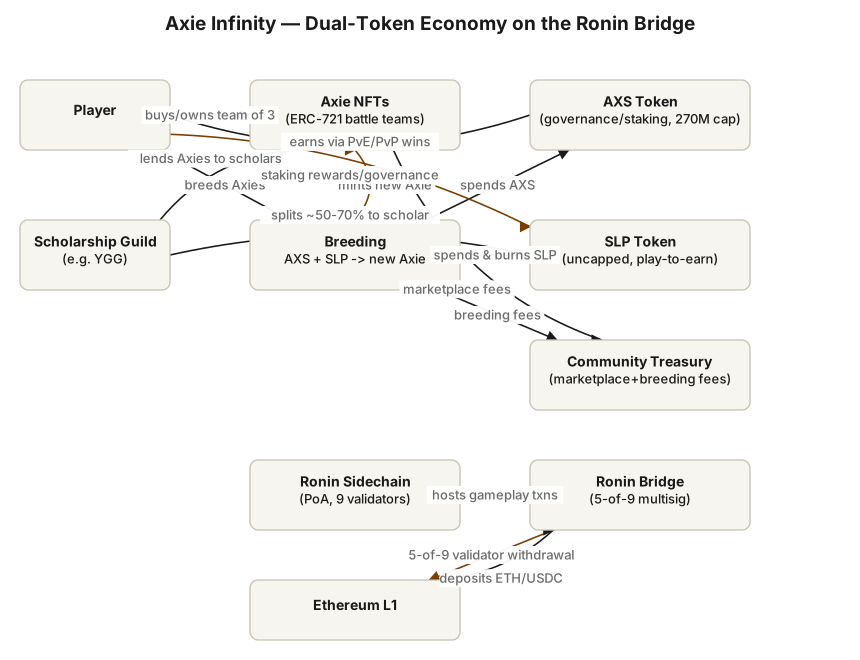 Open full-size diagram
Summary
Axie Infinity is a Pokémon-inspired battling and breeding game built by Vietnamese studio Sky Mavis, launched on Ethereum in March 2018 after development began in 2017. Each creature ("Axie") is an NFT; players assemble teams of three to battle, and breed Axies to mint new ones. In 2020–2021 it became the flagship of "play-to-earn": players earned Smooth Love Potion (SLP), a tradable ERC-20, through gameplay, and at the peak roughly 2.7 million daily active users participated — over 40% from the Philippines, where "scholarship" guilds lent Axies to players who split token earnings with asset owners. To escape Ethereum fees, Sky Mavis shipped its own sidechain, Ronin, in early 2021. The experiment peaked spectacularly and then collapsed on two axes: the SLP token economy hyperinflated once player growth stalled, and in March 2022 the Ronin bridge was drained of 173,600 ETH and 25.5M USDC ($624M) by North Korea's Lazarus Group. Sky Mavis reimbursed users, rebuilt the bridge, and pivoted messaging from "play-to-earn" to "play-and-earn"; the game and Ronin chain continue operating at a fraction of peak scale.
Design (Mechanism)
- NFT creatures with breeding sink. Axies are NFTs with heritable body parts determining battle abilities. Breeding costs AXS plus SLP and produces a new Axie NFT, making breeding the primary token sink. New-player demand for teams (three Axies minimum) drove NFT floor prices.
- Dual-token economy. AXS (Axie Infinity Shards; ERC-20 at 0xBB0E17EF65F82Ab018d8EDd776e8DD940327B28b, fixed 270M supply) is the governance/staking asset capturing marketplace and breeding fees into a Community Treasury. SLP is an uncapped utility token minted by gameplay (daily quests, PvE, PvP wins) and burned by breeding. The design intent: separate the speculative/governance asset from the inflationary rewards asset.
- Play-to-earn emissions. SLP earnings were effectively a wage denominated in a floating token; equilibrium required breeding demand (from new-player inflow) to absorb gameplay emissions.
- Scholarships (asset delegation). Because Axie teams became expensive (hundreds to thousands of dollars in mid-2021), guilds like Yield Guild Games lent teams to "scholars" who kept a share (commonly ~50–70%) of SLP earned — an emergent labor/capital market layered on the NFT design.
- Ronin sidechain and bridge. Ronin launched in February 2021 as a Proof-of-Authority chain with nine validators; the Ethereum↔Ronin bridge released withdrawals when 5 of 9 validator signatures approved, a small multisig trust model chosen for speed and cheap gameplay transactions.
Outcome
Axie generated staggering mid-2021 numbers: ~2.7M peak DAU, over $1.3B in cumulative protocol revenue by late 2021 (breeding + marketplace fees), AXS reaching a multibillion-dollar capitalization, and genuine income effects in the Philippines and Venezuela during COVID (widely covered by CoinDesk, CNBC, and others). SLP, however, peaked in mid-2021 and entered sustained decline as emissions outran breeding demand; by early 2022 scholar earnings had fallen below local minimum wages and player counts slid. On March 23, 2022, an attacker compromised five validator keys — four Sky Mavis nodes plus the Axie DAO validator, whose gas-free RPC allowlist granted to Sky Mavis in late 2021 had never been revoked — and withdrew ~$624M. The breach went unnoticed for six days until a user's failed 5k ETH withdrawal. The FBI attributed the attack to Lazarus Group. Sky Mavis raised $150M (led by Binance), reimbursed users, reopened the bridge in June 2022 after audits, and expanded the validator set. The game survived; the play-to-earn economy did not return to anywhere near peak. Ronin later repositioned as a general gaming chain. Outcome: partial success — a landmark demonstration with two canonical failure modes attached.
Why it worked
- Real ownership + real income met a real moment. COVID-era unemployment in the Philippines gave P2E immediate product-market fit; scholarships let capital-poor players participate, creating viral, community-driven distribution no marketing budget could buy.
- The breeding sink coupled token demand to game growth. While new players arrived, SLP had a genuine burn and Axie NFTs had genuine demand — the flywheel was self-reinforcing on the way up.
- Vertical integration via Ronin. Owning the chain cut fees to near zero, kept marketplace revenue in-house, and made mainstream-scale onboarding feasible in 2021 conditions.
Why it failed or underperformed
- Ponzi-adjacent equilibrium. SLP sinks depended almost entirely on new-player inflow (breeding to sell to entrants). When growth stalled, emissions vastly exceeded burn, SLP hyperinflated downward, wages collapsed, and players who joined for income left — a reflexive death spiral inherent to the design, not an execution accident.
- Extreme bridge centralization. A 5-of-9 validator multisig, four keys held by one company, plus an unrevoked DAO allowlist meant a single spear-phishing campaign (reportedly via a fake job offer) crossed the threshold. Monitoring was so thin the theft of $624M went undetected for six days.
- Earning crowded out playing. The core loop was thin as a game; most participants were there for yield, so retention had no floor once yield vanished.
Lessons
- An uncapped rewards token whose only major sink is minting more player assets is structurally dependent on user growth; sustainable game economies need sinks that scale with engagement, not just with recruitment.
- Dual-token designs do not insulate the economy — SLP's collapse dragged the whole ecosystem despite AXS's fixed supply and treasury capture.
- Bridge security is validator-key security: threshold signatures held mostly by one organization are a single point of failure, and stale permissions (the Axie DAO allowlist) are attack surface. Withdrawal monitoring/circuit breakers matter as much as signature thresholds.
- Emergent labor markets (scholarships) can be a distribution superpower, but importing wage-dependent workers into a speculative token economy converts market drawdowns into humanitarian harm and reputational collapse.
Redesign (EDITORIAL — hypothesis, not fact)
This section is editorial speculation. A redesigned Axie might: (1) denominate gameplay rewards in a non-transferable points system that vests into the tradable token only through engagement-gated sinks (cosmetics, tournaments, land gameplay), throttling emissions by an on-chain controller targeting a burn/mint ratio near 1; (2) cap breeding-driven supply of playable NFTs with seasonal decay or rentals-by-protocol, so entry cost stays low without guild intermediation capturing most worker upside; (3) run the bridge on a large, economically-staked validator set with per-day withdrawal limits, anomaly-triggered pauses, and independent watchtowers — any 24-hour outflow above a small treasury multiple requiring timelocked exit; and (4) publish real-time emission/burn dashboards so the "wage" is legible as variable revenue-share rather than implied salary. The bet: slower, less viral growth in exchange for an economy that survives its first demand shock.
Sources
- Axie Infinity Whitepaper — Team — primary (docs)
- Axie Infinity Whitepaper — primary (docs)
- AXS Token Tracker (Etherscan) — primary (contract)
- Ronin Blog: Back to Building — Ronin Security Breach Postmortem — primary (retrospective)
- Halborn: Explained — The Ronin Hack (March 2022) (analysis)
- Elliptic: $540 Million Stolen from the Ronin DeFi Bridge (Lazarus attribution) (analysis)
- Cointelegraph: Ronin bridge reopens following hack (news)
- CoinDesk: For Filipinos, Axie Infinity Is More Than a Crypto Game (news)
- Sky Mavis Support: Navigating the History of Axie Infinity — primary (docs)
Related experiments
Last verified: 2026-07-27 · Spot an error? Suggest a correction