Wolf Game
The 2021 'risk-to-earn' NFT game where staked Sheep earn WOOL that staked Wolves tax and steal — a protocol-enforced predator/prey economy that defined the game-theory-mint genre, survived a critical contract vulnerability, and limped through years of pivots.
▶ Run interactive simulation animated mechanism with editable parameters
How it works onchain
 Open full-size diagram
Summary
Wolf Game launched on Ethereum on November 18–21, 2021, at the peak of the NFT bull market, created by a pseudonymous founder known only as "The Shepherd." It branded itself "risk-to-earn": every core rule — minting, staking, theft, taxation — was enforced by smart contracts, with art and metadata stored on-chain. Minters had a 90% chance of receiving a Sheep and 10% chance of a Wolf, two classes locked in an adversarial economy over the WOOL token. The game did roughly 4,300 ETH of trading volume in its first 24 hours and rare Wolves traded for as much as ~$80,000, before a critical vulnerability disclosed on November 22, 2021 forced a full pause and contract migration within its first week. It survived, spawned an entire genre of "game-theory mint" clones, and continued operating for years through successive expansions and chain migrations (Blast, a halted 2025 Solana relaunch, then Abstract), but never regained its early cultural or economic peak.
Design (Mechanism)
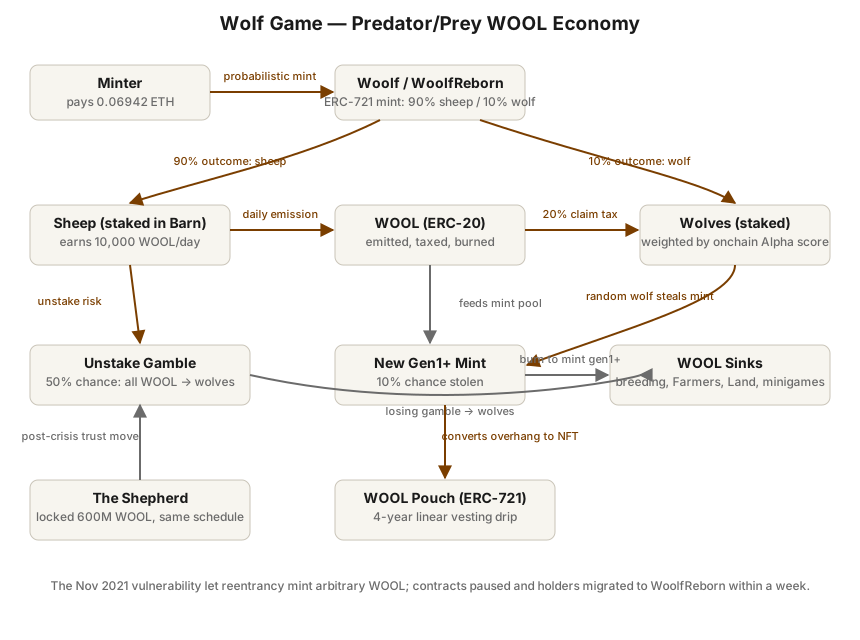
- Probabilistic mint: 10,000 Gen 0 NFTs minted for ETH (0.06942 each); each mint had a 90% chance of being a Sheep, 10% a Wolf. Later generations (toward a 50,000 cap) were mintable only by burning WOOL.
- Sheep (prey): Staking a Sheep in the Barn accrued 10,000 WOOL/day. Claiming WOOL while remaining staked incurred a 20% tax paid to staked Wolves. Unstaking was a gamble: a 50% chance that all accumulated WOOL went to the Wolves.
- Wolves (predators): Wolves earned by taxing Sheep claims (pro-rata by an on-chain Alpha score) and by theft: any newly minted Gen 1+ animal had a 10% chance of being stolen outright by a randomly selected staked Wolf. Wolves were ~10x scarcer, so the "losing" mint outcome was the valuable one.
- WOOL sinks: Burns for breeding/minting new generations (~76M WOOL burned for Gen 1), Farmers (10,000 WOOL burn each), Relic auctions, and later Land (20,000 genesis plots) and expansion gameplay (Risky Game, Alpha Game, Cave Game).
- Post-crisis addition — WOOL Pouch: a tradable ERC-721 that drips WOOL linearly over four years, converting an emissions overhang into a sellable vesting position; The Shepherd publicly locked 600M WOOL on the same schedule.
Outcome
Explosive first week: sellout mint, ~4,300 ETH day-one secondary volume, and mainstream crypto-press coverage. On November 22, 2021, security researcher "notstoops" disclosed critical flaws; the commissioned Herdsman's Report (Bernhard Mueller) documented three: (1) a reentrancy bug allowing arbitrary WOOL minting (e.g., ~6M WOOL instead of 20,000 on unstake), (2) a reentrancy in the rescue/unstake path that could corrupt state and lock others' assets, and (3) weak block-based randomness that let sophisticated actors revert unfavorable mints (via Flashbots) and guarantee Wolves. Contracts were paused with ~13,809 animals trapped; the team could not patch in place and migrated holders to a new "WoolfReborn" contract around November 27, 2021, adding audits and a bug bounty. The game then shipped years of content (Risky Game, Alpha Game, Cave Game, Land, a "full" release in December 2022) and lifetime NFT volume around $43M, but WOOL and asset values decayed through the bear market. An April 9, 2025 "Wolf Game 2.0" relaunch on Solana — which burned players' legacy NFTs without equivalent replacements and bypassed the WOOL-holder Farmhands Council — was contested by holders; it was halted April 14, 2025, the new SOL token's liquidity was pulled, and CEO "GFunk" resigned. The project subsequently migrated to Abstract under new leadership and remains live in 2026 (Valley on Ethereum, Caves on Abstract). Net: enormous mechanism-design influence and early success, followed by a security crisis and a long, turbulent decline — a partial success.
Why it worked
- The mint itself was the game. Making 10% of mints "lose" into the more valuable asset class turned minting into a legible, thrilling lottery and made scarcity mechanical rather than curated.
- Adversarial PvE-as-PvP: the tax/theft loop gave both classes a reason to exist and stake, creating an internal economy with real (if zero-sum) stakes instead of pure emission farming.
- On-chain credibility and pseudonymous mystique: fully on-chain rules and art, plus The Shepherd's in-fiction communications, fit the 2021 moment perfectly and generated organic virality.
- Crisis handling built trust: rapid pause, an independent expert report, a clean migration, and the WOOL Pouch vesting design converted a potentially fatal exploit into a survivable event.
Where the design broke
- Unaudited complexity at launch: reentrancy and manipulable randomness in contracts holding tens of millions of dollars; the flaws were found days after launch by outsiders, not before launch by auditors.
- Zero-sum, emission-heavy economy: WOOL had no external demand source; once speculative inflows slowed, sinks (burns, land, minigames) could not outpace emissions and sell pressure.
- Dependence on continuous novelty: each expansion produced a smaller engagement spike; the core loop was thin without new content.
- No enforceable gate on migrations: nothing in the protocol required a chain or contract migration to preserve player assets or clear the WOOL-holder Farmhands Council before shipping; the 2025 Solana relaunch burned players' legacy NFTs without equivalent replacements and bypassed that council, shattering the accumulated trust the original crisis response had earned.
Lessons
- A "losing" mint outcome can be the product. Wolf Game proved that embedding asymmetric, adversarial odds into issuance creates demand no static PFP drop can match — a template copied by hundreds of forks.
- On-chain randomness is an attack surface, not a feature, unless it is commit-revealed or oracle-supplied. Block-based randomness plus revertable transactions equals a selectable lottery for sophisticated actors.
- Ship audits before mechanisms, especially when the mechanism is the marketing. The more novel the economic loop, the less prior art protects you.
- Vesting can be productized: the WOOL Pouch (a tradable NFT dripping tokens over four years) let holders exit without dumping — an underrated primitive for emission overhangs.
- Community-assented migration is a moat; forced migration is a detonator. The 2021 migration (opt-in, asset-preserving) saved the game; the 2025 relaunch (burn-your-assets, council bypassed) nearly killed it.
Redesign (EDITORIAL — hypothesis, not fact)
This section is editorial hypothesis, not established fact. A modern Wolf Game would keep the predator/prey issuance lottery but fix the three structural weaknesses. First, randomness: use a VRF or commit-reveal scheme for mint outcomes and theft rolls, making Flashbots-style outcome selection impossible. Second, the token loop: denominate Wolf income partly in the scarce asset (Sheep NFTs or protocol fees in ETH) rather than purely in inflationary WOOL, and cap emissions against measured sink volume so the token cannot outrun its own economy. Third, governance and continuity: encode migration rights on-chain — any contract upgrade or chain move requiring approval by a token-weighted council with a mandatory asset-preservation invariant — so no future operator can burn player assets unilaterally. Finally, the 50% unstake gamble could be generalized into a player-chosen risk curve (the direction the Risky Game briefly explored), letting the market price risk appetite instead of imposing one coin-flip on everyone.
Sources
- Wolf Game official site / Woolpaper — primary (docs)
- Wolf Game Herdsman's Report (Bernhard Mueller, commissioned security review) — primary (audit)
- Original Woolf contract (Etherscan) — primary (contract)
- WOOL token contract (Etherscan) — primary (contract)
- The Shepherd on WOOL lock and governance (project X account) — primary (archive)
- What Happened To Wolf Game? (Mintable Editorial) (analysis)
- Wolf Game NFTs: A Guide to Gameplay, Wool, and More (nft now) (analysis)
- Community timeline (Wolf Game Guide) (archive)
- 'Wolf Game' Halted After Solana Relaunch Prompts Backlash (Decrypt) (news)
- Wolf Game Migrates to Abstract (GAM3S.GG) (news)
Related experiments
Last verified: 2026-07-26 · Spot an error? Suggest a correction