ZED RUN
Digital horse-racing game where NFT racehorses with algorithmic 'DNA' were bought, bred, and raced for wagered prize pools — a P2E blue chip of 2021 that was sunset in 2025 and replaced by a new game with none of the old assets.
▶ Run interactive simulation animated mechanism with editable parameters
How it works onchain
 Open full-size diagram
Summary
ZED RUN was a blockchain horse-racing game built by Sydney-based Virtually Human Studio (VHS), launched in early 2019. Players bought NFT racehorses — marketed as "breathing NFTs" with unique algorithmic DNA — then bred them to mint offspring and entered them in continuous 3D-simulated races with paid entry fees and winner-take-most prize pools. The idea reportedly came to co-founder Chris Laurent, then consulting for an Australian bookmaker, after seeing a stud-farm ad noting a stallion could breed 200 times a year: real bloodstock economics, ported on-chain. ZED RUN became one of the breakout NFT games of 2021, riding the NBA Top Shot-era wave: VHS raised a $20M Series A led by TCG (The Chernin Group) with Andreessen Horowitz participating in July 2021, and reported tens of millions of dollars in horse sales. Over its life the game saw more than 420,000 horses bred and roughly $400M in transactions (per sunset coverage). But activity collapsed after the 2021–22 cycle; VHS sunset ZED RUN on February 28, 2025 and relaunched as "ZED Champions" on Base — without a migration path for legacy horse NFTs, which drew public criticism from long-time holders after their horses were not carried over to the new game.
Design (Mechanism)
- Genetic NFTs ("breathing NFTs"): Each horse was an ERC-721 (the "ZT" token, originally on Ethereum; gameplay assets migrated to Polygon in 2021 for gas relief) encoding bloodline, genotype, gender, coat color, progeny count, and race record. Performance was determined by a hidden algorithm seeded by these traits — no two horses identical.
- Bloodline scarcity tiers: Four bloodlines named after crypto figures — Nakamoto (rarest/strongest), Szabo, Finney, Buterin (most common) — plus breed types (Genesis, Legendary, Exclusive, Elite, Cross, Pacer) and genotype "Z-numbers" measuring generational distance from Genesis stock. Scarcity was engineered top-down: bloodline and low Z-number commanded premiums.
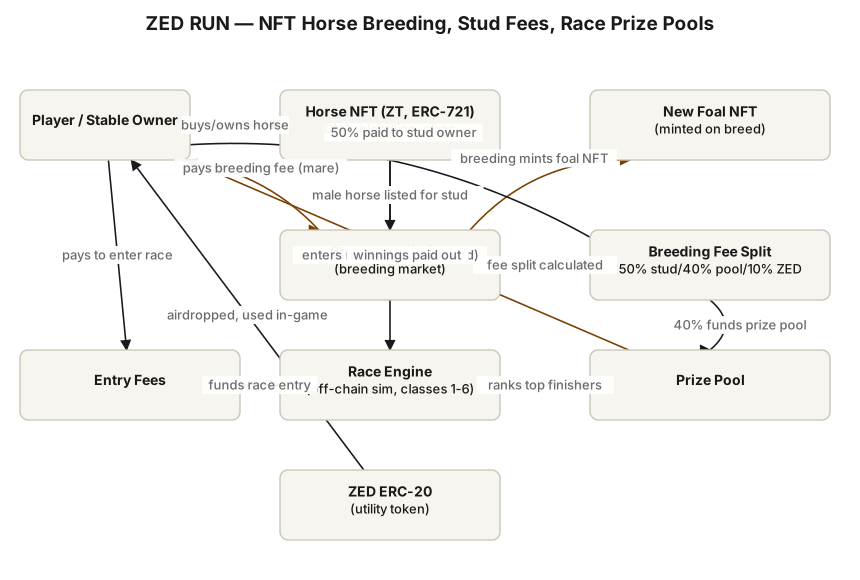
- Breeding market: Owners of male horses listed them in a "stud farm" for fees; mare owners paid to breed and received the foal. The published fee formula weighted bloodline (80%) and breed type (20%) off a base price, with proceeds split 50% to the stud owner, 40% to race prize pools, and 10% to ZED — a built-in supply inflation engine that paid existing holders.
- Racing and classes: Races ran around the clock with paid entry (some free races); entry fees funded prize pools paid to top finishers. New horses ran placement races and were slotted into classes 1–6 by performance, so faster horses faced faster competition — a matchmaking/handicapping ladder.
- Token layer: A ZED ERC-20 utility token (developed with Future Future Labs) was later airdropped/integrated for in-game functionality, layered onto an economy originally denominated in ETH/WETH.
Outcome
Peak ZED RUN (mid-2021) was a genuine phenomenon: horses sold for five and six figures, drops sold out instantly, and mainstream sports/entertainment brands (e.g., a NASCAR-branded stable) partnered with the game. Cumulatively the game processed roughly $400M in transactions and 420,000+ bred horses. But the economy was reflexive: horse prices and breeding demand depended on new-entrant inflow, and the breeding engine minted supply relentlessly. As the NFT market deflated through 2022–2023, floor prices collapsed and prize pools thinned. By early 2025 monthly NFT trading volume had fallen to roughly $28,000 (February) then $627 (March, per CryptoSlam). VHS shut the game down on February 28, 2025 and launched ZED Champions on Base in spring 2025, with fresh horses, an auto-racing format, and a new token strategy. Legacy ZED RUN horses did not carry over (only certain badge-holders got new-game rewards), leaving long-time stable owners with no path to preserve value in the horses they had bred and raced for years. Outcome: a technically and culturally successful product whose token economy was not sustainable — and whose end demonstrated that "true ownership" NFTs were worthless without the operator's off-chain simulation.
Why it worked
- Real bloodstock economics as a game loop: Breeding, bloodlines, and handicapped racing are a centuries-old, proven engagement engine; ZED RUN translated them faithfully (scarcity tiers, stud fees, class ratings) into an always-on digital format.
- Yield-bearing collectibles: A horse was not just a JPEG — it could earn race winnings and stud fees, giving holders a cash-flow narrative that most 2021 NFTs lacked.
- Constant content: 24/7 races gave the community something to watch, wager attention on, and stream — a spectator layer most NFT projects never achieved.
- Timing and distribution: Launching before the 2021 mania meant a mature product when capital arrived; top-tier backers (TCG, a16z) and brand partnerships supplied legitimacy.
Where the design broke
- Inflationary supply vs. speculative demand: The breeding engine was revenue (10% to ZED, 50% to studs) but also a money printer of horses. Once new-buyer inflow slowed, 420,000+ horses chased shrinking prize pools and floors collapsed — classic P2E death spiral.
- Entry-fee-funded prize pools: Prize pools were funded by entry fees rather than external revenue; with class matchmaking, mid-tier horses' expected prize winnings did not reliably cover their holding and entry costs.
- Opaque performance algorithm: Horse ability lived in VHS's closed simulation, not on-chain, so the NFT was a claim on a proprietary service — which is exactly what expired in February 2025.
- Asset discontinuity at relaunch: By not migrating legacy horses to ZED Champions, VHS left long-time holders' NFTs without continuity in the new game, illustrating that a horse NFT's usability depended on the operator continuing to run the off-chain simulation.
Lessons
- An NFT whose utility lives in an operator's closed simulation is a service subscription with a resale market, not durable property; when the server sunsets, "ownership" sunsets with it.
- Breeding mechanics that pay incumbents from newcomer fees are demographically leveraged: they amplify growth on the way up and guarantee oversupply on the way down. Sinks (burns, retirement, caps) must scale with mints.
- Skill-tiered, entry-fee racing funds prize pools from player deposits rather than external revenue; sustainable game economies need outside revenue (spectators, sponsorship, cosmetics) rather than recycling entry fees among players.
- Sequel launches that orphan legacy assets destroy the one asset crypto games uniquely claim to offer — credible continuity. Migration bridges, even symbolic ones, are cheap relative to community trust.
- Engineered scarcity narratives (bloodlines, Z-numbers) work as demand bootstraps, but the rarest tiers' valuations depend most heavily on continued new entry, so those tiers see the largest price declines once entry slows.
Redesign (EDITORIAL — hypothesis, not fact)
This section is editorial hypothesis, not fact. A sturdier ZED RUN would (1) put the performance function on-chain or in verifiable compute (e.g., committed RNG plus published trait weights) so horses are provably what they claim and any client can run races — making the NFTs survivable beyond one operator; (2) hard-cap effective horse population via mandatory retirement-to-breed conversions, so every mint has a matched burn and prize pools per horse stay stable; (3) fund prize pools primarily from spectator-side revenue — parimutuel wagering by non-owners where legal, sponsorships, and cosmetics — instead of racer entry fees, shifting prize-pool funding from player entry fees to an external audience; (4) place the racing engine and IP license in a foundation with an on-chain covenant that any successor product must honor legacy tokens at a published conversion rate, priced into the roadmap from day one; and (5) replace the airdropped utility token with revenue-share staking on race takeout, aligning token value with actual game activity rather than emissions.
Sources
- ZED: ZT Token (horse NFT contract) — Etherscan — primary (contract)
- ZED RUN (ZED) ERC-20 token — Etherscan — primary (contract)
- Bloodlines: Part One / Part Two — ZED RUN official Medium (ZED Guide) — primary (docs)
- From Neigh to Zed: How Digital Horse Racing Became an NFT Favorite — Decrypt (news)
- Zed Run Developer VHS Raises $20M in Funding Round Led by TCG — CoinDesk (news)
- Ethereum NFT Horse Racing Game 'Zed Run' Reborn on Base as 'Zed Champions' — Decrypt (news)
- Zed Champions Beta on the Horizon as Virtually Human Studio Moves on from Zed Run — PlayToEarn (news)
- Web3 Game Zed Run Shuts Down to Launch Zed Champions — GAM3S.GG (news)
- ZED RUN: The Future of Horse Breeding and Racing — Consensys (analysis)
- ZED RUNdown Edition 19 — official community blog (links @zed_run) — primary (archive)
Related experiments
Last verified: 2026-07-27 · Spot an error? Suggest a correction