Usual Money
RWA stablecoin protocol that redistributed T-bill revenue via the USUAL token and grew to ~$1.9B TVL before a unilateral change to USD0++ redemption terms depegged its bond token and shattered user trust.
▶ Run interactive simulation animated mechanism with editable parameters
How it works onchain
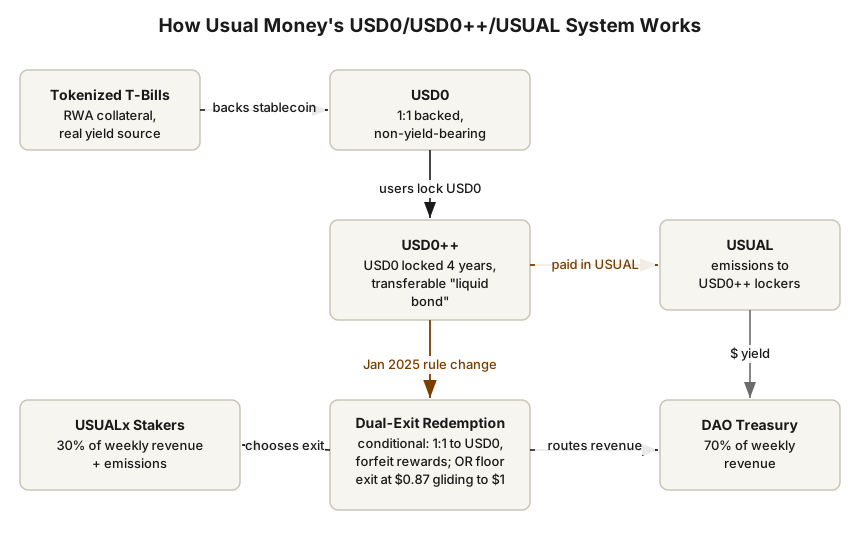 Open full-size diagram
Summary
Usual Money is an Ethereum-based stablecoin protocol built by Usual Labs, founded in 2022 by Pierre Person (a former French MP for Paris and Macron campaign adviser), Adli Takkal Bataille, and Hugo Sallé de Chou. Its pitch inverted the Tether/Circle model: USD0, a stablecoin fully backed by short-term U.S. Treasury Bill exposure (via tokenized RWA instruments), whose yield is not kept by the issuer but redistributed to users through the USUAL governance token — "100% of protocol revenue rights" to the community, per the docs. After a $7M strategic round (IOSG Ventures, Kraken Ventures, April 2024) and a private phase that gathered ~$75M TVL, USD0 launched publicly on July 10, 2024. Aggressive points ("Pills") farming and the USD0++ locked bond drove TVL to roughly $1.9B by early January 2025, briefly making Usual one of the fastest-growing stablecoin protocols ever. On January 9–10, 2025, USD0++ redemption terms were changed without a governance vote, introducing a $0.87 floor; USD0++ depegged to ~$0.89–0.92, leveraged loopers were wrecked, and trust collapsed. The protocol survives — USD0 itself stayed backed — but by mid-2026 TVL sat near $97M (DefiLlama) and USUAL traded around $0.009 (CoinMarketCap), down more than 99% from its post-launch peak despite ongoing buybacks and a "Revenue Switch."
Design (Mechanism)
Three interlocking tokens:
- USD0 — a non-yield-bearing stablecoin, 1:1 backed by aggregated tokenized T-bill products (real-world-asset collateral rather than bank deposits), with on-chain reserve transparency. USD0 holders get liquidity but no yield.
- USD0++ — a "liquid bond": USD0 locked for a 4-year term. Instead of receiving the underlying T-bill yield in dollars, USD0++ holders receive USUAL token emissions. USD0++ itself is transferable and was widely used as collateral (Morpho, Pendle, Curve pools), enabling leveraged looping.
- USUAL — the governance/revenue token, launched with a Binance Launchpool in November 2024 and TGE in mid-December 2024. Its core gimmick: emissions are calibrated to grow more slowly than TVL/revenue (emission rate inversely tied to TVL growth), so each USUAL notionally represents an increasing claim on protocol revenue — marketed as "deflationary-by-design" versus hyperinflationary farm tokens. Staked USUAL (USUALx) earns 22% of all daily USUAL emissions plus weekly protocol revenue distributions.
The economic engine: the protocol earns real T-bill yield on the whole collateral base, pays USD0++ lockers in speculative USUAL instead of dollars, and accrues the dollar revenue to the DAO/stakers. The January 2025 "dual-exit" change made the bond structure explicit: 1:1 redemption to USD0 only by forfeiting accrued rewards (conditional exit), or immediate exit at a floor price starting at $0.87 and gliding to $1 over four years (unconditional exit). In 2025 Usual added a Revenue Switch (weekly revenue: 30% to locked USUAL holders, 70% to DAO treasury), a ~$300K/week buyback program that repurchased over 10% of circulating USUAL, Usual Savings, and announced products like ETH0 and USD0a; the DAO reached 100% ownership of protocol assets in December 2025.
Outcome
Explosive success, then a trust rupture. TVL: ~$75M private phase → ~$1.9B peak (early January 2025) → ~$1.6B immediately post-depeg → ~$97M by mid-2026. USUAL surged after its December 2024 TGE, then fell over 99% to ~$0.009 (market cap ~$16M, mid-2026). The January 10, 2025 redemption change dropped USD0++ to ~$0.89, imbalanced Curve's main USD0/USD0++ pool ~92%, and triggered liquidations of leveraged loop positions on lending markets. Critics documented that the $0.87 floor appeared in documentation retroactively, without prior governance process. USD0 the stablecoin never broke its backing; the protocol continues operating with buybacks and revenue sharing, but it never recovered its growth trajectory. Classified partial_success: the RWA-stablecoin engineering and revenue-redistribution machinery worked; the credibility layer failed.
Why it worked
- Real yield as the base layer. Unlike algorithmic predecessors, the collateral was genuinely productive (T-bills), so there was actual revenue to redistribute — the flywheel wasn't purely reflexive.
- "Become the issuer" narrative. Redistributing what Tether keeps was a sharp, legible pitch, amplified by a politically prominent founder and a Binance listing.
- Emission math engineered for scarcity. Tying USUAL issuance inversely to TVL growth made early APYs spectacular on paper and gave farmers a reason to lock for four years.
- Composability. USD0++ as collateral on Morpho/Pendle/Curve let degens loop, multiplying TVL far beyond organic demand.
Where the design broke
- A duration instrument traded at par. USD0++ traded and was integrated (and margined) at $1 across DeFi, but was legally/economically a 4-year zero-coupon-like instrument. When the discount ($0.87 floor) was enforced, holders were exposed to duration risk that the $1 trading price had not reflected.
- Redemption terms changed without a governance vote. The redemption terms and their documentation could be modified overnight, without a governance vote or advance notice, so a design clarification landed as an unannounced change to exit terms.
- Reflexive TVL. Much of the $1.9B was leverage-looped farm capital chasing USUAL emissions; once the token fell, the emissions-denominated yield collapsed and capital fled, feeding the token further down.
- Asymmetric yield allocation. Lockers received USUAL emissions, a token whose price fell over 99% from its post-TGE peak, while the DAO retained the dollar-denominated T-bill yield on the underlying collateral.
Lessons
- If an instrument has duration risk, it must be priced, named, and integrated as a bond from day one; letting markets treat a lockup token as a $1 stablecoin is a depeg with a timer on it.
- Retroactively editing redemption terms — even ones arguably implicit in the whitepaper — destroys more value in trust than it saves in reserves; changes to exit mechanics need long notice periods and binding governance.
- Emissions inversely tied to TVL create magnificent headline APYs and equally magnificent reflexive unwinds; real-yield redistribution only stabilizes a token if the yield is paid in the asset users actually want (dollars, not the governance token).
- A "we share 100% of revenue" narrative raises the bar: any operator discretion that touches user principal will be judged against that promise, not against industry norms.
Redesign (EDITORIAL — hypothesis, not fact)
This section is editorial hypothesis, not fact. A redesigned Usual would (1) launch USD0++ explicitly as a dated, discounted zero-coupon bond (e.g., tradable at NAV along a published accretion curve to maturity), never marketed at par, with oracles and lending integrations quoting the curve price; (2) hard-code redemption mechanics in immutable contracts or behind a long timelock with mandatory on-chain votes, so terms cannot change faster than users can exit; (3) pay lockers a hybrid coupon — a dollar-denominated base share of T-bill revenue plus a USUAL kicker — so yields degrade gracefully instead of collapsing with the token; and (4) cap loop leverage on its own bond via supply caps in partner markets during the bootstrap phase, trading slower TVL for TVL that survives the first stress test.
Sources
- Usual Docs — What is Usual? — primary (docs)
- Usual Docs — USD0 Stablecoin — primary (docs)
- USD0 token contract (Etherscan) — primary (contract)
- USD0++ token contract (Etherscan) — primary (contract)
- USUAL token contract (Etherscan) — primary (contract)
- Usual Blog — Revenue Switch, A New Dawn for USUALx Holders — primary (governance)
- Usual Docs — Usual: The First Two Years (roadmap) — primary (docs)
- Stablecoin developer Usual faces backlash after changing redeem function (crypto.news) (news)
- DeFi: Usual cuts redemption price on depegged stablecoin, keeps $1.6B TVL (Lex Sokolin) (analysis)
- Collateral Damage: USD0++ Depeg Leaves Farmers in the Red (Leviathan News) (analysis)
- Usual — DefiLlama protocol page (analysis)
- Usual (USUAL) — CoinMarketCap (analysis)
Related experiments
Last verified: 2026-07-27 · Spot an error? Suggest a correction