TerraUSD / LUNA
An algorithmic dollar-pegged stablecoin (UST) stabilized by a mint/burn arbitrage loop with its volatile sister token LUNA, which entered a reflexive death spiral and collapsed to near-zero in May 2022.
▶ Run interactive simulation animated mechanism with editable parameters
How it works onchain
 Open full-size diagram
Summary
TerraUSD (UST) was a decentralized, dollar-pegged algorithmic stablecoin built on the Terra blockchain, a Cosmos-SDK Layer 1 developed by Terraform Labs (co-founded by Do Kwon and Daniel Shin). Rather than holding fiat or crypto collateral like USDC or DAI, UST maintained its $1 peg through a purely algorithmic mint/burn arbitrage relationship with its sister token, LUNA. At its 2022 peak the ecosystem exceeded roughly $40-45 billion in combined market capitalization, and LUNA reached an all-time high near $119. In May 2022 UST lost its peg and both tokens collapsed to near-zero within about a week — one of the largest value-destruction events in crypto history — triggering cascading failures across lenders (Celsius, Voyager), funds (Three Arrows Capital), and eventually contributing to the collapse of FTX.
Design (Mechanism)
The system used a two-token seigniorage / burn-and-mint equilibrium model:
- UST was the stablecoin, targeting $1.
- LUNA was the volatile "absorber" token that also served as the chain's staking/governance asset.
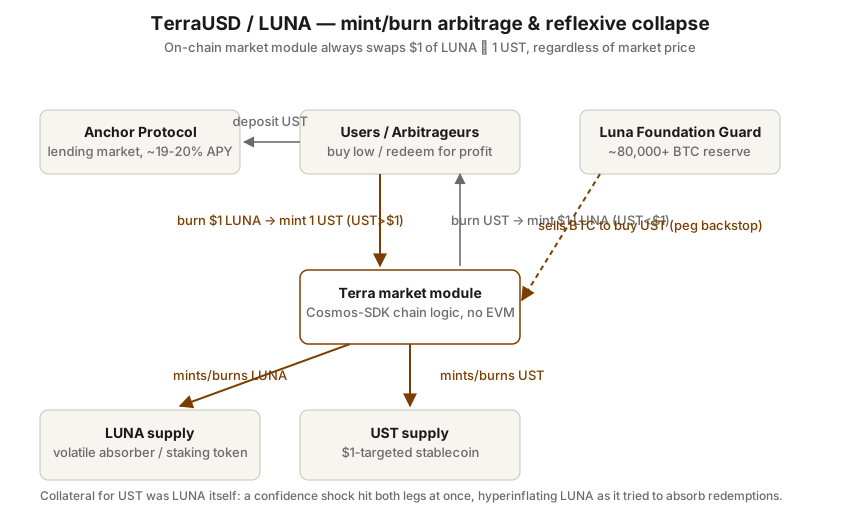
The core rule: the protocol always allowed swapping $1 of LUNA for 1 UST, and 1 UST for $1 of LUNA, regardless of market price, via an on-chain module (not an EVM contract — Terra was Cosmos-SDK, so this lived in the chain's market module).
- If UST > $1: arbitrageurs burned $1 of LUNA to mint 1 UST and sold it, expanding UST supply and pushing the price down.
- If UST < $1: arbitrageurs bought cheap UST, redeemed it for $1 of freshly minted LUNA, and sold the LUNA, contracting UST supply and pushing the price up.
The mechanism relied entirely on market confidence in LUNA's value to absorb redemptions. Demand for UST was heavily driven by Anchor Protocol, a lending market that paid depositors an advertised yield of roughly 19-20% APY on UST. This yield was subsidized (funded from a reserve rather than organic borrow demand), effectively acting as the primary demand engine for the entire stablecoin. In January 2022 the Luna Foundation Guard (LFG) was created to build an exogenous reserve, accumulating on the order of 80,000+ BTC (~$2.4B) plus other assets, intended as a backstop to defend the peg — an implicit admission that the pure algorithm was insufficient.
Outcome
Outcome: failed. The mechanism's fatal flaw was reflexivity: LUNA's value depended on confidence in UST, and UST's peg defense depended on confidence in LUNA. In early May 2022, large UST withdrawals from Anchor and coordinated/de-pegging sell pressure (partly around Curve pool imbalances) pushed UST below $1. As arbitrageurs redeemed UST for LUNA, LUNA's supply hyperinflated — from a few hundred million tokens to trillions within days — crushing LUNA's price. This destroyed the very collateral value meant to backstop UST, accelerating the de-peg instead of arresting it: the textbook death spiral.
Key dates: UST began losing peg around May 9, 2022; the Terra chain was halted May 13, 2022; a community relaunch (Terra 2.0, new LUNA) was approved May 25-28, 2022, with the original chain becoming Terra Classic (LUNC/USTC). LFG's Bitcoin reserve was deployed and largely exhausted without saving the peg. Terraform Labs filed for Chapter 11 bankruptcy in January 2024 and has since wound down.
Why it worked
For roughly 18 months the design worked well enough to scale UST into the largest algorithmic stablecoin ever:
- Clean arbitrage incentive: The always-available $1-for-$1 swap gave a simple, mechanical peg-restoration path that held under normal conditions and modest volatility.
- Capital efficiency narrative: Being "collateral-free" let UST scale far faster than over-collateralized rivals like DAI, appealing to a market that saw over-collateralization as inefficient.
- Demand engineering via Anchor: The ~20% yield created enormous, sticky demand for UST, giving the peg deep liquidity and the appearance of stability during a bull market.
- Reflexive tailwind (upside): In bull conditions, rising LUNA price and rising UST demand fed each other virtuously, making the system look self-reinforcing.
Why it failed or underperformed
- Endogenous collateral: UST was ultimately "backed" by LUNA, an asset whose value derived from the same system — there was no independent value anchor, so a confidence shock hit both legs simultaneously.
- Reflexive death spiral: The mint mechanism that restored the peg in calm markets became an amplifier under stress, printing unlimited LUNA and diluting it to zero.
- Unsustainable subsidized yield: Anchor's ~20% APY was not organically funded; it inflated UST demand artificially, and the prospect of that yield falling created a large, fragile pool of "hot" capital primed to exit.
- Insufficient / late exogenous reserves: The LFG Bitcoin backstop was too small relative to UST's ~$18B supply and had to be sold into a falling market, worsening the crash.
- Redemption bottlenecks and liquidity limits: On-chain swap parameters and slippage limited how fast UST could be absorbed, so the peg broke faster than arbitrage could repair it.
Lessons
- Algorithmic stablecoins backed by their own reflexive governance token are structurally fragile. When the "collateral" and the liability share a single source of confidence, a bank-run condition collapses both at once; robust designs require exogenous, independently-valued collateral.
- Subsidized yield is demand, not stability. Bootstrapping adoption with an unsustainable yield (Anchor's ~20%) manufactures fragile TVL that flees at the first sign the subsidy or peg is at risk; the demand engine must be distinguished from the stability mechanism.
- Peg-defense capacity must be sized for the tail, not the mean. A backstop reserve introduced late and small (LFG's BTC vs. ~$18B UST) cannot stop a reflexive run; either full over-collateralization or hard supply/redemption circuit breakers are needed.
- Systemic contagion is real. UST/LUNA's collapse cascaded into 3AC, Celsius, Voyager, and the broader 2022 crypto credit crisis — interconnected leverage turns one protocol's failure into a market-wide event.
Redesign (EDITORIAL — hypothesis, not fact)
The following is the researcher's analysis and speculation, not established fact.
A more robust redesign would keep the capital-efficiency appeal while removing the single-point-of-confidence failure:
Hybrid collateralization with a hard floor. Rather than pure algorithm, back UST with a majority of exogenous, liquid, diversified collateral (BTC, ETH, T-bill-like assets) held from day one, using the LUNA-style token only for the marginal, above-collateral portion (a "fractional-algorithmic" model). The exogenous reserve should scale automatically with supply, not be bolted on after $18B of liabilities exist.
Reflexivity dampeners / circuit breakers. Cap the rate and total quantity of LUNA that can be minted per epoch during a de-peg, forcing redemptions through the exogenous reserve first and preventing unbounded dilution. Accept a temporary "soft peg" band under stress rather than defending $1 at the cost of infinite token printing.
Organic, capped yield. Replace subsidized 20% yields with yield derived from real reserve returns (e.g., short-term treasuries or protocol fees), so demand reflects sustainable economics and there is no cliff of hot money.
Transparent, on-chain solvency proofs. Continuously publish the reserve-to-liability ratio on-chain so holders can price run-risk accurately, converting an opaque confidence game into a legible, collateral-backed instrument.
The core hypothesis: UST's failure was not merely a liquidity event but an inevitable consequence of endogenous backing plus subsidized demand. Any redesign that retains a purely self-referential collateral token is likely to fail the same way; survival requires exogenous collateral sized for the tail and mechanisms that refuse to sacrifice supply integrity to defend a peg.
Sources
- Terra (blockchain) — Wikipedia (analysis)
- SEC Charges Terraform and CEO Do Kwon with Defrauding Investors — primary (governance)
- Terra: USTC Token (Wrapped UST) — Etherscan contract — primary (contract)
- Terra: LUNC Token (Wrapped LUNA) — Etherscan contract — primary (contract)
- Why Stablecoins Fail: An Economist's Post-Mortem on Terra (Richmond Fed) (analysis)
- How the crypto stablecoin 'UST' failed and what we can learn from it (WEF) (analysis)
- Asset Risk Assessment — Terra (UST), Dec 2021 (LlamaRisk) (audit)
- The Death Spiral: How Terra's Algorithmic Stablecoin Came Crashing Down (Forbes) (analysis)
Related experiments
Last verified: 2026-07-26 · Spot an error? Suggest a correction