Empty Set Dollar
A pioneering uncollateralized, seigniorage-style algorithmic stablecoin that used voluntary rebases, bonding, and burn-for-coupon debt to target 1 USDC, and became a canonical example of a coupon death spiral.
▶ Run interactive simulation animated mechanism with editable parameters
How it works onchain
 Open full-size diagram
Summary
Empty Set Dollar (ESD, symbol ∅) was one of the earliest "seigniorage-shares"-style algorithmic stablecoins on Ethereum, launched in September 2020 by an anonymous team calling itself the Empty Set Squad ({ess}). It aimed to be a decentralized, uncollateralized reserve currency for DeFi that would trade around 1 USDC without any backing assets. ESD is a canonical historical experiment because it made two influential design bets: a single-token model where the same token was simultaneously the stablecoin and the governance/seigniorage share, and a "voluntary rebase" system in which supply changes only accrued to users who actively bonded tokens into the DAO rather than mutating everyone's wallet balance (as AMPL did).
The protocol launched with zero initial supply and no pre-mine, expanded rapidly during a bootstrapping period, briefly held its peg, and then depegged in late December 2020. It slid to roughly $0.23 by early 2021 and never durably recovered. Its collapse — driven largely by an expiring-coupon debt mechanism — became a widely-cited case study in why "empty set" style algorithmic dollars are prone to permanent breakage. A partially-collateralized redesign (Empty Set V2 / "Continuous ESD," with a reserve and ESDS governance token) was later proposed and audited, and the Empty Set team eventually pivoted toward a different collateral product (DSU / Digital Standard Unit).
Design (Mechanism)
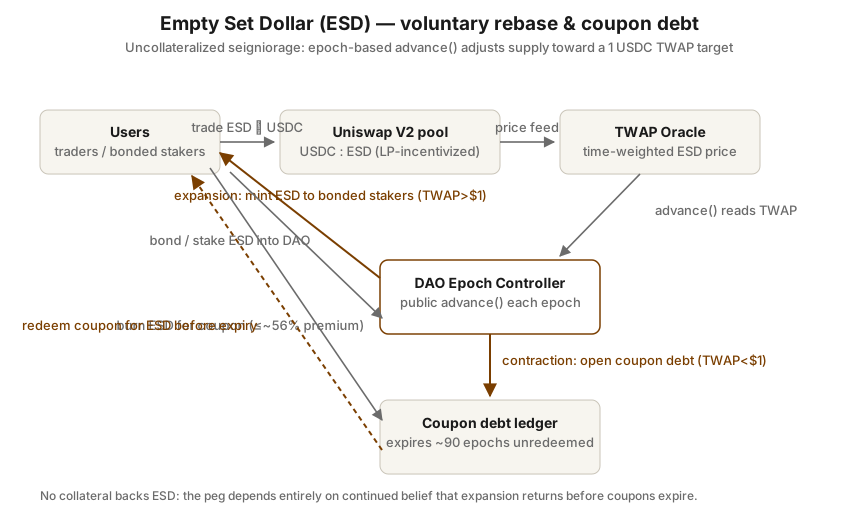
ESD targeted a 1 USDC time-weighted average price (TWAP) sourced from an incentivized Uniswap V2 USDC:ESD pool. The protocol advanced in discrete epochs (originally 8-hour epochs in the whitepaper design; later community iterations and forks used other lengths), and on each epoch a public advance() call read the oracle and adjusted supply:
- Expansion (TWAP above $1): New ESD was minted. Crucially, rebases were voluntary — newly minted ESD went only to users who had bonded their ESD into the DAO or locked LP tokens in the incentivized pool. Passive holders' balances did not change, which the team argued reduced the panic dynamics of balance-mutating rebases like AMPL and BASED.
- Contraction (TWAP below $1): Instead of forcing supply down, the protocol issued debt and let holders voluntarily burn ESD for coupons — zero-coupon-bond-like claims redeemable for more ESD once the protocol next expanded. Coupons carried a premium that scaled with how long ESD had traded under peg (a reported max premium around 56%), incentivizing burning to shrink supply and push price back up.
- Coupon expiry: Coupons expired ~90 epochs after purchase and became worthless if not redeemed before expansion resumed — the mechanism that made the downside brutally reflexive.
- Governance/DAO: Fully on-chain from launch. Proposing implementations required a stake threshold (
1%) with a quorum (33%) to pass; tokens had to be staged for a long lockup (on the order of 300 epochs in later parameterizations) to bond into or exit the DAO, and a Gnosis Safe multisig (4-of-7) held certain admin rights.
The bootstrap period ran the oracle at a fixed elevated price (about 1.10 USDC) for the first ~90 epochs, guaranteeing steady expansion and high APYs to attract bootstrap capital. ESD explicitly built on Basis.io's seigniorage concept while borrowing from 0x staking and Uniswap V2 oracles.
Outcome
Status: failed (as an original uncollateralized stablecoin).
ESD launched around late September 2020, attracted significant capital during its high-yield bootstrap, and held near peg for a period. Beginning in late December 2020 the price fell steadily; by early 2021 ESD traded near $0.23 and did not recover to $1. As of research, ESD trades at a small fraction of a cent — effectively a dead peg. The core v1 contracts were unaudited at launch (the team shipped explicit experimental-risk warnings). A redesigned Empty Set V2 / Continuous ESD — a partially collateralized system with a reserve, an ESDS governance token, and (initially) an sESD stabilizer — was proposed by Scott Lewis and Will Price and audited by OpenZeppelin (report dated April 1, 2021; no critical findings, two high, twelve medium, and the Stabilizer module removed post-audit). The organization ultimately pivoted to building DSU (Digital Standard Unit) collateral under the EmptySet DAO banner rather than reviving the original algorithmic dollar as a mainstream product.
Why it worked
- Genuinely fair launch: Zero pre-mine, zero initial supply, no VC allocation, and on-chain governance from day one gave it strong credibility with early DeFi users during the "DeFi summer / fair launch" era.
- Voluntary-rebase insight: Decoupling seigniorage from passive wallet balances was a real conceptual advance over AMPL-style forced rebases; it concentrated both upside and risk on active participants who opted in.
- Bootstrapping worked as designed (short term): The fixed 1.10 oracle bootstrap and LP incentives successfully attracted liquidity and pushed ESD to and above peg quickly, proving the expansion engine.
- Composable, single-token simplicity: One ERC-20 acting as stablecoin + share made it easy to integrate and speculate on, fueling early reflexive demand.
Where the design broke
- Coupons were a debt trap, not a floor: The burn-for-coupon mechanism only works if expansion returns before coupons expire. Once ESD fell below peg for an extended stretch, coupon buyers faced expiring, worthless claims, so rational actors stopped burning — removing the very demand meant to restore the peg.
- No collateral, no backstop: With nothing backing the token, the peg depended entirely on continued belief in future expansion. When belief broke, there was no reserve to defend $1 — the textbook reflexive death spiral the team had claimed to avoid.
- Reflexivity cut both ways: The same speculative demand that levitated ESD in expansion evaporated instantly in contraction; seigniorage that seemed like yield was really a bet on perpetual growth.
- Bootstrap over-issuance: Rapid early expansion created a large float that later contractions could not credibly buy back.
- Structural lockups amplified panic: Long staging/bonding periods meant participants couldn't exit quickly, and unaudited v1 contracts added trust risk during the very period confidence was eroding.
Lessons
- Expiring debt instruments do not create a price floor. Any algorithmic-stablecoin contraction mechanism that relies on holders voluntarily buying expiring claims on future supply becomes reflexively worthless exactly when it is most needed — sustained sub-peg trading kills coupon demand and accelerates the spiral.
- Uncollateralized "seigniorage" pegs are confidence machines, not stability machines. Without a reserve or exogenous backing, the peg is only as strong as belief in perpetual future growth; the failure mode is permanent, not temporary. Later designs (including ESD's own v2) moved toward partial collateral for exactly this reason.
- Voluntary rebasing reduces one panic vector but not systemic risk. Shielding passive holders from balance changes is elegant, but it just relocates the fragility onto the bonded/coupon layer rather than removing it.
- Fair launch and decentralization are necessary but not sufficient. ESD had exemplary launch fairness and on-chain governance yet still failed on core economics — mechanism soundness dominates distributional virtue.
- Ship audits before, not after, mainnet capital. Launching unaudited and auditing only the v2 redesign meant the highest-TVL period ran on unreviewed code.
Redesign (EDITORIAL — hypothesis, not fact)
The following is the researcher's editorial analysis, not established fact.
If rebuilt today, an ESD-style protocol would almost certainly abandon the pure uncollateralized model. The most defensible redesign — largely the direction ESD's own v2 (Continuous ESD) took — is a partially collateralized reserve that holds real assets (USDC and/or yield-bearing collateral) and defends the peg with a transparent, on-chain redemption floor: users can always burn ESD for a pro-rata share of reserves, so the token has a hard mathematical price floor rather than a faith-based one. Seigniorage from above-peg expansion would fund the reserve first, distributing surplus to a separate governance/equity token (ESDS-style) only once the collateral ratio exceeds a target, so the protocol de-risks in good times instead of maximizing float.
The expiring-coupon mechanism should be replaced outright. A cleaner contraction tool is reserve-backed open-market buybacks (mint-and-sell above peg, buy-and-burn below peg funded by the reserve) plus, if debt is used at all, non-expiring, continuously-priced bonds auctioned at a market-clearing discount — removing the cliff-edge worthlessness that drove ESD's spiral. Additional guardrails: circuit breakers that pause expansion when the collateral ratio is low, a Chainlink-plus-TWAP oracle rather than a single-pool Uniswap TWAP (which is manipulable and thin), shorter or eliminated exit lockups to avoid trapping fleeing users, and audited, formally-verified contracts before any incentivized liquidity goes live. The honest conclusion, consistent with the entire 2020–2022 algorithmic-stablecoin cohort, is that the "empty set" (zero-collateral) target is probably unachievable at scale; the viable descendant is a capital-efficient, partially-reserved, redemption-flooded dollar — which is effectively where the design space converged.
Sources
- emptysetsquad/dollar (protocol source + contract addresses) — primary (contract)
- ESD token contract (Etherscan) — primary (contract)
- Empty Set Dollar Basics (official docs) — primary (docs)
- Empty Set Dollar, the next epoch — Scott Lewis & Will Price (v2 vision) — primary (retrospective)
- Empty Set V2 Audit — OpenZeppelin — primary (audit)
- EIP-1: Improvements to ESD Coupon Redemption (governance forum) — primary (governance)
- Empty Set Dollar (ESD): an experiment in decentralised money — lewi (analysis)
- Empty Set Dollar — IQ.wiki (analysis)
- The Algorithmic Stablecoin Game — Empty Set Døllar (Gamma Point Capital) (analysis)
Related experiments
Last verified: 2026-07-26 · Spot an error? Suggest a correction