Disco.xyz
A 'data backpack' for portable, privacy-preserving identity: user-owned decentralized identifiers plus off-chain verifiable credentials spanning Web2 accounts and multiple chains, which never found a self-sustaining market and merged into Privado ID in 2024.
▶ Run interactive simulation animated mechanism with editable parameters
How it works onchain
 Open full-size diagram
Summary
Disco.xyz was a New York–based decentralized-identity startup founded by Evin McMullen (a former ConsenSys project lead) with Nguyet Vuong listed as design cofounder. Its flagship metaphor was the "Data Backpack": a personal, user-controlled repository of decentralized identifiers (DIDs) and W3C verifiable credentials (VCs) that could travel with a person across Web2 apps and Web3 chains. Disco publicly welcomed users in September 2022 via its Mirror announcement and grew a profile through 2022–2023 as one of the most visible consumer-facing attempts to make verifiable credentials legible to crypto users ("nuanced reputation beyond your wallet balance"). PitchBook-aggregated figures put total funding at roughly $9M. The standalone product never achieved durable commercial traction: in September 2024 Disco merged into Privado ID (the Polygon ID spinout), with McMullen joining as cofounder and Chief Strategy Officer. The Disco product and docs subsequently went dark — as of mid-2026 the disco.xyz domain serves unrelated spam content — making this an acqui-merger exit for the team but an end-of-life for the experiment itself.
Design (Mechanism)
- DIDs as the root of identity. Each user controlled one or more decentralized identifiers (Disco accounts resolved to
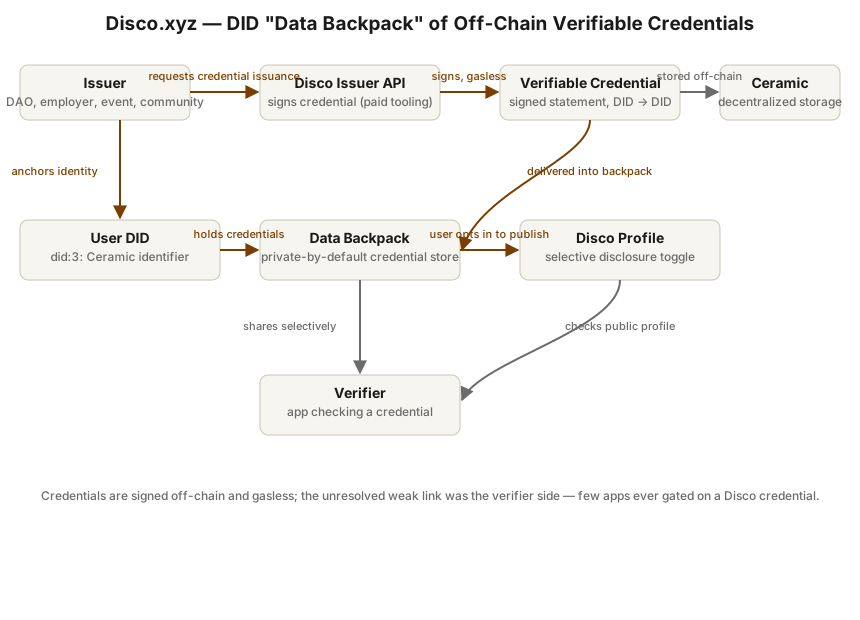
did:3:Ceramic identifiers; wallets and Web2 accounts could be linked). Identity was thus anchored to keys the user held, not to a platform account. - Verifiable credentials, off-chain and gasless. A credential is a signed statement by one DID about another DID (membership in a DAO, event attendance, employment, education, endorsements). Signing makes it tamper-evident; because credentials lived off-chain in the user's data store, issuance cost no gas and worked across ecosystems — Disco described itself as blockchain-agnostic.
- User-controlled storage with selective disclosure. Credentials were private by default — visible only to issuer and holder — and the user could choose to make specific credentials public on their Disco profile. Account data was stored on Ceramic, a decentralized data network, rather than in Disco's own silo (in principle making the backpack portable if Disco disappeared).
- Issuer/verifier tooling. Disco offered APIs and dashboards for organizations to issue, manage, and verify credentials at scale — the intended revenue side of the market, with communities and companies paying to issue credentials that end users held for free.
- The "backpack" UX layer. The core design bet was that self-sovereign-identity primitives (DIDs/VCs, which predate crypto-native consumer apps) fail on usability, so Disco wrapped them in a friendly profile-plus-cards interface targeted at DAOs, communities, and events.
Outcome
Partial success ending in absorption. Disco earned genuine mindshare in the 2022–2023 identity wave (Zerion dApp Dive coverage, major conference stages, active community credential drops) and validated that gasless off-chain VCs were a workable UX. But no self-sustaining business emerged around issuer fees, and consumer demand for holding credentials stayed thin — the recurring problem of the whole VC sector: few verifiers, so credentials had nowhere to be spent. On September 17–19, 2024 Disco merged into Privado ID, which framed the deal around unified chain-agnostic identity infrastructure (expanding to Optimism, Arbitrum, Base; a Telefónica Tech partnership; an ambition of 100 million credentials issued — a target, not an achieved metric). McMullen went on to cofound Billions Network out of Privado ID. Standalone Disco infrastructure (site, docs) is now offline. Independent user/credential counts for Disco itself: Unknown / not found.
Why it worked
- Best-in-class narrative and UX framing. "Data backpack" translated the abstract DID/VC stack into something normal users could picture; Disco was arguably the most legible consumer face of SSI in crypto.
- Gasless, chain-agnostic architecture. Keeping credentials off-chain on Ceramic sidestepped gas costs, chain fragmentation, and the privacy hazards of writing personal data on-chain — the correct technical call, later echoed by attestation systems generally.
- Privacy-by-default. Private credentials with opt-in publicity avoided the "public-by-accident" failure mode of on-chain reputation systems.
- Credible founder distribution. McMullen's ConsenSys background and relentless evangelism gave Disco access to DAOs, conferences, and investors that most identity startups never reach.
Where the design broke
- Two-sided market with no verifier side. Credentials only have value where they are checked. Almost no apps gated features on VCs in 2022–2024, so issuers had weak reasons to pay and holders had weak reasons to care. The backpack filled up with commemorative badges, not load-bearing claims.
- Competition from simpler on-chain primitives. POAPs, Gitcoin Passport stamps, and later Ethereum Attestation Service offered "good enough" attestations with less conceptual overhead, while zk-native stacks (Polygon ID/Privado, Semaphore-based systems) won the privacy-tech mindshare.
- Bear-market timing. The 2021-vintage identity/reputation thesis depended on a flourishing DAO and metaverse economy that contracted sharply in 2022–2023, shrinking the customer base before network effects formed.
- Dependence on a nascent storage layer. Building on Ceramic meant inheriting its immaturity; and despite the decentralization narrative, the product's disappearance after the merger shows the backpack's portability was never stress-tested by users in practice.
Lessons
- Reputation systems are demand-constrained, not supply-constrained. Minting credentials is easy; the scarce resource is verifiers who gate something valuable on them. Bootstrap verification use cases first, issuance second.
- A great metaphor is necessary but not sufficient. "Data backpack" solved the comprehension problem of SSI, but comprehension without a recurring reason to open the backpack does not produce retention.
- Off-chain, gasless, private-by-default is the right substrate for personal data — a design validated by successors (EAS off-chain attestations, zk credential systems) even as Disco itself wound down.
- User-owned data claims should be tested against provider death. If a product's disappearance effectively strands the user's "portable" data, the sovereignty was rhetorical. Exportability and third-party resolvers need to exist before the shutdown, not in the whitepaper.
- In infrastructure winters, consolidation beats persistence. Merging into Privado ID preserved the team and thesis inside a better-capitalized zk-identity stack rather than burning to zero.
Redesign (EDITORIAL — hypothesis, not fact)
This section is editorial hypothesis, not a factual account. A revived Disco would invert the go-to-market: start with one high-frequency verification loop rather than a general-purpose backpack. Candidates: sybil-resistant airdrop/quest eligibility, ticketed-event access, or KYC-reuse across exchanges — contexts where a verifier already exists and pays per check. Credentials would be issued as signed off-chain objects (as Disco did) but anchored via revocation registries and schema hashes on a cheap L2 through a neutral standard like EAS, so any third party can verify without Disco's servers — solving the provider-death problem that ultimately stranded Disco backpacks. Selective disclosure would use zk proofs over credentials (the Privado/Billions direction) so holders prove predicates ("over 18", "member since 2022") instead of revealing documents. Monetization: per-verification fees paid by verifiers, with issuance free — aligning revenue with the side of the market that captures value. Finally, the consumer "backpack" would ship as a wallet plug-in inside existing wallets rather than a standalone destination app, because identity is a feature users exercise mid-task, not a place they visit.
Sources
- Privado ID and Disco.xyz Announce Merger (Sept 19, 2024) — primary (news)
- Disco.xyz official site (Wayback archive, Dec 2023) — primary (archive)
- Disco Docs (docs.disco.xyz — now offline) — primary (docs)
- Welcome to the Disco!! (official Mirror announcement, Sept 2022) — primary (docs)
- Zerion — dApp Dive: Disco & Decentralized Identity (May 2023) (analysis)
- Tech.eu — Privado ID and Disco.xyz merge for a new era in multichain digital identity (news)
- PitchBook — Disco.xyz company profile (analysis)
- NEWFORUM interview — Evin McMullen on private verifiable data (analysis)
Related experiments
Last verified: 2026-07-26 · Spot an error? Suggest a correction