Flaunch
A Uniswap v4-hook-powered memecoin launchpad on Base that returns 100% of trading fees (in ETH) to creators and communities via programmable 'Progressive Bid Wall' buybacks and revenue-streaming NFTs.
▶ Run interactive simulation animated mechanism with editable parameters
How it works onchain
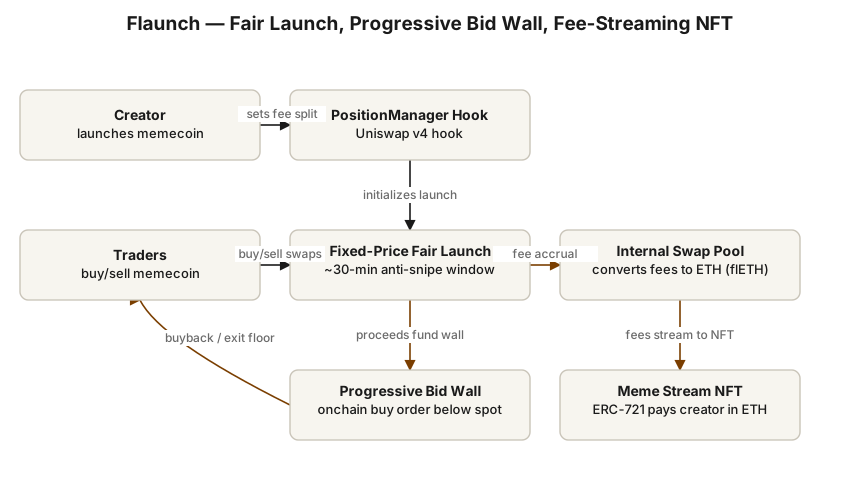 Open full-size diagram
Summary
Flaunch is a memecoin/token launchpad on Base built by Flayer Labs (the team formed from NFTX and FloorDAO contributors) that went live in early February 2025. Its pitch is a direct inversion of the pump.fun economic model: instead of the platform extracting trading fees, 100% of swap fees are routed — in ETH — to the token's creator and community, with the split (0–100%) configured at launch. The system is implemented as a set of Uniswap v4 hooks: a 30-minute fixed-price "Fair Launch" window neutralizes snipers and bots, an "Internal Swap Pool" converts fee accrual into ETH with zero price impact, and a "Progressive Bid Wall" recycles the community's fee share into an on-chain buy order just below market price that ratchets upward as price rises. Creator fee rights are tokenized as a transferable NFT (the "Meme Stream"), making cash-flow ownership itself composable. Flaunch was audited by Omniscia and Enigma Dark and remains live and actively developed as of mid-2026.
Design (Mechanism)
Flaunch is essentially a bundle of mechanism-design fixes for the standard launchpad failure modes, all enforced by Uniswap v4 hooks on Base:
- Fixed-price fair launch. Every coin begins with a ~30-minute window in which a portion of supply sits at a single tick — the price is fixed, so bots, KOLs, and retail all enter at the same cost basis. During this window all ETH proceeds are funneled into the Progressive Bid Wall, so early buyers can exit at roughly their entry price (minus AMM fee); sniping the first block confers no advantage.
- Progressive Bid Wall (automated buybacks). The community's share of trading fees accumulates and, at ~0.1 ETH increments, is placed as a bid just below spot. As price rises the wall re-pegs upward, creating a rising, fee-funded soft floor rather than the reflexive rug-shaped liquidity of typical memecoins.
- ETH-denominated creator revenue ("Meme Stream"). Each launch mints an ERC-721 to the creator representing the right to the pool's fee stream (up to ~1% of each swap). An Internal Swap Pool converts accrued memecoin fees into ETH with zero price impact before orders hit the AMM, so creators earn ETH without dumping their own token. The NFT is transferable — fee streams can be sold, DAO-owned, or handed to a community in a CTO.
- Configurable split and treasury managers. Creators choose what fraction of fees goes to themselves versus community buybacks/holders; treasury-manager integrations let fees route to group treasuries, revenue-sharing schemes, or AI-agent-owned wallets.
- flETH. ETH in the system is held as flETH, a yield-bearing wrapper (deployed at
0x000000000d564d5be76f7f0d28fe52605afc7cf8), with yield strategies (e.g., lending) subsidizing the fee-return model.
Core contracts (PositionManager, BidWall, Flaunch NFT, Memecoin implementation) are verified on Base and open-sourced under MIT in flayerlabs/flaunchgg-contracts, with a TypeScript SDK for programmatic launches.
Outcome
Flaunch launched publicly in early February 2025 and reported $628,900+ returned to creators and communities within its first two days — strong immediate traction on the "anti-pump.fun" positioning. It became one of the flagship consumer demonstrations of Uniswap v4 hooks (featured by the Uniswap Foundation's Builder Stories) and carved out a niche on Base alongside Zora and Clanker in the creator-coin/launchpad wars. DefiLlama has tracked it at roughly $2M TVL with annualized fees/revenue in the low millions (figures fluctuate with memecoin cycles; exact mid-2026 numbers not independently confirmed). It did not displace pump.fun's Solana volume dominance, and no Flaunch-branded token launch achieved a durable large-cap breakout; the protocol's own governance/token layer sits with Flayer's FLAY. Three-plus audits (Omniscia, Enigma Dark x3) with all findings remediated or acknowledged; no major exploit found in research. Status: ongoing.
Why it worked
- Aligned incentives were the product. Redirecting 100% of fees to creators/communities, instead of routing them to the platform, gave creators a direct financial reason to choose it over fee-taking launchpads.
- Hooks made the promises credible. Fair-launch pricing, ETH fee conversion, and bid-wall buybacks are enforced by immutable v4 hook logic, not platform policy — trust-minimized versions of promises other launchpads make socially.
- ETH-denominated income solved creator dumping. Creators earning ETH from fee flow don't need to sell their token to monetize, removing the canonical memecoin death spiral trigger.
- Experienced team. The NFTX/FloorDAO lineage meant the team had already shipped AMM-adjacent liquidity machinery through a full cycle.
Limitations and criticisms
- Chain disadvantage. The 2024–25 memecoin volume overwhelmingly lives on Solana; Base launchpad flow is a fraction of pump.fun's, capping Flaunch's addressable market regardless of mechanism quality.
- Fair mechanisms don't guarantee attention. Memecoin launches are attention markets driven by volume and price-volatility signals, and the bid wall's price support reduces the volatility that otherwise draws high-frequency trading interest.
- Crowded home turf. On Base itself, Zora's creator coins and Clanker's agent-native launches compete for the same creators, fragmenting the "fair launch on Base" niche.
- Complexity tax. Fee-stream NFTs, flETH, and configurable splits are harder to explain than "bonding curve go up," raising onboarding friction for the casual audience memecoins attract.
Lessons
- Routing 100% of fees to participants is a viable wedge against incumbents that route trading fees to the platform, but fee generosity alone doesn't overcome a liquidity/attention deficit on a smaller chain.
- Uniswap v4 hooks are expressive enough to turn launchpad "policy promises" (fair launch, buybacks, no-dump creator pay) into contract-enforced guarantees — a genuine trust upgrade over app-layer launchpads.
- Tokenizing a fee stream as a transferable NFT cleanly separates cash-flow rights from token ownership, enabling CTOs and treasury handoffs without token transfers.
- Price-support mechanisms (bid walls) are double-edged in high-volatility memecoin markets: they protect holders but reduce the volatility that attracts trading volume.
- Fixed-price launch windows are a simple, effective anti-sniping primitive: if everyone gets the same entry price and can exit at cost, being first block loses its economic value.
Redesign (EDITORIAL — hypothesis, not fact)
This section is editorial hypothesis, not fact. A redesign would keep the hook-enforced fee routing and fair-launch window but attack the attention problem directly: deploy the same hook suite cross-chain (including a Solana-adjacent venue or an aggregated superchain deployment) so the mechanism meets liquidity where it lives, rather than asking liquidity to migrate. Make the bid wall configurable as a "volatility budget" — creators could choose between full price support and a mode that releases the wall during upside momentum to preserve the lottery dynamics traders want. Lean harder into the Meme Stream NFT as the core primitive: a public marketplace for fee-stream NFTs would price creator cash flows, enable fee-stream lending, and make Flaunch a yield venue rather than only a launchpad. Finally, simplify the surface: a one-slider UX (creator % vs community %) with everything else defaulted would cut the complexity tax that likely suppressed casual adoption.
Sources
- Flaunch Docs — primary (docs)
- flayerlabs/flaunchgg-contracts (GitHub, deployed addresses) — primary (contract)
- Flaunch Docs — Audits (Omniscia, Enigma Dark) — primary (audit)
- Uniswap Foundation — Builder Stories: How Flaunch is Revolutionizing Liquidity with Hooks — primary (retrospective)
- blocmates — Flaunch: Redefining Launchpads with Fixed Price Fair Launch (analysis)
- Bankless — How to Launch Better Memecoins on Flaunch (analysis)
- DefiLlama — flaunch (TVL, fees, revenue) (analysis)
- Flaunch SDK (npm, @flaunch/sdk) — primary (docs)
Related experiments
Last verified: 2026-07-27 · Spot an error? Suggest a correction