Bags.fm
Solana memecoin launchpad that hardcodes a perpetual 1% trading-volume royalty to creators (and socially-verified 'fee split' recipients) into every token at launch.
▶ Run interactive simulation animated mechanism with editable parameters
How it works onchain
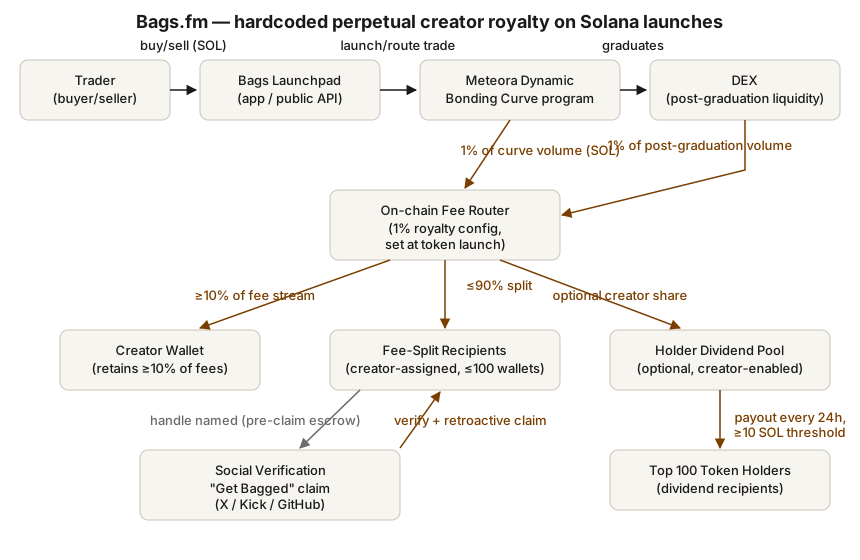 Open full-size diagram
Summary
Bags.fm ("Bags") is a Solana token launchpad, live since roughly May 2025, that took the Pump.fun-style memecoin factory and re-centered it on creator monetization. Its core mechanism: every token launched on Bags carries an on-chain fee configuration under which 1% of all trading volume is routed, in SOL and in perpetuity, to designated royalty recipients — by default the creator, who can split the stream with collaborators or with the public figure a token references. The company traces back to Bags App (founded ~2022 by Hunter Isaacson, the creator of NGL, together with Finn, previously associated with the DeGods NFT ecosystem per third-party profiles); the launchpad pivot arrived in 2025 and quickly became one of the largest venues on Solana. By early 2026 Bags reported more than $5 billion in cumulative onchain volume and over $40 million paid out to creators, ranked second on Jupiter's launchpad leaderboard behind Pump.fun, and had a viral moment when Steve Yegge's "Gas Town" GAS token generated outsized creator-fee payouts.
Design (Mechanism)
- Bonding-curve launch. Bags builds on Meteora's Dynamic Bonding Curve (DBC) program (
dbcij3LWUppWqq96dh6gJWwBifmcGfLSB5D4DuSMaqN). Tokens launch on a curve and graduate to open DEX liquidity, following the standard Solana launchpad template. - Hardcoded perpetual royalty. 1% of trading volume on each token flows to royalty recipients, paid in SOL, configured on-chain at launch rather than as an off-chain revenue-share promise.
- Fee splitting. The launching creator retains at least 10% of the fee stream and can allocate up to 90% across other wallets (reported up to ~100 addresses) — collaborators, featured personalities, or bots. This turns a token launch into a programmable cap table for attention.
- Social verification and "Get Bagged." Fee recipients can be designated by social identity (X, Kick, GitHub). A person whose handle was named as a recipient can later verify the account and retroactively claim accrued fees — meaning third parties can launch a token "for" someone and escrow them a royalty stream they never asked for but can claim.
- Optional holder dividends. Creators can enable periodic distribution (reported: every 24 hours, above a ~10 SOL threshold) of a portion of fees to the top 100 token holders.
- Distribution channels. Launches can be triggered by tagging @LaunchOnBags on X; a public API (
public-api-v2.bags.fm) supports programmatic launches, which made Bags a favored venue for AI-agent tokens.
Outcome
Ongoing and, so far, one of the more successful "second-wave" launchpads. Reported milestones: $1 billion in 30-day volume by mid-2025; $5B+ cumulative volume and $40M+ in creator payouts; ~33.5% share of Jupiter-tracked launchpad volume ($293M weekly vs. Pump.fun's $448M / 51.2%) during the early-2026 surge; 3,900+ tokens created daily in early 2026. The GAS token episode (Steve Yegge's coding-agent project; +700% in a day, dragging CMEM, RALPH, VVM and others up with it) demonstrated the model's flywheel: a real builder visibly earning fees attracts more builders. In 2026 Bags announced a $4M developer-fund hackathon and won a FinTech Breakthrough "Crowdfunding Innovation" award. No native $BAGS platform token, major exploit, or public audit was confirmed in this research.
Why it worked
- Aligned the one actor Pump.fun ignored. Pump.fun's fees accrue to the platform; Bags gives the creator a perpetual 1% of volume, converting launches from one-shot extractions into annuities and giving creators a reason to keep promoting.
- Retroactive claims defused the impersonation problem. Instead of banning tokens about public figures, Bags escrows them a claimable royalty — turning likely adversaries into potential beneficiaries.
- Composability with the AI-agent wave. The API-first launch path made Bags the default venue for agent- and dev-tool-themed tokens exactly when that meta peaked, producing organic case studies (GAS) no marketing budget could buy.
- Built on proven infrastructure. Reusing Meteora's DBC avoided novel AMM risk and shipped fast.
Limitations and criticisms
- Still second to Pump.fun in volume share; the perpetual royalty is a differentiator but not yet a moat, since incumbents can copy fee-sharing.
- The underlying asset class is memecoins: the vast majority of launched tokens go to zero, and creator royalties scale with churn-heavy speculative volume, making revenue attention-cyclical (as The Defiant notes, akin to Zora's spikes on Base).
- No public security audit of the fee-routing configuration was found, and the dividend/fee-split logic concentrates trust in Bags' claim infrastructure.
- Unclaimed "Get Bagged" streams for celebrities who never engage sit in limbo, and third-party launches "for" someone still monetize an identity without consent until claimed.
Lessons
- Fee routing is a design surface, not an afterthought. Hardcoding a perpetual, splittable royalty at token creation turned the launchpad's commodity function (minting) into a creator-economy primitive.
- Escrowed retroactive claims are a general remedy for unauthorized-identity tokens. Paying the impersonated party beats whack-a-mole moderation.
- Perpetual royalties change creator behavior after launch. An annuity on volume incentivizes sustained promotion, unlike sell-the-allocation models — but it also incentivizes volume for volume's sake.
- API-first launchpads capture new metas fastest. Bags' programmatic launch path let it dominate the AI-agent token wave without predicting it.
Redesign (EDITORIAL — hypothesis, not fact)
This section is editorial hypothesis, not a factual claim. A stronger version of Bags would (1) publish and have audited an immutable on-chain fee-split registry so recipients don't trust platform infrastructure for claims; (2) vest the creator royalty on a volume- or time-decay schedule that pays more for sustained, dispersed holder bases than for wash-traded churn, blunting the incentive to manufacture volume; (3) require opt-in (or an explicit revenue-to-charity default) before a living person's identity can be attached to a token, converting "Get Bagged" from consent-after-the-fact to consent-first; and (4) route a small protocol share into an insurance pool for buyers of tokens whose creators abandon claimed fee streams, pricing in the known mortality rate of memecoins.
Sources
- Bags API Documentation — primary (docs)
- Bags on Solana: Project Review, Programs, Token, Metrics (Solana Compass) (analysis)
- Bags Launchpad Activity Surges After GAS Token Soars 700% (The Defiant) (news)
- Bags.fm Launches Global Hackathon With $4M Developer Fund (Business Wire via Morningstar) (news)
- Bags.fm Wins Crowdfunding Innovation Award in 2026 FinTech Breakthrough Awards (GlobeNewswire) (news)
- Bags FM API (Bitquery Docs) (docs)
Related experiments
Last verified: 2026-07-27 · Spot an error? Suggest a correction