Doppler Protocol
Whetstone Research's Uniswap v4 hook-based token launch protocol that replaces static bonding curves with a dutch-auction dynamic bonding curve for fair onchain price discovery.
▶ Run interactive simulation animated mechanism with editable parameters
How it works onchain
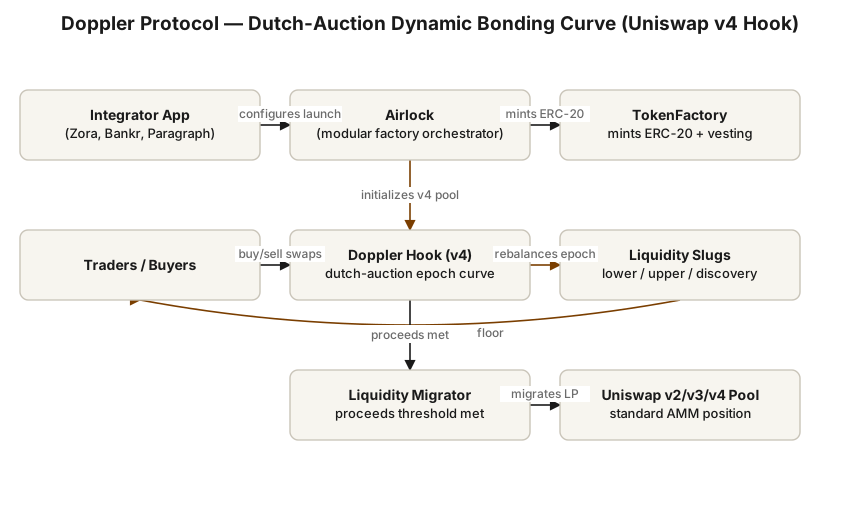 Open full-size diagram
Summary
Doppler is a liquidity bootstrapping and token launch protocol built by Whetstone Research, founded by Austin Adams, a former protocol researcher at Uniswap Labs. Instead of the static constant-product bonding curves popularized by pump.fun-style launchpads, Doppler introduces a "dutch-auction dynamic bonding curve" executed entirely inside a Uniswap v4 hook: the sale price decays when demand lags a predefined schedule and ratchets up when it runs ahead, so the market — not the deployer's guess — sets the clearing price. Around the auction sits "Airlock," a modular factory system (token factory, governance factory, pool initializer, liquidity migrator) that mints the token, runs price discovery, and then migrates proceeds into a standard Uniswap v2/v3/v4 position without burning LP tokens. Doppler went live with Unichain's mainnet in February 2025 (with Pure Markets as its first front end) and became infrastructure for consumer apps such as Zora, Paragraph, Noice, and Bankr. By January 2026, Whetstone reported that over 90% of new DEX pools on Base launched through Doppler, with 40,000+ assets created daily and $1B+ in cumulative trading volume, and raised a $9M seed led by Pantera Capital.
Design (Mechanism)
Doppler's core bet is that launch mechanism design matters as much as the token itself. Key components, per the official docs and the contract repository:
- Dutch-auction dynamic bonding curve. A token sale is divided into epochs over a fixed duration with a target sale schedule. Immediately before the first swap of each epoch (in the
beforeSwaphook), the curve rebalances: if net sales are behind schedule, the curve is dutch-auctioned downward proportionally to the shortfall (e.g., 80% of expected tokens sold triggers 20% of the maximum per-epoch adjustment); if net sales are zero or negative, the full maximum downward shift — (endingTick − startingTick) / number of epochs — is applied; if sales run ahead, the curve moves up by the oversold delta. This punishes snipers who buy at the opening price of a launch that would otherwise decay cheaper, and it lets mispriced launches self-correct instead of dying. - Liquidity "slugs." The hook maintains three liquidity layers: a lower slug below the current price holding all sale proceeds (so every buyer can always sell back into real two-sided liquidity — a built-in buyback floor), an upper slug above the price sized to the expected sales pace, and price-discovery slugs spread across the remaining curve for future epochs. LP fees and Uniswap protocol fees are excluded from accounted proceeds so fee income doesn't distort position sizing.
- Airlock and modules. A top-level
Airlockcontract orchestrates pluggable modules — TokenFactory (mints the ERC-20 with programmable vesting/allocations), governance factory (OpenZeppelin-based), pool initializers (Uniswap v3 static curve or v4 dynamic auction, later a "multicurve" initializer allowing several price curves across market-cap ranges), and liquidity migrators. After the auction meets its proceeds threshold, liquidity is migrated to a standard AMM pool rather than LP tokens being burned, preserving composability and fee streams. - Integrator-first distribution. Doppler ships as audited contracts plus a TypeScript SDK (
@whetstone-research/doppler-sdk); apps like Zora, Paragraph, Noice, and Bankr configure supply curves, vesting, governance, and fees without writing Solidity. Deployments span seven mainnets including Base, Ethereum, Unichain, Monad, Ink, MegaETH, and Robinhood Chain, with Solana on devnet.
Outcome
Ongoing and, so far, one of the strongest product-market-fit stories of the Uniswap v4 hooks era. After a $1.3M pre-seed led by Variant (announced February 2025) and the Unichain mainnet debut via Pure Markets, Doppler pivoted its center of gravity to Base, where it became the default launch rail for the "content coin" and creator-token wave (Zora's coin infrastructure, Paragraph, Noice, Bankr). Per The Block (January 2026), Whetstone claimed over 90% of new DEX pools on Base originate through Doppler, roughly 40,000 assets created daily, about $1.5B in total value represented, and over $1B in cumulative volume, alongside a $9M seed led by Pantera with Variant, Figment Capital, and Coinbase Ventures. These figures are company-reported. No major exploit of the core protocol was found as of the last verification date. Whetstone has not launched a protocol token as of this writing.
Why it worked
- B2B2C positioning. Rather than compete with pump.fun for retail attention, Doppler sold launch infrastructure to apps that already had users (Zora, Bankr), inheriting their volume.
- Mechanism actually solves a felt pain. Sniping and mispriced initial curves were the most-complained-about failures of 2024-era launchpads; a decaying/rising schedule-driven curve directly addresses both.
- Uniswap-native credibility. Adams's background as a Uniswap Labs researcher and the hook-enshrined design made Doppler the flagship demonstration of what v4 hooks are for, attracting ecosystem support (Unichain launch partner, Variant/Pantera backing).
- Composability preserved. Migrating to standard Uniswap positions instead of burning LP tokens keeps launched assets legible to aggregators, routers, and explorers.
Limitations and criticisms
Headline metrics (90% of Base pools, 40k assets/day) are self-reported and count mass-produced content coins, most of which end at near-zero value; quality of launches, not count, will determine durability. Doppler's volume is tightly coupled to Base's content-coin meta and to a handful of large integrators — if Zora-style coining fades, Doppler's volume fades with it. Value capture for Whetstone itself (fees vs. integrator leverage) remains an open question, and the launchpad-infrastructure niche is highly competitive and fork-prone.
Lessons
- Launch mechanisms are infrastructure: selling price discovery to apps with existing distribution beats building another standalone retail trading front end.
- Dynamic, schedule-aware curves (dutch auction down, ratchet up) blunt sniping and remove the deployer's obligation to guess a correct initial price — a genuine mechanism improvement over static bonding curves.
- Uniswap v4 hooks make it possible to enshrine an entire auction inside the AMM itself, keeping liquidity composable end-to-end instead of trapping it in a bespoke launch contract.
- Keeping proceeds in a live "lower slug" gives buyers a continuous exit floor during the sale, structurally reducing rug risk compared to escrow-until-graduation designs.
- Infrastructure that rides a memetic wave (content coins) should be judged on retention through the wave's end, not on peak deployment counts.
Redesign (EDITORIAL — hypothesis, not fact)
This is editorial speculation, not a description of Doppler's plans. Three directions could harden the design. First, quality-weighted economics: per-asset creation is effectively free, so spam launches dominate the numbers; a small refundable bond or a fee curve that scales with launch frequency per creator could shift the mix toward serious issuers without harming permissionlessness. Second, demand-revealing pre-commitment: allow sealed or batched bids during early epochs (commit-reveal or frequent batch auctions inside the hook) so the dutch-auction schedule reacts to revealed demand rather than only to executed swaps, further shrinking the sniper/latency edge on fast chains. Third, protocol-level value capture and neutrality guarantees: publish an immutable fee split and integrator-governance framework so that large integrators (who currently concentrate flow) cannot later be advantaged, and consider routing a slice of migration fees into an insurance backstop for launches that fail their proceeds threshold. The main risk to Doppler is not mechanism failure but meta-dependence; diversifying into RWA and long-tail equity-like issuance (the "custom capital markets" thesis) before the content-coin cycle turns would be the strategic hedge.
Sources
- Doppler Docs — primary (docs)
- Doppler contract addresses (official docs) — primary (docs)
- Doppler mechanism documentation (Doppler.md, whetstoneresearch/doppler) — primary (docs)
- whetstoneresearch/doppler — core contracts — primary (contract)
- Doppler whitepaper — Austin Adams — primary (docs)
- Doppler official site — primary (docs)
- The Block — Token creation platform Doppler raises $9 million seed round led by Pantera Capital (Jan 2026) (news)
- Jesse Walden (Variant) on pre-seed investment in Whetstone/Doppler (analysis)
- PANews — Whetstone completes $1.3M pre-seed and launches Doppler (news)
- Whetstone Research — Doppler page — primary (docs)
Related experiments
Last verified: 2026-07-27 · Spot an error? Suggest a correction