Fractal ID
Berlin-based web3 KYC/proof-of-personhood provider whose 'verify once, reuse everywhere' identity layer powered 250+ crypto projects — and whose 2024 breach of ~55k users' passport data became the canonical argument against centralized KYC honeypots.
▶ Run interactive simulation animated mechanism with editable parameters
How it works onchain
 Open full-size diagram
Summary
Fractal ID is the flagship product of Trust Fractal GmbH, founded in Berlin in 2017 by Julian Leitloff (CEO) with co-founders including Júlio Santos (CTO). Launched in beta in September 2018 as an "OAuth-style" login for web3, it let crypto projects outsource KYC/AML, KYB, and proof-of-personhood checks while users completed verification once and reused the credential across integrated dapps. It became one of the most widely deployed compliance layers in crypto — the company claimed 1.2M+ verified users across 250+ projects, including Avalanche, Ocean Protocol, Polygon ID, Gnosis Pay, and Manta Network. The experiment's arc spans three phases: a Web2.5 KYC-as-a-service business (2018–2021), a token-incentivized "Fractal Protocol" for user-controlled data on Polkadot (2021–2023, discontinued), and a pivot to issuing verifiable credentials into idOS, a decentralized identity-storage network co-built with NEAR, Gnosis, and Aleph Zero (2023–). In July 2024 an attacker compromised an operator account and exfiltrated KYC data — including passport scans and facial images — of roughly 55,000 users, making Fractal ID a case study in the systemic risk of centralized identity honeypots serving decentralized systems.
Design (Mechanism)
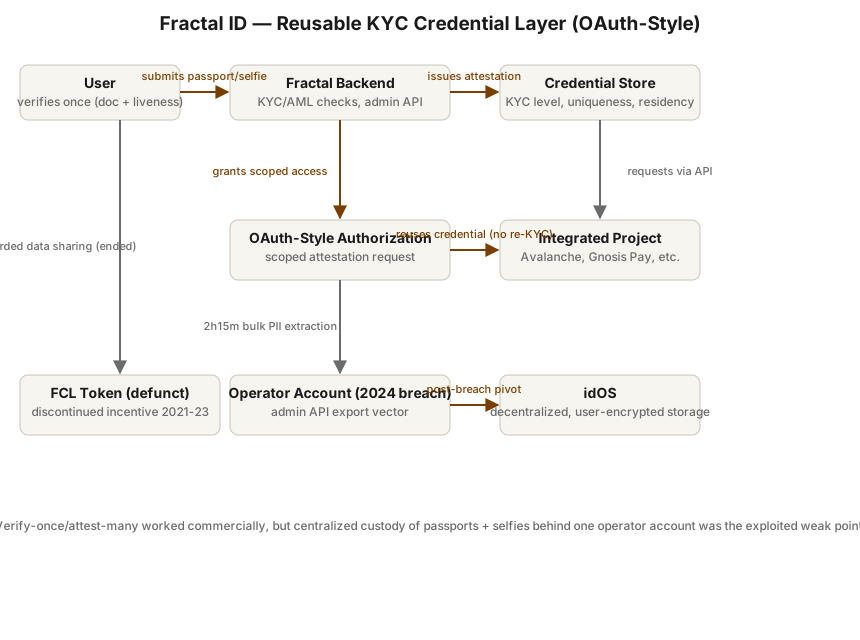
- Reusable KYC credential (the core loop). A user verifies once with Fractal ID (document check, liveness, AML screening — the "banking-grade" stack described in the 2018 launch post). Any integrated project then requests scoped access via an OAuth-like authorization flow, receiving attestations ("KYC level uniqueness/plus," residency, accreditation) rather than re-running verification. This amortizes a ~$1–3 verification cost across many relying parties and cuts onboarding friction for token sales, permissioned DeFi pools, and airdrops.
- Proof of personhood / sybil resistance. Beyond regulatory KYC, Fractal sold "human uniqueness" attestations used for sybil-resistant airdrops and quadratic-style distributions — a bridge between legal identity and cryptoeconomic uniqueness.
- Fractal Protocol + FCL token (2021). An ERC-20 (FCL, Ethereum, contract above) launched via a Polkastarter IDO on 25 February 2021 (4M tokens, $0.10 each, $400k raised, sold out in ~8 minutes). The protocol aimed at user-consented data sharing (a privacy-preserving alternative to ad-tech cookies) with monthly FCL incentive rewards for users running the Fractal Wallet, and a planned Substrate chain in the Polkadot ecosystem.
- Pivot to idOS (2023). In September 2023 Fractal discontinued the protocol, the incentive rewards, and the Substrate chain, redirecting effort to idOS: user-encrypted credential storage on a decentralized network, with Fractal ID repositioned as an issuer of verifiable credentials rather than a custodian. Post-verification, PII is deleted from Fractal's central systems after a 14-day window ("dataless" model).
- Trust model (the weak point). Until the idOS transition, verification artifacts lived in Fractal's centralized backend, accessible to internal operator accounts with admin/API rights — the exact surface exploited in 2024.
Outcome
Partial success. As a business and adoption story, Fractal ID succeeded where most crypto-identity experiments failed: real revenue, 250+ integrations, 1.2M verified users, and survival across multiple market cycles; it remains operating in 2026 as the primary credential issuer for idOS. But the token experiment failed — FCL collapsed to fractions of a cent and the Fractal Protocol was formally discontinued in September 2023. And on 14 July 2024, an attacker (reportedly entering via infostealer-compromised operator credentials) used an admin account to run an API extraction script for 2h15m, stealing names, emails, wallet addresses, phone numbers, physical addresses, facial images, and identity-document photos for ~0.5% of the user base (55k people). Downstream users of Gnosis Pay and other partners were notified; the linkage of wallet addresses to home addresses and passports created lasting physical-security risk ($5-wrench-attack exposure) that no remediation can undo. Fractal published a post-mortem and accelerated its dataless/idOS architecture.
Why it worked
- It sold compliance, not ideology. Projects needed to legally gate token sales and RWA/DeFi products; Fractal packaged that as an API with a familiar OAuth developer experience.
- Reuse created real network effects. Each new integration made an existing Fractal credential more valuable to users, and each verified user made integration cheaper for the next project.
- Chain-agnosticism. By staying middleware rather than betting on one L1, Fractal survived the death of individual ecosystems (including its own Polkadot ambitions).
- Honest retreat. Discontinuing the FCL protocol rather than zombie-maintaining it let the team concentrate on the idOS pivot — a rare disciplined shutdown.
Where the design broke
- Centralized custody contradicted the product's thesis. A service selling trust-minimization to web3 kept the most toxic data (passports + selfies + linked wallet addresses) reachable through a single operator account — no hardware-key enforcement or sufficient segmentation to stop one compromised endpoint.
- The token was bolted on. FCL's data-sharing rewards had little organic demand connection to the KYC business; when incentives ended, the protocol ended, validating that the token was a 2021-cycle fundraising artifact rather than a mechanism.
- Breach externalities land on users. Affected individuals bear permanent doxxing risk while the vendor bears mostly reputational cost — a misaligned liability structure endemic to KYC middleware.
- Proof-of-personhood competition. Biometric (Worldcoin) and web-of-trust (BrightID, Gitcoin Passport) approaches fragmented the sybil-resistance market Fractal hoped to anchor.
Lessons
- KYC providers are the honeypot of the onchain economy. Linking wallet addresses to legal identity and home addresses creates irreversible harm on breach; the blast radius argument for "dataless"/user-encrypted architectures is now empirical, not theoretical.
- Delete-by-default should precede scale, not follow a breach. Fractal's 14-day PII deletion and idOS issuance model came after six years of accumulation; the 2024 exfiltration hit data the newer architecture would not have held.
- Reusable credentials are the right primitive; custody is the design variable. The verify-once/attest-many loop demonstrably works commercially — the open question each successor must answer is who holds the underlying documents and under what access-control regime (operator accounts with bulk API export are the anti-pattern).
- A token needs a mechanism, not a mission statement. FCL rewarded data sharing nobody was demanding; utility that ends when emissions end was never utility.
Redesign (EDITORIAL — hypothesis, not fact)
This section is speculative analysis by the Atlas, not a description of Fractal's actual plans. A redesigned Fractal ID would make itself incapable of the 2024 breach: verification artifacts encrypted client-side at capture time to user-held keys (with social/passkey recovery), with Fractal retaining only a signed attestation hash and a sanctions-screening result — bulk export becomes cryptographically impossible rather than procedurally forbidden. Attestations would be issued as onchain, selectively disclosable credentials (BBS+/zk proofs) so a relying protocol can verify "KYC'd, non-sanctioned, unique human, jurisdiction ∈ allowed set" without ever learning name or address, and revocation would run through an onchain registry rather than API calls. Operator access would require hardware-bound credentials, per-record rate limits, and anomaly tripwires (a 55k-record read in two hours should alarm in minutes). If a token exists at all, it should bond issuers: verifiers stake against the accuracy of their attestations and are slashed on proven false or leaked credentials — pricing the negative externality that the 2024 breach pushed onto users. The plausible risk to this redesign is regulatory: some AML regimes require issuers to retain source documents, which caps how "dataless" a compliant provider can be; a jurisdiction-segmented retention vault with per-record HSM access would be the pragmatic compromise.
Sources
- Introducing Fractal ID – Gateway to the Web 3.0 (Julian Leitloff, Sept 2018) — primary (docs)
- Fractal Token Launch on Polkastarter — primary (docs)
- Fractal ID Update: Launching the idOS and the plan ahead (Sept 2023) — primary (retrospective)
- Fractal Protocol: FCL Token — Etherscan — primary (contract)
- Fractal ID Data Breach Post Mortem (official) — primary (retrospective)
- Blockchain identity platform Fractal ID suffers data breach — Cointelegraph (news)
- Web3 KYC vendor Fractal ID loses over 50k users' passport info in data breach — CryptoSlate (news)
- Infostealer Infection Results in Blockchain Identity Platform Fractal ID Hack — Alon Gal (analysis)
Related experiments
Last verified: 2026-07-26 · Spot an error? Suggest a correction