Orange Protocol
A reputation 'minting' middleware that aggregates on-chain and off-chain data through pluggable data and model providers to issue portable reputation proofs as Verifiable Credentials, NFTs, and zkTLS-backed humanity scores.
▶ Run interactive simulation animated mechanism with editable parameters
How it works onchain
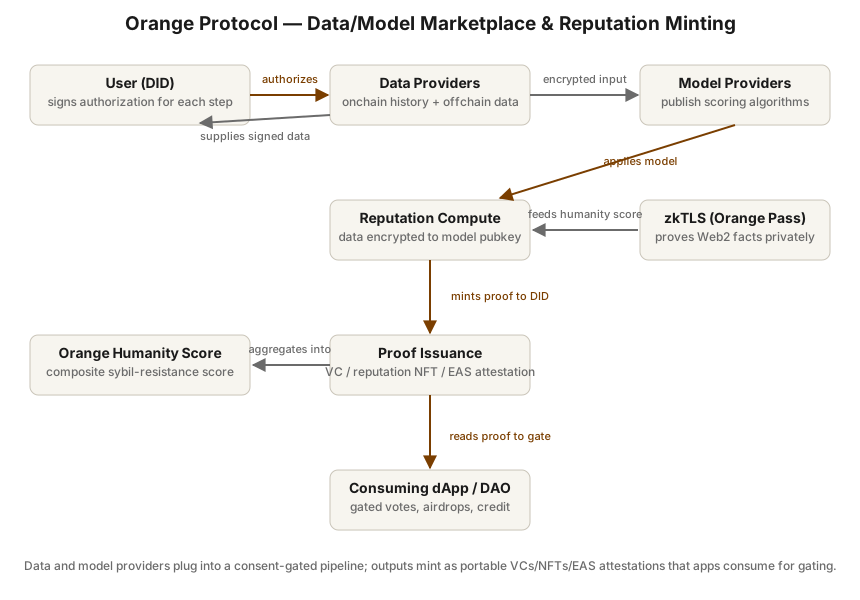 Open full-size diagram
Summary
Orange Protocol is a reputation-and-trust "minting" protocol: middleware that aggregates a user's on-chain and off-chain data, runs it through community-supplied reputation models, and issues the result as a portable proof — a Verifiable Credential (VC), a reputation NFT badge, or a live score — bound to the user's decentralized identifier (DID). It emerged from the Ontology decentralized-identity ecosystem's orbit (Ontology alumni such as Erick Pinos worked on its business development, and it supports Ontology EVM), announcing its design in late 2021 and running its first large NFT-based reputation campaigns on BNB Chain and Polygon in 2022. The pitch: Web3 reputation is siloed — Gitcoin scores, DAO contribution history, DeFi track records, and POAPs cannot talk to each other — so Orange provides a common rail where "data providers" and "model providers" plug in, and any dApp or DAO can consume the output to gate voting rights, airdrops, or undercollateralized credit. The protocol has since pivoted its emphasis toward zkTLS-secured proofs (the "Orange Pass" Chrome extension) and an aggregate "Orange Humanity Score" for Sybil resistance, deploying issuance across Ethereum, Base, Optimism (via EAS attestations), Linea, and BNB Chain. It never launched a token; sustainability has rested on grants (e.g., $20,000 from Aave Grants DAO in April 2022) and B2B integrations. It remains live but niche.
Design (Mechanism)
Orange is a two-sided marketplace sitting between raw identity data and applications that need trust signals:
- Data Providers (DPs) supply attestable inputs: on-chain history (transactions, asset balances, contract interactions, NFT holdings via partners like NFTScan), and off-chain data (social profiles, KYC facts from exchanges, gaming achievements). DPs transmit data encrypted to the model provider's public key.
- Model Providers (APs/MPs) publish reputation algorithms — e.g., "Aave power user," "DAO contributor tier," "NFT whale" — that compute over authorized data. Anyone can publish a model through the later "Reputation Studio" tooling.
- User-signed authorization is mandatory at every step: each computation feeding a score must carry the user's signature, so no data is attached to a DID without consent, and the stack is non-custodial.
- Proof issuance: results are minted as Verifiable Credentials or NFTs tied to the user's DID, portable across chains. Later, Orange integrated the Ethereum Attestation Service (EAS) on OP Mainnet so reputation outputs live as standard on-chain attestations composable by third parties, and deployed issuance on Base and Linea.
- Consumption: dApps/DAOs read proofs to trigger privileges — reputation-weighted voting, gated airdrops/mints (the 2022 Genesis Drops and Dework contributor drops were live demos of this), or credit scoring for DeFi.
- zkTLS layer (later era): the Orange Pass browser extension uses zkTLS to prove facts from authenticated Web2 sessions (accounts, activity) without revealing raw data, feeding the composite Orange Humanity Score used for proof-of-personhood/Sybil resistance.
There is no protocol token; incentives for DPs/MPs were designed as future fee-sharing, with the near-term economy run on partnerships and campaigns.
Outcome
Ongoing but modest. Orange executed a steady drumbeat of ecosystem campaigns in 2022 — Genesis Drop reputation NFTs on BNB Chain (6,000+ participants) and Polygon, an NFT-whale badge campaign, MetaCartel/MCON access drops, and Dework contributor recognition — plus a $20,000 Aave Grants DAO award to prototype reputation-based lending concepts. It survived the 2022–23 bear market without a token launch, shipped the EAS/OP Mainnet integration, expanded to Base and Linea, and repositioned around zkTLS humanity scoring, still marketing actively at Devcon 7 (late 2024) and beyond. However, it never became a default reputation standard: adoption is campaign-driven rather than deeply protocol-embedded, public usage metrics are scarce, competitors (Gitcoin Passport, EAS-native scoring, Karma, POAP, WorldID) crowd the category, and no major DeFi protocol is known to gate credit on Orange scores in production. Founding team identities are not publicly documented on the official site. Verdict: technically functional and still shipping — an ongoing experiment that has not yet found escape velocity.
Why it worked
- Right abstraction: separating data provision from model computation from proof issuance made the system genuinely pluggable, anticipating the later "attestation stack" consensus (it adopted EAS rather than fighting it).
- Consent-first architecture: user signatures on every computation and non-custodial data flow meant no data was attached to a DID without the user's authorization, unlike identity systems that captured and monetized user data by default.
- Campaign-based distribution: reputation-gated NFT drops (Genesis Drops, Dework) gave partners an immediate, legible use case and onboarded thousands of wallets cheaply.
- No token dependency: surviving on grants and integrations meant no death spiral when the 2022 market collapsed, and no regulatory overhang.
Limitations and criticisms
- Cold-start on both sides: models are only valuable with rich data and consumers; consumers only integrate if scores are widely held. Orange has yet to cross that flywheel threshold.
- No native incentive for providers: without a token or fee volume, third-party data/model providers have little reason to build on Orange rather than publish standalone.
- Reputation demand was weaker than assumed: DAOs mostly kept token-weighted voting; undercollateralized DeFi credit largely didn't materialize as a market in this period, removing the flagship use case.
- Crowded, standardizing category: Gitcoin Passport and EAS captured the mindshare for Sybil scores and attestations; Orange remains one aggregator among many rather than the rail.
- Opaque team/governance: no publicly named founding team or progressive decentralization path makes it harder for DAOs to treat Orange as neutral infrastructure.
Lessons
- Reputation middleware is a two-sided cold-start problem squared: you must bootstrap data providers, model authors, AND consuming apps simultaneously; campaigns rent usage but don't compound into embedded integrations.
- Adopt the winning primitive early: Orange's move onto EAS attestations was correct — proprietary proof formats lose to neutral standards, so value must accrue in the models/aggregation layer, not the format.
- Consent and signatures are cheap to design in and expensive to retrofit: Orange's user-signed computation flow is a reusable pattern for any identity system.
- A use case that doesn't exist yet (undercollateralized DeFi credit) can't anchor a protocol's demand side: anchor on demand that exists today (Sybil-gating airdrops proved to be the real buyer).
- Tokenless survival is possible but caps provider incentives: grants keep the lights on, yet without fee flow or token upside the supply side of a marketplace stays thin.
Redesign (EDITORIAL — hypothesis, not fact)
This section is editorial hypothesis, not a factual account. A redesign today would invert the go-to-market: instead of a general reputation marketplace, ship one killer score with distribution built in — e.g., an airdrop-Sybil score sold B2B to token issuers, priced per verified wallet, with revenue split on-chain (0xSplits-style) to the data and model providers whose inputs the score used. That creates the missing provider incentive without a token. All proofs would issue natively as EAS attestations from day one, with Orange operating purely as a scoring/aggregation DAO whose model weights are governed transparently — publishing model code and dispute windows so scored users can contest outputs (a Kleros-style challenge game would harden it against gamed inputs). The zkTLS humanity work is the right 2024+ bet, but it should be unbundled as a standalone verifiable oracle any scorer can consume, since bundling data capture, modeling, and issuance in one brand recreates the silo problem Orange set out to solve. Finally, publish the team and a credible neutrality roadmap: infrastructure that adjudicates reputation cannot itself be reputationally anonymous.
Sources
- Orange Protocol official site — primary (docs)
- Orange Protocol documentation — What Orange Does — primary (docs)
- Orange: What the Web3 Reputation Protocol is Made of (Medium, Oct 2021) — primary (docs)
- Orange Protocol Genesis Drop NFT Comes to Polygon (Medium, Aug 2022) — primary (docs)
- Orange Protocol Receives Funding from Aave Grants DAO (Medium, Apr 2022) — primary (docs)
- Orange Protocol integrates EAS attestations on OP Mainnet (Medium) — primary (docs)
- Orange Protocol Recognizes Top Dework Contributors with Reputation NFT Drop (Mirror, 2022) — primary (docs)
- Orange Protocol Integrates with Base Chain (Blockchain Reporter) (news)
- Crypto Sapiens podcast — Erick Pinos, Business Development Lead, Orange Protocol (analysis)
- Orange Protocol at Devcon 7 (Brave New Coin) (news)
Related experiments
Last verified: 2026-07-26 · Spot an error? Suggest a correction