FundingWorks
A non-speculative Ethereum crowdfunding primitive where supporters lock ETH inside a burnable (rage-quittable) soulbound NFT that streams to a creator over time, backing the person rather than a product.
▶ Run interactive simulation animated mechanism with editable parameters
How it works onchain
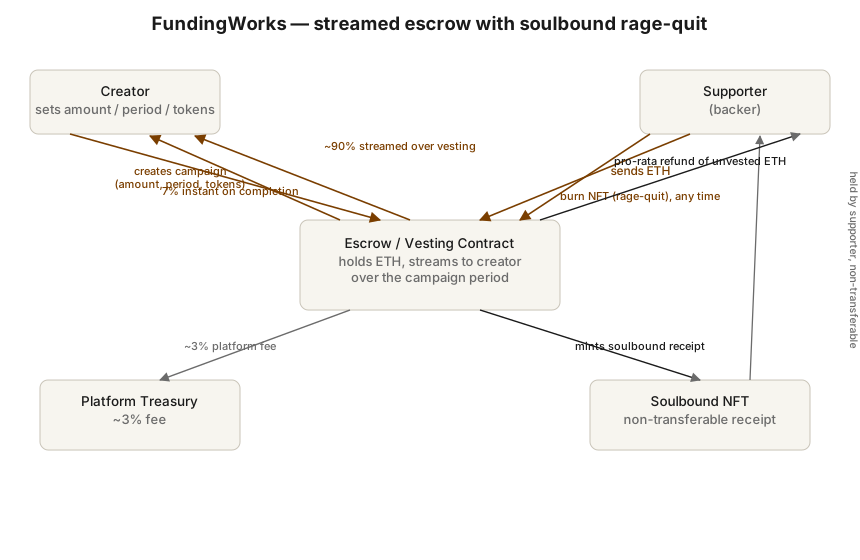 Open full-size diagram
Summary
FundingWorks is a creator-funding primitive built by TokenWorks, the Ethereum "onchain financialized ideas" studio run by Adam Lizek (known onchain as Rhynotic). It reframes crowdfunding around a deliberately anti-speculative thesis: supporters "back the person, not the product." A supporter commits ETH and receives a soulbound NFT that acts as an escrow receipt. Rather than paying the creator a lump sum, the contract releases a small slice immediately (7% to the creator on campaign completion) and streams the remainder to the creator over a defined vesting window. Because the NFT is soulbound and non-transferable, there is no secondary market and no price to speculate on — the position cannot be flipped. The distinguishing safety feature is a "rage quit": a supporter can burn their NFT at any time to withdraw their pro-rata share of any funds that have not yet vested, which keeps continuous, credible pressure on the creator to keep delivering.
FundingWorks was first used in mid-2025 as the funding rail for TokenWorks' own S01 campaign, which raised roughly 250 ETH from ~170 supporters. In January 2026 the platform was opened to the public, and in February 2026 TokenWorks ran a Season 2 (S02) campaign on the same infrastructure. The mechanism sits in the lineage of Patreon/Kickstarter-style patronage and Moloch-style "ragequit" DAO exits, but ported into a permissionless, open-source Ethereum contract set.
Design (Mechanism)
Core flow, per the official site and About page:
- Campaign creation. A creator sets three parameters: the amount to raise, the campaign/vesting period, and the number of campaign tokens to distribute. Campaigns are permissionless to launch.
- Supporter commitment. Supporters send ETH and receive a soulbound (non-transferable) NFT representing their contribution. The ETH is held inside the NFT/escrow contract, not handed to the creator up front.
- Fee and payout split (public FundingWorks flow). ~3% platform fee, 7% paid to the creator immediately, and ~90% streamed to the creator over the vesting period. (TokenWorks' own S02 campaign used a bespoke split — 10% instant ETH, 10% paid in PNKSTR, 80% streamed — showing the parameters are configurable per campaign.)
- Streaming/vesting. Undistributed ETH vests continuously to the creator across the campaign window rather than being released as a single tranche, converting a one-time patronage into an ongoing accountability relationship.
- Rage quit. At any point a supporter can burn their NFT to reclaim the still-unvested portion of their contribution, pro rata. This is the load-bearing incentive: creators only fully "earn" the raise by continuing to ship, and disappointed backers have a unilateral exit that does not depend on governance.
- Non-speculative by construction. Soulbound receipts mean no trading, no secondary price, and (per Rhynotic) "no expectation of financial return." Any campaign token is described as a means of tracking attention/participation rather than a tradable equity-like claim.
The contracts are described as permissionless and open source; TokenWorks maintains public Solidity repositories under its GitHub org (e.g. cmd — "the people contract" — and `fwa-relaunch"). A specific verified FundingWorks/S02 escrow contract address could not be confirmed at time of research (see Contracts: Unknown).
Outcome
Status: too_early_to_judge. The primitive has demonstrable real usage — it successfully escrowed and streamed a 250 ETH raise for TokenWorks S01 (170 backers) and was reused for a public launch (Jan 2026) and an S02 campaign (Feb 23, 2026, Ethereum mainnet). That is meaningful evidence the contracts work and that at least the studio's own audience will fund through it. What is not yet established is durable, independent adoption: whether unaffiliated creators use FundingWorks at scale, whether the rage-quit exit actually protects backers in a disputed real-world case, and whether "back the person, not the product" attracts funding without the speculative upside that drives most crypto crowdfunding. No exploit, insolvency, or abandonment has been reported. TokenWorks' broader ecosystem (PunkStrategy/NFTStrategy) reaching nine-figure market caps gives the studio distribution, but that success is orthogonal to FundingWorks' own long-run traction.
Why it worked
- Aligned, continuous accountability. Streaming + rage-quit means a creator cannot take the money and disappear; funds are earned over time and can be clawed back while unvested. This is a genuinely better default than lump-sum crypto crowdfunds that pay 100% up front.
- Removes the speculation attack surface. Soulbound, non-transferable receipts eliminate the pump-and-dump dynamics and mercenary flipping that plague token-based fundraising, which is exactly the failure mode it was designed against.
- Credible operator and built-in demand. TokenWorks/Rhynotic had an existing, engaged audience and a track record of shipping (PNKSTR, NFTStrategy), so the first campaigns had real backers rather than needing cold-start liquidity.
- Simple, legible primitive. The Patreon/Kickstarter analogy plus a one-button "burn to refund the rest" is easy to reason about — a strength for trust in a space full of opaque tokenomics.
Why it failed or underperformed
It has not failed, but the risks/weaknesses are:
- No upside = weak fundraising gravity. Explicitly offering "no financial return" competes against a memecoin/creator-token meta where backers fund precisely because they want asymmetric upside. Patronage economics are historically small.
- Adoption beyond the studio is unproven. Nearly all documented usage is TokenWorks funding itself. Reflexive, first-party demand is not the same as a two-sided marketplace of independent creators and backers.
- Rage-quit can undercut creators. The same exit that protects backers makes a creator's runway unstable — a coordinated or panic burn mid-campaign can strand a project, discouraging serious builders who need funding certainty.
- Unverified on-chain surface for outsiders. A canonical, clearly-labeled, audited contract address was not readily discoverable at research time, which raises the diligence bar for cautious backers.
Lessons
- Vesting + unilateral clawback is a strong anti-rug template. Streaming funds to a creator while letting backers reclaim the unvested remainder converts crowdfunding from a one-shot trust bet into an ongoing, revocable relationship — a pattern other funding protocols should copy.
- Soulbound receipts kill speculation but also kill the growth flywheel. Removing transferability solves flipping and price manipulation, yet it also removes the very incentive (upside/liquidity) that bootstraps most crypto crowdfunds; designers must consciously choose which failure mode they'd rather have.
- First-party dogfooding validates a primitive but does not prove market fit. Running your own raise through your own rail is excellent evidence the code works and terrible evidence that strangers will adopt it; treat internal usage and external traction as separate milestones.
- Configurable payout splits (instant/token/stream) let one contract serve very different campaigns — but per-campaign discretion also fragments the "standard" and raises the diligence burden on backers.
Redesign (EDITORIAL — hypothesis, not fact)
The following is the researcher's analysis, not established fact.
FundingWorks' core tension is that "no upside" is a hard sell in a market that funds on upside. A redesign could keep the anti-rug streaming/rage-quit core while reintroducing aligned, non-speculative upside: (1) Milestone-gated vesting — replace pure time-based streaming with creator-declared milestones that unlock tranches, and let backers rage-quit only the tranches tied to unmet milestones. This preserves accountability but gives creators funding certainty for work already delivered, addressing the "coordinated burn strands the project" risk. (2) Optional retroactive rewards, not equity — allow creators to earmark a small future revenue share or reputation credential (a non-transferable "I backed this early" attestation with downstream perks) so backers get something durable without a tradable token that recreates speculation. (3) A public, audited, canonical registry — a single verified factory contract and an on-site "verified contract" badge with an Etherscan link, plus a lightweight audit, to lower the trust cost for outside backers who currently cannot easily confirm what they're minting. (4) Reputation portability for creators — a soulbound track record ("completed 3 campaigns, 0 mass-rage-quits") so serious builders accumulate fundraising credibility over time, converting the platform from a one-off patronage tool into a repeated-game creator credit system. The goal: keep the honest, anti-rug mechanics that make FundingWorks distinctive, while removing the two biggest adoption blockers — no upside for backers and no certainty for creators.
Sources
- FundingWorks — official site — primary (docs)
- FundingWorks — About page (mechanism, fee split) — primary (docs)
- TokenWorks S02 minting campaign (season 2 built on FundingWorks) — primary (docs)
- TokenWorks — official studio site (X/GitHub/Farcaster handles) — primary (docs)
- TokenWorks GitHub organization (open-source Solidity repos) — primary (contract)
- The Bored Ape Gazette — 'The Funding Works: A New Creator Funding Meta' (analysis)
- Bankless — 'What TokenWorks Is Building Next' (news)
- RootData — TokenWorks project profile (analysis)
Related experiments
Last verified: 2026-07-26 · Spot an error? Suggest a correction