S02
TokenWorks' Season 2 fundraiser: an open-edition, 1-ETH soulbound-NFT mint on Ethereum that funds the studio via streaming vesting, ragequit refunds, and an automatic PNKSTR reserve buy — funding the studio itself rather than selling a speculative token.
▶ Run interactive simulation animated mechanism with editable parameters
How it works onchain
 Open full-size diagram
Summary
S02 ("Season 2", catalog #013) is the second studio-wide fundraiser run by TokenWorks, the pseudonymous Ethereum studio that calls itself "a playground for onchain financialized ideas" and is publicly associated with the builder Rhynotic (Adam Lizek). It is not a single mechanism-token in the way earlier TokenWorks experiments (btc/acc, SPAWN, PunkStrategy) were; instead it is a fundraising campaign for the studio itself, packaged as an open-edition mint. It went live on Ethereum mainnet on 23 February 2026 at 20:00 UTC, priced at 1 ETH per NFT, and ran for a short window (roughly through that Saturday, per the campaign copy).
S02 is the sequel to TokenWorks S01 (#008, May 2025), which raised on the order of ~250 ETH from ~170 supporters and was the first real deployment of the studio's soulbound-fundraising model. Between the two seasons, TokenWorks generalized that model into a standalone, permissionless product called FundingWorks (funding.works), opened it to the public in January 2026, and then ran S02 on top of it in February 2026. So S02 is best understood as TokenWorks dogfooding its own FundingWorks primitive at Season-scale: the studio raises operating capital from its community while explicitly refusing to sell them a speculative token. The distinctive S02 twist over both S01 and vanilla FundingWorks is that part of the raise is programmatically routed into a PunkStrategy ($PNKSTR) reserve to align the studio's treasury with its own flagship asset.
Design (Mechanism)
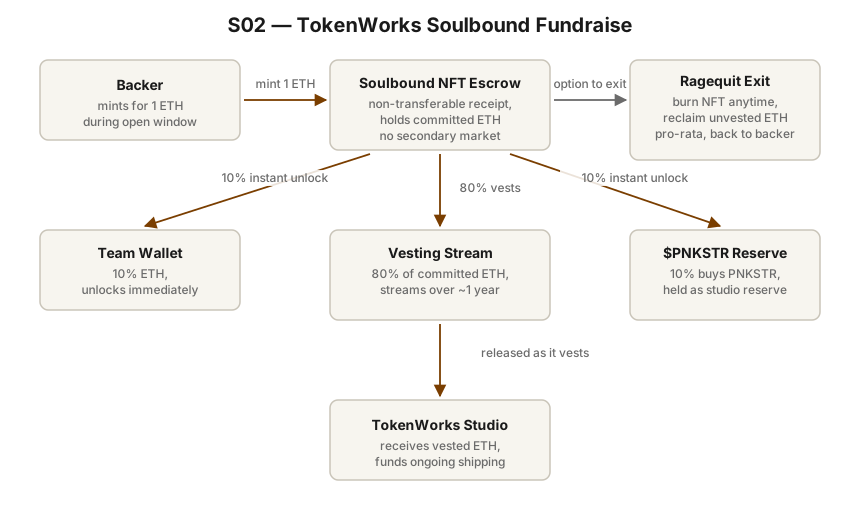
S02 uses the FundingWorks mechanism — a soulbound-NFT escrow with streaming vesting and a ragequit exit — with a bespoke, S02-specific payout split:
- Open-edition, fixed-price mint. Anyone can mint at 1 ETH. There is no tradable ERC-20 and no bonding curve; supply is whatever the open edition sells during the window. An allowlist ran first (per the founder's launch tweet, allocations scaled by holdings of PNKSTR, CMD, S01 and S02-related NFTs — e.g. "5 per S02 NFT," "3 per S01 NFT," "1 for holding PNKSTR/CMD"), then a public phase (3 per wallet).
- Soulbound receipt. Each supporter receives a non-transferable (soulbound) NFT that holds their committed ETH in escrow. Because it cannot be sold, there is no secondary market and no price to speculate on — the position is a patronage receipt, not equity.
- S02 payout split. On mint completion, 20% unlocks immediately (10% as ETH to the team, 10% converted into $PNKSTR) and the remaining 80% streams/vests to the studio over roughly one year. This differs from the public FundingWorks default (~3% platform fee, 7% instant, ~90% streamed) and from S01, showing the split is a per-campaign parameter.
- PNKSTR reserve. The 10% PNKSTR tranche is used to buy PunkStrategy supply into a long-term studio reserve, tying the studio's balance sheet to the token that anchors its NFTStrategy ecosystem. This is the design element unique to S02.
- Ragequit exit. At any time a supporter can burn their soulbound NFT to reclaim the still-unvested portion of their ETH, pro rata. This keeps continuous accountability on the studio: the raise is only fully "earned" by continuing to ship across the vesting year, and disappointed backers have a unilateral, non-governance exit.
The contracts are open-source Solidity under the TokenWorks GitHub org; the fwa-relaunch ("FundingWorks") and cmd ("the people contract") repositories are the relevant code. A specific verified, canonical S02 escrow/mint contract address was not confirmed at research time — the S02 site itself showed "contract not published yet" during the pre-launch/preview state, and the soulbound receipt (having no market) surfaces no price data on aggregators. Contract: Unknown.
Outcome
Outcome status: too_early_to_judge. S02 launched on schedule (23 Feb 2026) and was covered by multiple outlets as a live, working campaign, so the mechanism executed. What is not reliably documented is S02's own final tally: a widely repeated "~250 ETH / ~170 backers" figure actually belongs to S01 (summer 2025), and should not be attributed to S02. S02-specific totals (ETH raised, mints sold) were not confirmed in primary sources at research time and should be treated as Unknown. There is no evidence of an exploit, rug, or abandonment tied to S02. The studio's surrounding ecosystem (PunkStrategy / NFTStrategy) reached nine-figure market caps in the same period, which gave S02 real distribution — but that success is orthogonal to whether the S02 raise itself hit its goals or whether backers ultimately ragequit. Because vesting streams over ~a year, the campaign's true outcome (did the studio deliver enough to keep supporters from burning?) is literally still unfolding.
Why it worked
- Credible operator with built-in demand. TokenWorks/Rhynotic had a proven shipping record (PNKSTR, SPAWN, btc/acc, NFTStrategy) and an engaged audience, so an unusual "fund the studio, get no token" pitch still had willing backers — solving the cold-start problem that kills most crowdfunds.
- Anti-rug mechanics as a trust feature. Streaming vesting plus burn-to-refund means the studio can't take the money and vanish; that credibility is itself the product being sold, which suits a repeat operator raising from its own community.
- Reflexive treasury alignment. Routing 10% into a PNKSTR reserve signals the studio is a buyer, not just a seller, of its own flagship asset — a narrative that resonates with an ecosystem built on "strategy" (treasury-accumulation) tokens.
- Dogfooding validates the primitive. Running Season 2 on FundingWorks is strong evidence the escrow/streaming/ragequit code works at scale, strengthening the FundingWorks product it sits on top of.
Where the design broke
It has not failed, but the structural weaknesses are real:
- No upside is a hard sell. Soulbound, non-tradable receipts deliberately remove the asymmetric-upside incentive that drives virtually all crypto fundraising. Pure patronage is historically small, and S02 competes against a meta where people fund because they want a flippable token.
- First-party demand ≠ market validation. Almost all documented usage of this model is TokenWorks funding itself. S02 proves the studio's own audience will pay, not that the pattern generalizes.
- Ragequit destabilizes runway. The same exit that protects backers means a coordinated or panic burn mid-year could strand the studio's treasury — funding certainty is structurally weak.
- Opaque on-chain surface for outsiders. A clearly labeled, verified, canonical S02 contract was not easily discoverable at research time, and per-campaign custom splits fragment the "standard," raising the diligence bar for cautious participants.
Lessons
- You can raise for the operator, not the product — if you already have trust. S02 shows that a studio with a track record can crowdfund itself directly, but this substitutes reputation for the upside that normally bootstraps a raise; it is not a cold-start template.
- Streaming + ragequit is a reusable anti-rug fundraising pattern. Vesting funds over time while letting backers reclaim the unvested remainder converts a one-shot trust bet into an ongoing, revocable relationship — a default other creator-funding protocols should copy.
- Routing part of a raise into a protocol reserve aligns treasury with community. The 10%-to-PNKSTR mechanic is a clean example of programmatic treasury alignment; the studio becomes a structural buyer of its own asset, though it also concentrates treasury risk in a single reflexive token.
- Dogfooding proves the code, not the market. Running your own Season on your own rail is excellent evidence the contracts work and weak evidence that independent creators will adopt them — track "our raise" and "their adoption" as separate milestones.
Redesign (EDITORIAL — hypothesis, not fact)
The following is the researcher's editorial hypothesis, not established fact.
S02's core tension is identical to FundingWorks': "no upside" is a hard sell, and pure time-vesting gives the studio unstable runway because any backer can ragequit at will. A redesign could keep the honest, anti-rug soulbound core while removing the two biggest frictions:
Milestone-gated vesting instead of pure time-streaming. Let the studio publish Season-2 deliverables (e.g. "ship experiment #014," "open-source contract X") and unlock tranches against them, allowing ragequit only on tranches tied to unmet milestones. This preserves accountability but gives the studio funding certainty for work already delivered — directly addressing the "coordinated burn strands the treasury" failure mode.
Durable, non-speculative backer perks. Instead of a bare receipt, attach a soulbound "S02 patron" credential that confers concrete, non-tradable benefits across future Seasons (guaranteed allowlist slots, governance-signal weight, early access). This gives backers something lasting without reintroducing a flippable token — turning one-off patronage into a repeated-game relationship.
Transparent, audited, canonical contract with a public dashboard. Publish a single verified S02 escrow contract with an Etherscan-linked "verified" badge and a live dashboard showing ETH raised, amount vested, amount ragequit, and PNKSTR reserve size. The current opacity (no confirmable contract, no public totals) is the main diligence blocker; radical transparency is cheap and on-brand for a studio selling trust as the product.
Reserve diversification guardrails. Concentrating the reserve entirely in PNKSTR ties studio solvency to one reflexive asset. A redesign could cap PNKSTR at a fraction of the reserve and hold the balance in ETH/stables, so a PNKSTR drawdown doesn't simultaneously drain the treasury and trigger backer ragequits.
The hypothesis: S02's mechanics are honest and genuinely anti-rug, and its underperformance risk stems not from the idea but from three fixable choices — time-only vesting, no durable backer upside, and an opaque on-chain surface. Milestone gating, non-speculative perks, radical transparency, and a diversified reserve would keep everything distinctive about S02 while removing the frictions that make "fund the studio, get no token" a niche pitch.
Sources
- TokenWorks S02 — official campaign site — primary (docs)
- TokenWorks S02 — mint page — primary (docs)
- FundingWorks — official site (the funding rail S02 runs on) — primary (docs)
- TokenWorks — official studio site (X/GitHub/Farcaster/ENS handles) — primary (docs)
- TokenWorks GitHub organization (fwa-relaunch, cmd Solidity repos) — primary (contract)
- The Bored Ape Gazette — 'TokenWorks Season 2 NFT Mint Is Live' (news)
- Tekedia — 'SKR Token Pumps Amid TokenWorks Season 2 Mint Going Live' (news)
- Bankless — 'What TokenWorks Is Building Next' (news)
Related experiments
Last verified: 2026-07-26 · Spot an error? Suggest a correction