f(x) Protocol
AladdinDAO protocol that splits ETH (and later BTC) collateral into a low-volatility 'floating stablecoin' tranche and a zero-funding leveraged-long tranche, evolving into the fxUSD stablecoin and fxSAVE yield vault.
▶ Run interactive simulation animated mechanism with editable parameters
How it works onchain
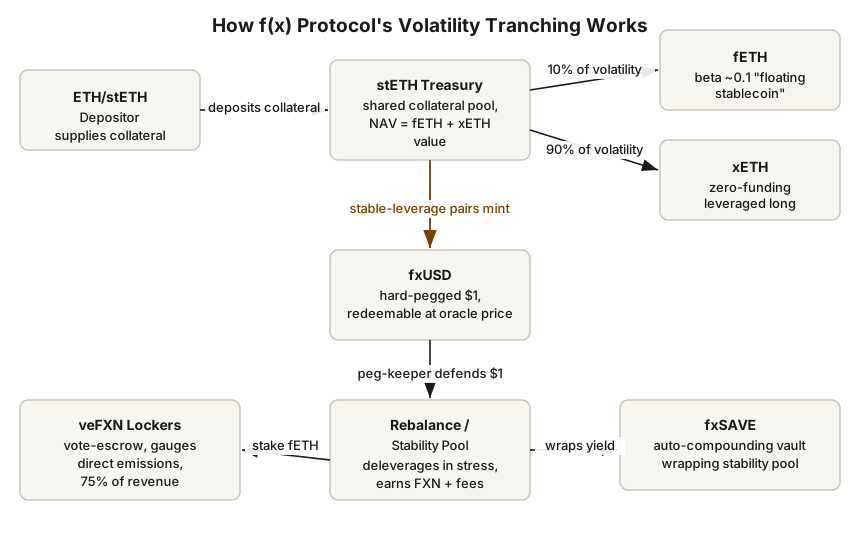 Open full-size diagram
Summary
f(x) Protocol is AladdinDAO's third product (after Concentrator and CLever) and its first fully original mechanism: a system that tranches the volatility of a yield-bearing collateral asset into two complementary tokens. Launched on Ethereum in August 2023, v1 split ETH (via stETH) into fETH, a "floating stablecoin" that captures only ~10% of ETH's price movements (beta = 0.1), and xETH, a leveraged long ETH token with zero funding costs that absorbs the other ~90% of the volatility. In February 2024 the protocol layered on fxUSD, a fully hard-pegged, redeemable USD stablecoin minted against stable-leverage pairs on liquid staking tokens, and in late 2024/early 2025 it shipped v2 with fixed-leverage positions (up to 7x on ETH and WBTC) plus the fxSAVE auto-compounding stability-pool vault. Governance runs through the FXN token (launched September 2023) using a Curve-style ve/gauge model. The protocol remains live and growing as of 2026.
Design (Mechanism)
The core idea is invariant accounting over a shared collateral pool. All collateral (initially stETH) sits in a treasury; against it the protocol issues two claim tokens whose net asset values (NAVs) must always sum to the value of the reserve:
- fETH (beta ≈ 0.1): its NAV moves 10% as much as ETH's price. Not pegged to $1 — a deliberate "floating stablecoin" that avoids both fiat dependence and the full reflexivity of algorithmic pegs.
- xETH (beta > 1): the residual claim. Because xETH holders absorb the volatility fETH sheds, xETH functions as a variable-leverage long ETH perpetual with zero funding fees and no discrete liquidation price — leverage floats with the fETH/xETH supply ratio.
Stability is managed via a collateral-ratio (CR) state machine. When the system CR falls toward risk thresholds, "stability mode" kicks in: minting incentives flip (xETH minting subsidized, fETH minting paused/penalized), and a Rebalance Pool — where fETH holders stake in exchange for yield from the treasury's stETH staking income and FXN emissions — can be drawn on to redeem fETH against collateral, deleveraging the system without forced user liquidations.
fxUSD (Feb 2024) generalized this: hard-pegged to $1, minted 1:1 against baskets of stable-leverage pairs over LSTs (initially stETH and sfrxETH), always redeemable at oracle price for underlying collateral, with stability pools acting as automated peg-keepers (buying fxUSD below peg, selling above). v2 (announced Oct 2024, live ~Jan 2025) restructured the product into fxUSD plus fixed-leverage xPOSITIONs (and later sPOSITION shorts) on wstETH and WBTC, funded by an fxUSD/USDC stability pool; fxSAVE (April 2025) wraps that pool into an auto-compounding, composable yield-bearing token whose returns come from organic protocol revenue (funding/trading fees and LST yield) rather than emissions. FXN governance copies the veCRV playbook — vote-escrow, gauges directing emissions, 75% of protocol revenue to lockers — and Convex integrated FXN into its meta-governance layer. The team reports 16 audits including OpenZeppelin (v2) and Trail of Bits.
Outcome
Ongoing, with a pivot that worked. v1's fETH was intellectually elegant but commercially niche — a beta-0.1 asset is hard to use as money or collateral, and fETH supply stayed modest. The redeemable, hard-pegged fxUSD and especially the v2 leverage + fxSAVE stack found clearer product-market fit: the protocol reported TVL doubling within weeks of the v2 launch, fxUSD market cap crossing ~$70M in 2025 (described by Messari-cited material as among the faster-growing decentralized stablecoins of the cycle), and fxSAVE holding roughly $50M TVL by late 2025 with consistently top-tier stablecoin APYs (high single digits to ~18% at points, per Stablewatch and official posts). The team also highlighted that the system rebalanced autonomously through the August 2024 market crash without human intervention or bad debt. FXN token price performance has nonetheless been weak relative to 2023 highs, and the protocol remains mid-sized rather than a category leader.
Why it worked
- Genuine mechanism novelty: volatility tranching over yield-bearing collateral produced two products people actually want — a stable asset and cheap, liquidation-resistant leverage — from one pool, with each side subsidizing the other's existence.
- Zero-funding leverage is a real edge: xETH/xPOSITIONs offered leveraged long exposure without perpetual funding bleed or a hard liquidation price, a concrete improvement over perp DEXes for buy-and-hold leverage.
- Willingness to iterate: the team treated fETH's limited traction as data, shipping fxUSD, then v2 fixed leverage, then fxSAVE — each step moving toward more legible, composable products.
- Organic yield story: fxSAVE's returns come from real protocol cash flows (funding fees, LST yield), which held up as emissions-driven competitors faded.
- Credible security posture: extensive audits (OpenZeppelin, Trail of Bits among others) and no major exploit to date.
Limitations and criticisms
- fETH's "floating stablecoin" never found strong demand: an asset that is 90% stable is neither a stablecoin nor a trading asset; integrations and users gravitated toward fully-pegged alternatives, prompting the fxUSD redesign.
- Complexity tax: CR modes, rebalance pools, NAV invariants, and multiple token generations (fETH/xETH → fxUSD/xPOSITION → fxSAVE) make the protocol hard to explain, limiting retail and integration growth versus simpler CDP stablecoins.
- Reflexive dependence on leverage demand: the stable side's capacity and yield depend on people wanting the leveraged side; in risk-off regimes the balance must be actively incentivized.
- Crowded market: fxUSD competes with DAI/USDS, crvUSD, Liquity forks, and yield-bearing dollar products with far larger liquidity moats; FXN value accrual has not translated into strong token performance.
Lessons
- Tranching volatility is a powerful primitive: one collateral pool can simultaneously mint a stable claim and zero-funding leverage, with each side clearing the market for the other.
- "Almost stable" assets are a product dead zone — users and integrators want either a hard $1 peg or real upside; fETH's beta-0.1 design was mechanically sound but commercially unlegible, and the pivot to hard-pegged fxUSD is what unlocked growth.
- Liquidation-free leverage funded by a stability pool is a viable alternative to perp funding markets, but it caps leverage capacity at the size of the stable-side deposits — the two books must be grown together.
- Real-revenue yield vaults (fxSAVE) outlast emissions-subsidized yield, and packaging protocol cash flow into a single composable token dramatically improves distribution (money-market listings, L2/other-chain wrappers).
- Surviving a violent deleveraging event autonomously (Aug 2024) is worth more marketing credibility than any APY campaign.
Redesign (EDITORIAL — hypothesis, not fact)
This section is editorial speculation. A redesign might skip the fETH detour entirely and launch the hard-pegged stable + fixed-leverage pair from day one, since that is where demand proved to be. The stability pool's dual role (yield source and pegkeeper/liquidation backstop) could be made more robust by tiering it — a senior tranche with capped, steadier yield and guaranteed redemption priority, and a junior tranche earning boosted funding fees but absorbing rebalance risk first — reducing the reflexivity between leverage demand and stable capacity. Cross-margining the ETH and BTC books against a shared fxUSD liability could improve capital efficiency but would concentrate correlation risk; a cleaner path is per-collateral isolated markets with a shared redemption router, which f(x) partially adopted. Finally, FXN's ve/gauge model spends governance surface on emissions routing that matters less in a real-revenue regime; a simpler fee-switch-to-stakers model with emissions reserved solely for bootstrapping new collateral markets would likely serve token holders better.
Sources
- f(x) Protocol documentation (AladdinDAO docs) — primary (docs)
- f(x) Protocol contracts list (official docs) — primary (contract)
- fx-protocol-contracts (AladdinDAO GitHub, incl. v2 whitepaper) — primary (contract)
- fxUSD: The Nuts and the Bolts (official announcement) — primary (docs)
- Introducing fxSAVE (official announcement) — primary (docs)
- OpenZeppelin f(x) v2 audit — primary (audit)
- f(x) v2.0 launch announcement (official X) — primary (docs)
- OAK Research: f(x) Protocol (FXN) comprehensive overview (analysis)
- Convex Finance: Protocol Expansion — f(x) Protocol (analysis)
- DefiLlama: fx Protocol TVL, fees & revenue (analysis)
- Stablewatch: fxSAVE analytics (analysis)
Related experiments
Last verified: 2026-07-27 · Spot an error? Suggest a correction