Float
A non-pegged 'floating stablecoin' (FLOAT) stabilized by Dutch auctions against a crypto basket and a BANK seigniorage/governance token, notable for its whitelist-gated 'democratic launch' — active through 2021, quietly abandoned after early 2022.
▶ Run interactive simulation animated mechanism with editable parameters
How it works onchain
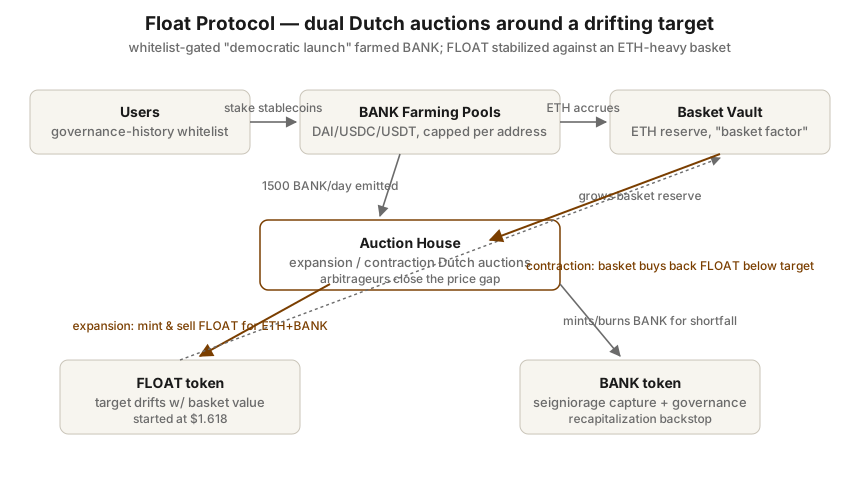 Open full-size diagram
Summary
Float Protocol was a 2021 Ethereum experiment in building a "floating stablecoin": a currency (FLOAT) that targets low short-term volatility without pegging to the US dollar, in the same design family as Reflexer's RAI and contemporaneous with Fei. Built by a pseudonymous collective calling itself "Abbey Road," the protocol paired FLOAT with BANK, a seigniorage-capture and governance token, and stabilized FLOAT's market price around a slowly moving target price (starting at $1.618, the golden ratio) via dual Dutch auctions backed by a basket of crypto assets. Its most distinctive social innovation was the "democratic launch" (Feb 7, 2021): initial BANK farming was restricted to a whitelist of addresses with proven governance participation in other DeFi protocols, with deposits capped per address to keep whales from dominating. FLOAT itself went live at Genesis on May 6, 2021. The team raised $1.2M in a September 2021 "treasury diversification round" (participants reported by Forbes included Eden Block, Stani Kulechov, and Santiago Santos) and published two audits, but the promised V2 never shipped; the official Medium went silent after February 1, 2022, and price trackers marked the asset inactive by 2023. Etherscan today shows only ~654k FLOAT outstanding across ~209 holders.
Design (Mechanism)
- Non-pegged target price. FLOAT launched at an arbitrary $1.618 target. Rather than a hard peg, the target was designed to drift slowly with the value of the protocol's reserve basket — appreciating when crypto demand and vault holdings grew, so FLOAT would function as a low-volatility native crypto currency rather than a dollar proxy.
- Basket reserve. A vault ("the basket," primarily ETH accumulated at launch and via expansions) partially collateralized FLOAT. The ratio of basket value to FLOAT's target market cap (the basket factor) informed target-price adjustment and determined how much of a stabilization operation was paid in basket assets versus BANK.
- Dual Dutch auctions. When FLOAT's market price exceeded target, the protocol ran expansion auctions: newly minted FLOAT sold (descending-price Dutch auction) for ETH plus BANK, growing the basket and burning BANK (seigniorage accruing to BANK holders). When price fell below target, contraction auctions bought FLOAT back using basket assets, minting/selling BANK to cover shortfalls. Arbitrageurs closing the gap between auction price and market price were the stabilization workforce.
- BANK token. Three roles: absorb upside from excess FLOAT demand, act as recapitalization backstop in weak demand, and govern the protocol.
- Democratic launch. Phase 1 (Feb 7 – Mar 21, 2021, 6 weeks) restricted BANK farming to addresses that had participated in governance elsewhere (Snapshot voters; Compound/Maker/Moloch onchain governance, later expanded to Yearn, Curve, Uniswap, UMA, YAM participants), with a $10k-per-pool / ~$30k total cap per address across DAI/USDC/USDT pools and 1,500 BANK emitted daily. Phase 2 opened participation broadly. Distribution: 50% community farming, 35% liquidity incentives, 10% treasury, 5% team (12-month lock).
Outcome
The launch mechanic itself was a clear success as a distribution experiment: project documentation reports over 3,000 participants, and the whitelist-by-governance-history idea was widely discussed and later imitated. FLOAT Genesis proceeded in May 2021 and the auction system operated through 2021, with the protocol iterating (Phase 3/4 pools, multiplier pools), completing a second audit of v1.1 (announced Feb 1, 2022), and raising $1.2M in September 2021. But FLOAT never achieved meaningful monetary adoption — it remained a small farm-and-arbitrage economy rather than a used currency. After the February 2022 audit post, public communications stopped; the promised V2 audit/release never materialized, tracker sites list the asset as inactive/untracked (last consistent price data around 2022–2023), and the FLOAT supply dwindled to roughly 654k tokens among ~209 holders. There is no known exploit or formal wind-down announcement — the project appears to have been quietly abandoned amid the 2022 bear market and the post-UST collapse in appetite for algorithmic stablecoins. Outcome status: abandoned.
Why it worked
- The democratic launch achieved its stated goal: broad, engaged early distribution (3,000+ participants), with caps and governance-history gating measurably diluting whale capture at launch — a genuine contribution to launch-mechanism design.
- The auction-based stabilization ran without a death-spiral blowup or exploit; unlike Basis-style rebase coins, the partial ETH basket gave contractions real buying power, and FLOAT avoided the catastrophic depeg failure mode while it was actively maintained.
- Anchoring to a drifting target instead of $1 removed the reflexive "broken peg = dead project" dynamic that killed many 2021 algostables.
Where the design broke
- No demand sink: FLOAT had essentially no use case beyond farming BANK and arbitraging auctions. A currency whose only holders are mercenary farmers has no organic demand floor once emissions decay.
- Crowded, discredited category: by mid-2022, UST's collapse poisoned the entire "algorithmic stablecoin" category; a small anonymous-team project with a hard-to-explain non-peg had no path to exchange listings, integrations, or trust.
- Complexity tax: a floating target derived from a basket factor is harder to reason about than RAI's single-collateral redemption rate, and harder to market than a $1 peg — it inherited the disadvantages of both.
- No exit mechanism: the design had no formal wind-down or redemption path built in, so when public communication stopped after the modest $1.2M raise, holders were left with an orphaned token rather than a treasury redemption.
Lessons
- Distribution mechanisms can outlive the protocol. Float's governance-participation whitelist is its most durable legacy; proving onchain "civic history" as a launch filter worked better than the monetary experiment it funded.
- A stabilization mechanism without a demand mechanism is half a currency. Auctions can enforce a price band, but nothing in the design generated reasons to hold or spend FLOAT; monetary experiments need integrations, credit markets, or payments demand from day one.
- Non-pegged is intellectually right and commercially hard. Both RAI and FLOAT showed floating targets are more robust than reflexive pegs, and both struggled for adoption — legibility ($1) is itself a network good.
- Plan the ending. Without a built-in sunset/redemption covenant, quiet discontinuation converts a partial success into reputational failure; an explicit sunset/redemption path (as some later protocols executed) preserves more value and trust than quiet abandonment.
Redesign (EDITORIAL — hypothesis, not fact)
This section is editorial hypothesis, not a factual claim about the project. A modern Float would keep two pieces — the drifting non-dollar target and the governance-history-gated launch — and replace the rest. First, make the basket fully collateralizing at genesis (e.g., staked-ETH-heavy with a hard basket-factor floor), so contraction auctions never depend on minting the volatile share token into a falling market; BANK becomes a pure surplus/junior-tranche claim rather than a recapitalization backstop. Second, manufacture demand before emissions: launch with FLOAT as the unit of account in one captive venue (an LP-denominated money market or a payments rail with fee rebates), and taper farming aggressively so the holder base transitions from mercenary to organic within months. Third, encode the exit: a covenant that if auction volume or governance participation falls below thresholds for N epochs, the basket automatically opens pro-rata redemption. That converts the worst case from "quiet abandonment with 209 stranded holders" into a graceful dissolve — and, paradoxically, credible exits make floating currencies easier to trust while they are alive.
Sources
- Announcing Float Protocol and its democratic launch (official Medium) — primary (docs)
- FLOAT Genesis — Thurs 6th May (official Medium) — primary (docs)
- Float Protocol: FLOAT Token — Etherscan — primary (contract)
- Float Bank (BANK) Token — Etherscan — primary (contract)
- Float Protocol docs — Why a Democratic Launch — primary (docs)
- Float Protocol Medium archive (last post Feb 1, 2022: '2nd Audit Complete') — primary (archive)
- Meet Float Protocol — The Algorithmic Stablecoin Built By An Anonymous Team (Forbes) (news)
- Decentralized FLOAT Stablecoin will Complement RAI and FEI Economies (BeInCrypto) (news)
- Float Protocol Float (FLOAT) — DefiLlama stablecoin page (analysis)
- FLOAT historical prices / inactive status (CoinLore) (analysis)
Related experiments
Last verified: 2026-07-26 · Spot an error? Suggest a correction