Saffron Finance
A DeFi 'risk tranching' protocol that let liquidity providers split yield-farm exposure into senior and junior tranches, briefly a DeFi-winter darling before its TVL and token collapsed and it pivoted to fixed-income yield vaults.
▶ Run interactive simulation animated mechanism with editable parameters
How it works onchain
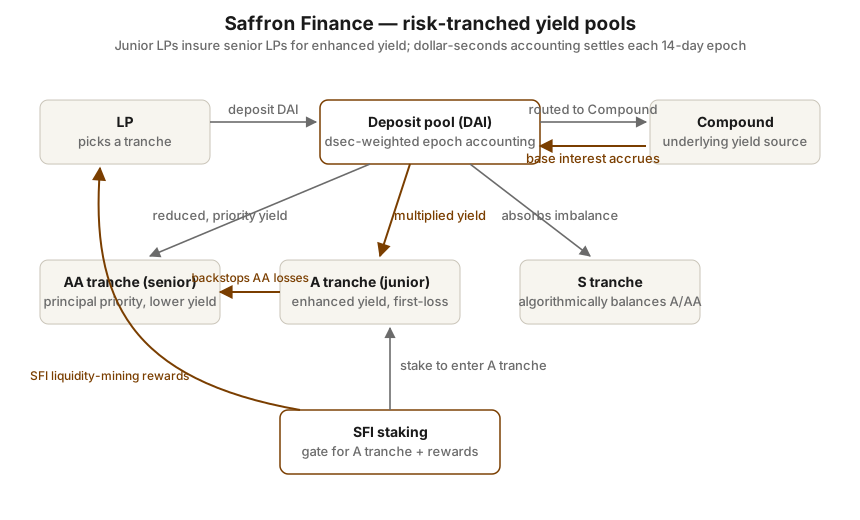 Open full-size diagram
Summary
Saffron Finance was one of the first attempts to import the structured-finance concept of risk tranching into DeFi. Announced on October 31, 2020 in a Medium post by the pseudonymous founder "psykeeper" and launched on Ethereum mainnet on November 1, 2020, Saffron described itself as a "peer-to-peer risk exchange protocol": liquidity providers deposit into a shared pool (initially DAI routed into Compound), and the pool's yield and loss exposure are split across tranches with different risk/return profiles. A senior "AA" tranche gets principal-repayment priority and a lower yield; a junior, yield-enhanced "A" tranche earns a multiple of base yield but acts as first-loss insurance for the seniors; an "S" tranche algorithmically balances liquidity between the two. Access to the lucrative A tranche required staking the protocol's native token SFI ("Spice"), a 100,000-max-supply token distributed through epoch-based liquidity mining from late 2020 to mid-2021. Saffron rode the DeFi-farming wave to a fast start ($5M TVL in six hours, ~$11M in a week, ~$20M by late 2020) and a spectacular token run (SFI all-time high of roughly $3,496 on February 19, 2021 per CoinGecko), but activity faded with the farming cycle. The team — still active as of 2026 — pivoted to "Saffron Vaults," a fixed-vs-variable yield-exchange product built on Uniswap LP positions, with nine audits completed as of December 2025 and a new release slated for early 2026.
Design (Mechanism)
The original protocol's core loop worked in 14-day epochs:
- Pooled deposits, tranched claims. LPs deposit a base asset (DAI at launch) which the protocol deploys to an underlying yield platform (Compound). Instead of every LP holding identical pro-rata risk, LPs choose a tranche. The AA ("risk mitigated") tranche is paid back first if the underlying platform loses funds (e.g., a Compound exploit); in exchange it earns a reduced share of interest. The A ("yield enhanced") tranche earns a multiple of the base yield but its principal backstops AA losses — junior LPs are effectively selling insurance to senior LPs and being paid in enhanced yield. An S tranche exists to keep the A/AA ratio balanced, allocating marginal liquidity where the tranche-balancing algorithm needs it.
- Dollar-seconds (dsec) accounting. Each deposit mints "dsec" tokens computed as dollar value × seconds committed, giving time-weighted claims on each epoch's interest and SFI rewards. Liquidity is locked for the epoch, though LP tokens themselves remained tradeable.
- Token-gated leverage on risk. Joining the A tranche required staking SFI alongside the deposit. This gave SFI a utility sink tied directly to demand for levered yield, on top of governance rights.
- SFI emissions. Hard cap of 100,000 SFI; the first epoch's large mint (the launch schedule described 40,000 for epoch 1; the first minting event on November 15, 2020 distributed 30,000) was followed by halvings through epoch 7, then a 200-SFI-per-epoch tail. There was no premine sale; distribution was via liquidity mining, including a much-copied SFI/ETH Uniswap "pool 2."
The later Saffron Vaults product generalizes the same yield-splitting idea into a two-sided term market: a fixed side deposits assets (e.g., Uniswap v3/v2 LP positions) and receives an upfront fixed payment, while a variable side pays that fixed amount in exchange for all yield the position generates over the vault's term — analogous, per the team's primer, to a reverse zero-coupon swap.
Outcome
Classified here as technically_successful_commercially_unsuccessful (with development still ongoing). The mechanism worked as designed: tranches filled, epochs settled, and no exploit or loss event of the core pools was found in this research (a widely-syndicated claim of an "early 2021 vulnerability" appears only in low-quality AI-generated summaries and could not be confirmed in primary sources — treated as not found). Commercially, Saffron was a creature of the 2020–21 farming cycle: TVL peaked in the tens of millions and SFI at ~$3,496 in February 2021, but by the mid-2020s DefiLlama tracked only ~$150K remaining in staking/pool2 contracts, and SFI's market cap sat under $10M (July 2026). Notably, the anonymous team did not abandon the project: it shipped the Fixed Income Vaults redesign, ran a Sherlock audit contest, accumulated nine audits by December 2025, and scheduled a new vault release for early 2026 — an unusually long tail of building for a farm-era protocol.
Why it worked
- A real, legible idea from TradFi. Tranching is a centuries-old risk-transfer primitive; Saffron's insight that DeFi LPs have heterogeneous risk appetites (and that juniors would happily insure seniors for enhanced yield) was correct and widely imitated (BarnBridge, later Pendle-style yield splitting).
- Fair-launch token with a genuine utility sink. No presale, a hard 100,000 cap, and SFI staking required for A-tranche access tied token demand to actual protocol usage during the mining epochs.
- Timing. Launching at the peak of "DeFi summer" yield-chasing gave it instant liquidity ($5M in six hours) and a cult token.
Where the design broke
- The insurance was priced by emissions, not by risk. Most of the "yield" in every tranche was SFI liquidity mining. When emissions decayed on their halving schedule, the organic interest differential between tranches (a few percent on Compound DAI) was too small to retain capital, and TVL followed the farm out the door.
- Epoch lockups fought DeFi's liquidity norms. Fourteen-day locked epochs were necessary for clean tranche accounting but made Saffron strictly less convenient than composable, instantly-redeemable alternatives.
- The tail risk it insured almost never materialized. Senior LPs were paying for protection against Compound failure — an event that didn't happen — so the product's value proposition was hard to feel; meanwhile junior yield depended on seniors showing up, a two-sided cold-start problem.
- Anonymous team, small ecosystem. Cross-chain expansion talks (e.g., Neo/Flamingo, 2021) didn't translate into durable adoption, and the pivot to fixed-income vaults arrived after Pendle and others had claimed the yield-trading category.
Lessons
- Tranching only matters when the underlying risk and yield are large enough to price. Splitting a 3% lending yield minus a rarely-triggered tail risk produces spreads too thin to overcome lockup friction; risk markets need volatile, meaningful underlying cash flows.
- Emission-subsidized insurance markets give false product-market-fit signals. Saffron's tranches filled because of SFI farming, not because seniors valued protection — when the subsidy halved, the market's true (small) size was revealed.
- Token-gated access to the best tranche is a double-edged sink. It created SFI demand in the bull market but taxed exactly the sophisticated junior-risk capital the system most needed, accelerating the unwind.
- Being first is not defensible in mechanism design. Saffron pioneered on-chain tranching in 2020, but later entrants (Pendle's yield tokenization, Element's principal/yield split) captured the category with more composable, non-epoch designs.
Redesign (EDITORIAL — hypothesis, not fact)
This section is editorial hypothesis, not fact. A modern Saffron would (1) drop epochs in favor of tokenized, continuously-tradeable senior/junior claims (transferable ERC-20 tranches with an AMM between them), letting the market price the insurance spread instead of a balancing algorithm; (2) target underlyings where tail risk is real and priced — LST/LRT slashing, stablecoin depegs, RWA credit — rather than blue-chip lending yield, so seniors have a concrete reason to pay juniors; (3) fund early junior yield from protocol fees on the senior side rather than token emissions, so the subsidy scales with actual demand for protection; and (4) make the token a fee-claim/insurance-backstop asset (staked SFI as a final loss layer earning premiums) instead of an access gate. In effect: Saffron's 2020 thesis was right, but it should have been built as a credit-default-swap market with permanent tokenized tranches, not an epochal yield farm.
Sources
- Introduction to Saffron (launch post by psykeeper, Oct 31 2020) — primary (docs)
- Saffron Intro — official documentation — primary (docs)
- Saffron Fixed Income Vault Primer (official Medium) — primary (docs)
- SFI token contract (Ethplorer) — primary (contract)
- Sherlock audit contest: Saffron Fixed Income Vaults (27,500 USDC) — primary (audit)
- Delphi Podcast: Psykeeper on Saffron's pools and building as an anonymous founder — primary (retrospective)
- Saffron Finance TVL — DefiLlama (analysis)
- Saffron Finance — IQ.wiki (analysis)
- saffron.finance (SFI) — CoinGecko (analysis)
- Transcript: Psykeeper discusses tranche-based DeFi platform (Neo News Today) (news)
Related experiments
Last verified: 2026-07-26 · Spot an error? Suggest a correction