Panvala
A ConsenSys-incubated, donor-driven endowment that issued quarterly PAN token grants for Ethereum public goods via slate governance, then pivoted to matching community donations through the Panvala League before winding down in 2023.
▶ Run interactive simulation animated mechanism with editable parameters
How it works onchain
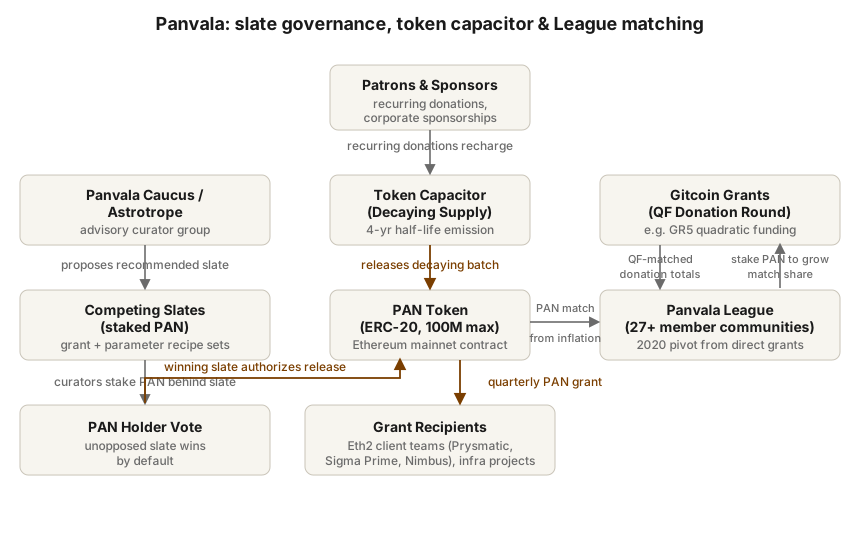 Open full-size diagram
Summary
Panvala was an attempt to build a Bitcoin-style "block reward" for Ethereum public goods: a shared endowment that issued grants of its own token, PAN, to teams doing the security and scaling work "the whole Ethereum community depends on." Conceived inside ConsenSys by Niran Babalola (who joined ConsenSys in 2015 and had contributed to Augur, Gnosis, the ERC-20 standard, and smart-contract audits), it was announced publicly in July 2018 and launched on Ethereum mainnet on August 22, 2019 at DappCon Berlin. Grants were awarded quarterly via a novel "slate governance" mechanism, with token release throttled by a "token capacitor" contract that mimicked Bitcoin's four-year halving. Early grantees included Prysmatic Labs, Sigma Prime, Nimbus (Status), Connext, and other core-infrastructure teams. Around 2020 Panvala pivoted from direct grants to the "Panvala League" — 27+ member communities whose Gitcoin Grants donations were matched with PAN from the treasury's inflation. The system operated for roughly four years before Babalola announced its shutdown in June 2023, with the last distributions in April–May 2023 and members pointed toward Gitcoin and Giveth.
Design (Mechanism)
- PAN token and the token capacitor. PAN is an ERC-20 with a maximum supply of 100 million. Rather than a time-based emission schedule, the "token capacitor" contract (labeled "Panvala: Decaying Supply" on Etherscan) released tokens as a function of its current balance, with a four-year half-life explicitly modeled on Bitcoin's halving: batch one released ~2.12M PAN, batch two ~2.03M, decaying to ~1.11M by batch sixteen. Donations flowed back into the capacitor, recharging future batches — the design intent was a self-sustaining endowment where donors extend the runway of a perpetual grant machine.
- Slate governance. Instead of token holders voting proposal-by-proposal (the low-information failure mode of token-curated registries), curators assembled slates — full recommended sets of grant recipients (and, separately, parameter changes) — and staked PAN behind them. Competing slates went to a token-holder vote; an unopposed slate was accepted by default. This turned governance into a competition between whole platforms/agendas, closer to representative democracy than referendum-per-line-item. In practice, the "Panvala Caucus" (an advisory group chaired by Babalola, later "the Astrotrope") produced the recommended slate each quarter.
- Panvala League (2020 pivot). Quarterly PAN inflation was reallocated to member communities in proportion to the donations they brought in, computed with quadratic funding so many small donors outweighed a few whales. In a Gitcoin Grants Round 5 experiment, Gitcoin matched all donations while Panvala added a second match for donations made in PAN — 268 donations generated an extra ~$26,740, with top projects gaining $1k–$5k more. Communities and patrons also staked PAN to increase their share of matching capacity, making holding/staking PAN the way a community grew its slice of the endowment.
- Funding sources. Corporate sponsors (launch sponsors included MythX, Gnosis, Status, Tenderly, Level K, Sigma Prime) and individual "Panvala Patrons" making recurring donations.
Outcome
Panvala shipped and operated its full mechanism on mainnet: an alpha MVP with slate governance, mainnet launch in August 2019, and quarterly grant batches (three batches completed by mainnet launch; 20+ projects funded at that point, including Eth2 client teams Prysmatic Labs, Sigma Prime, and Nimbus). The Block reported new sponsorships to fund further Eth2 work in 2020. The League grew to 27+ communities and ran repeated PAN-matching rounds alongside Gitcoin Grants. But PAN never achieved durable market value or deep liquidity, and the endowment's purchasing power depended on exactly that. On June 29, 2023, Babalola published "the end" on the Panvala Observer substack: the last distributions had gone out in April–May 2023, and members were directed to Gitcoin and Giveth. The website is now offline. The shutdown post offered gratitude ("working with you — our member communities — has been an honor") and conviction that "a community-first economy is in our future," but no detailed public postmortem of causes was found.
Why it worked
- The mechanisms functioned as designed for four years: slate governance avoided per-proposal voter-apathy failure, the token capacitor released tokens on schedule, and real, high-value teams (Eth2 clients, state-channel teams like Connext/L4) received funding.
- Slate governance was a genuine innovation over token-curated registries: bundling decisions into competing slates raised the information density of each vote and made an unopposed, well-researched default cheap to ratify.
- The League pivot found real demand: piggybacking PAN matching on Gitcoin's quadratic funding measurably increased funds raised for public goods without new donor dollars, and gave small communities a reason to coordinate.
Why it failed or underperformed
- Circular value dependency. Grants were denominated in PAN, and PAN's value depended on belief that future donors/sponsors would buy or hold PAN. Unlike Bitcoin's block reward (which pays for security that the asset's users directly consume), PAN's "philanthropy mining" had no endogenous demand sink; when speculative and donor demand faded, the endowment's real value shrank regardless of the emission schedule.
- Dependence on sponsor goodwill. Recurring patron donations and corporate sponsorships were the recharge mechanism, and both are pro-cyclical; the 2022–2023 bear market starved exactly that pipeline.
- Competition from simpler alternatives. Gitcoin's quadratic funding delivered the donor-matching experience in stablecoins without asking anyone to hold a bespoke token; Panvala itself pointed departing members to Gitcoin and Giveth.
- Governance centralization in practice. The Caucus/Astrotrope's recommended slates were rarely seriously contested, so the elaborate slate-competition machinery mostly ratified a single curator group's judgment.
Lessons
- An endowment denominated in its own token is only as durable as external demand for that token; emission-schedule discipline (halvings, capacitors) cannot substitute for a demand sink.
- Slate/bundled governance is a reusable primitive: it converts many low-information votes into one high-information choice between competing agendas, and "unopposed slate wins" is an efficient default.
- Matching overlays composable with an existing donation venue (Panvala × Gitcoin GR5) are a cheap way to bootstrap measurable impact — but they also reveal that the host platform can capture the whole use case.
- A graceful, announced wind-down with successor recommendations (Gitcoin, Giveth) preserves community goodwill and is itself a mechanism-design output worth planning for.
Redesign (EDITORIAL — hypothesis, not fact)
This section is editorial speculation, not historical fact. A modern Panvala would likely keep slate governance but drop the bespoke token as the unit of account. Hold the endowment in productive, externally-valued assets (staked ETH, yield-bearing stables) and distribute only the yield — Bitcoin-style decay applied to a principal that doesn't depend on reflexive belief in PAN. Retain PAN (or a non-transferable points system) purely as governance/curation weight, earned by donating, so matching power still accrues to contributors without a price to defend. Slate competition could be strengthened with retroactive evaluation: pay slate curators a performance bonus (retro-PGF style, per Optimism's model) when their funded slate's projects are later judged impactful, creating the adversarial curation market the original design imagined but never got. Finally, embed the matching overlay natively into an existing venue (Gitcoin/Allo or Giveth) as a protocol module rather than a standalone destination site, so the mechanism survives even if the brand doesn't.
Sources
- Panvala Handbook — PAN Token Economics — primary (docs)
- Panvala Handbook — The Token Capacitor — primary (docs)
- PAN Token contract on Etherscan — primary (contract)
- Token Capacitor (Decaying Supply) on Etherscan — primary (contract)
- "the end" — Panvala shutdown announcement (Niran Babalola, June 29, 2023) — primary (retrospective)
- Panvala Releases Alpha MVP with Slate Governance Model (ConsenSys Media) — primary (docs)
- How You Can Raise More Money For Ethereum Public Goods — Without Spending More (Panvala on Gitcoin GR5 PAN matching) — primary (retrospective)
- ConsenSys-Built Panvala Launches Mainnet for Donor-Driven Platform (news)
- Panvala founder Niran Babalola: Ship early, ship often (Decrypt) (news)
- DAO network Panvala set to fund more ETH2.0 projects with newly secured sponsorships (The Block) (news)
- DAOrayaki Research — Panvala: A Decentralized Ethereum Funding Platform (analysis)
Related experiments
Last verified: 2026-07-26 · Spot an error? Suggest a correction