Gnosis Dutch Auction ICO
Gnosis's April 2017 reverse Dutch auction hit its $12.5M cap in about ten minutes, selling only ~4.2% of GNO supply at an implied ~$300M valuation and becoming the canonical case study in why clever sale mechanisms can't outrun FOMO.
▶ Run interactive simulation animated mechanism with editable parameters
How it works onchain
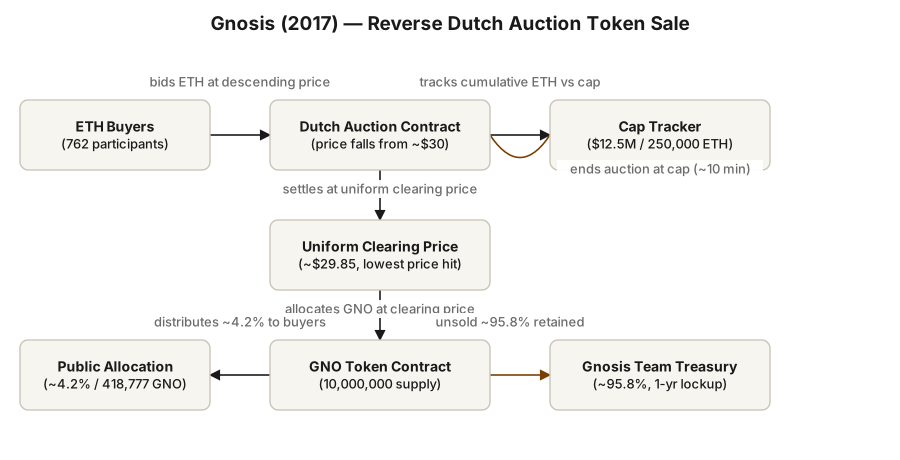 Open full-size diagram
Summary
On April 24, 2017, Gnosis — the Ethereum prediction-market startup founded by Martin Köppelmann and Stefan George — ran one of the first on-chain reverse Dutch auctions for a token sale. The mechanism was explicitly designed to fix the pathologies of 2017-era ICOs: gas wars, instant sellouts, and arbitrary pricing. Instead, it produced a new pathology. The auction hit its fixed $12.5 million cap (250,000 ETH) in roughly ten minutes, clearing at about $29.85 per GNO with only ~418,777 of 10 million tokens (4.2%) sold to 762 buyers. The team retained the other ~95.8% of supply, implying a fully diluted valuation around $300 million for a pre-product startup. The sale succeeded as a fundraise and the contracts worked flawlessly, but as a price-discovery and distribution mechanism it became the canonical cautionary tale, dissected in Vitalik Buterin's "Analyzing Token Sale Models" and contested for years afterward by activist token holders.
Design (Mechanism)
The Gnosis sale inverted the classic Dutch auction. The total raise was fixed at $12.5 million; what varied was how many tokens buyers collectively received for it. The effective price per GNO started high (around $30) and declined continuously over the scheduled sale period. The sale ended the moment cumulative ETH contributions hit the cap, and — critically — every participant paid the same final clearing price, the lowest price reached before the cap was hit (early buyers received a refund of the difference in tokens).
Because the raise was fixed, the fraction of the 10M GNO supply distributed to the public was a function of time-to-fill: per Vitalik's contemporaneous analysis, a first-day finish would distribute only ~5% of tokens, a second-day finish ~10%, and so on — so a buyer at time T was, in theory, guaranteed a valuation of at most roughly 1/T. Patient buyers would get more tokens per dollar; the crowd's willingness to wait would set the market-clearing valuation. Unsold tokens defaulted to the Gnosis team, subject to a stated one-year lockup. The auction contract (Etherscan-labeled "Gnosis: Dutch Auction" at 0x1d0dcc8d...) and the GNO token contract (0x6810e776..., authored by Stefan George) were verified on-chain, and Gnosis open-sourced the reusable dutch-auction contracts, which were widely forked.
Outcome
Nearly nobody waited. The cap filled in about ten minutes at close to the ceiling price, so the time-based supply schedule barely engaged: ~4.2% of supply went to the public, ~95.8% stayed with the team, and the implied ~$300M valuation drew immediate criticism ("ICO Insanity," in CoinDesk's headline). Mechanically, the sale was a success — no crash, no gas-auction chaos, uniform pricing, cap respected. Economically, it demonstrated that under FOMO, a descending-price auction with a hard cap simply clears at the top.
The aftermath mattered as much as the day itself. The 250,000 ETH treasury appreciated enormously, and by 2020 the asset manager Arca publicly campaigned against Gnosis, arguing GNO traded below the book value of the treasury backing it and that the team had strayed from its whitepaper promises; Gnosis responded by launching GnosisDAO (November 2020), moving 150k ETH and 8M GNO under DAO control. The company later pivoted repeatedly — spinning out Gnosis Safe (Safe) and CoW Protocol, and merging with xDai to become Gnosis Chain, where GNO is now the staking and governance asset. Treasury-versus-tokenholder tension resurfaced as late as 2025 with a contested redemption-offer governance vote. Gnosis the organization is ongoing; the auction itself is best read as a partial success whose stated goal (letting the market set a fair, unhurried valuation) failed.
Why it worked
- The contracts executed exactly as specified: capped raise, uniform clearing price, automatic settlement — a genuine engineering advance over 2017's first-come-first-served sales that rewarded gas-bidding bots.
- The fixed cap protected the team from over-raising criticism (in theory) and gave buyers certainty about maximum dilution of the raise.
- Uniform pricing removed the winner's-curse asymmetry between fast and slow participants; nobody was punished for transacting late within the window.
- As Vitalik noted, buyers who "irrationally" bought at the top were arguably right ex post: GNO traded above the sale price afterward, so the clearing price was not obviously a mispricing.
Where the design broke
- The mechanism's price-discovery premise assumed patient, coordinating buyers; instead, fear of missing the capped allocation caused an immediate rush, collapsing the descending-price schedule into a de facto fixed-price sale at the ceiling.
- The time-based token-release design meant a fast sale concentrated ~96% of supply with the team — the opposite of the broad distribution a public sale is supposed to produce — creating what Vitalik called a "central bank" overhang able to manipulate GNO's price after the one-year lockup.
- The interaction of two individually reasonable features (fixed raise + time-scaled distribution) produced a perverse composite: the more enthusiastic the demand, the worse the distribution.
- The enormous retained treasury became a governance liability, inviting the 2020 Arca activist campaign and years of book-value-versus-market-value disputes that a wider initial distribution would likely have avoided.
Lessons
- Auction mechanisms do not neutralize FOMO; with a hard cap and visible scarcity, participants race regardless of the price curve. Mechanism designers must model the panicked equilibrium, not just the patient one.
- Never let the team be the default recipient of unsold supply. Vitalik's proposed fix — routing unsold tokens to public goods, market makers, or burns — became standard advice, and later designs (batch auctions, LBPs, bonding curves) internalized it.
- Distribution is a first-class goal, not a byproduct: a sale that raises the target but leaves ~96% of supply with insiders fails even if every contract call succeeds.
- Large treasuries raised from tokenholders create a standing accountability claim; without credible commitments (DAO custody, buybacks, redemption rights), activist pressure like Arca's is a predictable eventual outcome.
- The experiment still moved the field: Gnosis's open-sourced dutch-auction contracts, and its later Gnosis Auction batch-auction product, seeded a lineage of fairer sale mechanisms.
Redesign (EDITORIAL — hypothesis, not fact)
This section is editorial hypothesis, not historical fact. A redesigned Gnosis sale would keep the uniform clearing price but sever the link between sale speed and insider allocation: fix the public tranche (say 30-40% of supply) and let the descending price determine only the raise, or run a sealed-bid uniform-price batch auction (as Gnosis itself later built with Gnosis Auction) so there is no advantage to racing. Unsold or unallocated tokens should flow to a non-team sink — burned, escrowed to a DAO from day one, or streamed to ecosystem grants — eliminating the central-bank overhang. Finally, encode treasury accountability at genesis: raised ETH held in an on-chain vehicle with tokenholder-governed spending and a standing redemption-at-book-value mechanism, which would have preempted the 2020 activist fight by making the implicit claim explicit.
Sources
- Etherscan — Gnosis: Dutch Auction contract — primary (contract)
- Etherscan — Gnosis (GNO) token contract — primary (contract)
- gnosis/gno-token — GNO token and related smart contracts — primary (contract)
- Vitalik Buterin — Analyzing Token Sale Models (June 2017) (analysis)
- CoinDesk — Ethereum Prediction Market Project Gnosis Sets ICO Launch Date (news)
- CoinDesk — ICO Insanity? $300 Million Gnosis Valuation Sparks Market Reaction (news)
- Forbes — Gnosis' Prediction Market Scores $12.5M In 'Record-Breaking' Crypto Auction (news)
- Arca — Investor Capital Is Being Withheld from GnosisDAO (analysis)
- CoinDesk — Arca to Gnosis: Show Us a Turnaround Plan or Give Investors' Money Back (news)
- The Defiant — Gnosis Treasury Redemption Vote Swings as Whale Counters Cofounder (news)
Related experiments
Last verified: 2026-07-27 · Spot an error? Suggest a correction