Term Finance
Non-custodial fixed-rate lending protocol that ports the tri-party repo model on-chain, using recurring sealed-bid double auctions to clear a single market rate for collateralized, fixed-term loans.
▶ Run interactive simulation animated mechanism with editable parameters
How it works onchain
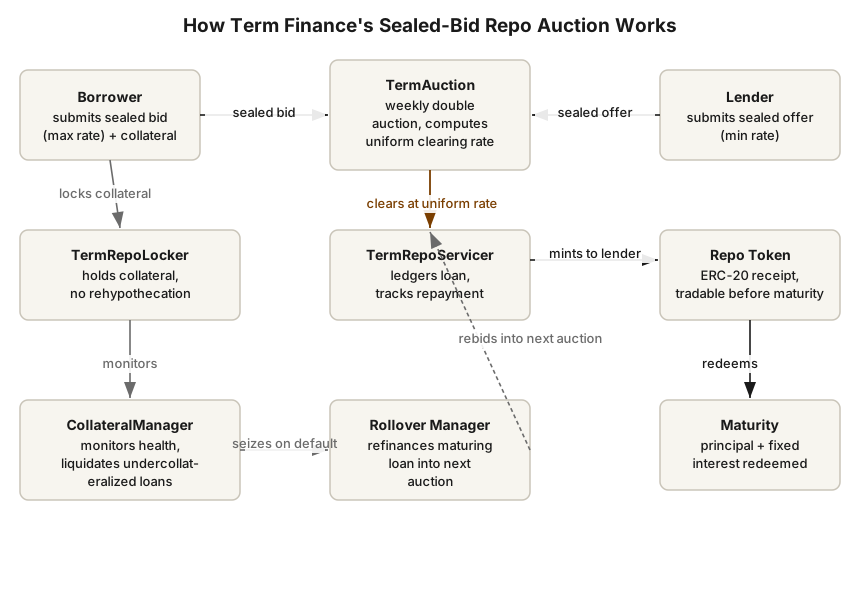 Open full-size diagram
Summary
Term Finance is a non-custodial, fixed-rate, fixed-term lending protocol built by Term Labs, Inc. and launched on Ethereum mainnet on August 1, 2023. Its core wager is that DeFi's dominant lending primitive — floating-rate, perpetual pools like Aave and Compound — is poorly suited to anyone who needs predictable cash flows, and that the fix is not a new AMM curve but a faithful on-chain port of a traditional-finance workhorse: the tri-party repurchase (repo) agreement. Instead of algorithmic utilization curves, Term runs recurring sealed-bid, sealed-offer double auctions in which borrowers and lenders directly discover a single market-clearing interest rate for each collateral/term pair. Term Labs raised a $2.5M seed round in 2023 (Electric Capital lead, with Coinbase Ventures, Circle Ventures, Robot Ventures, MEXC Ventures) and a $5.5M strategic round in July 2024 that included Maelstrom and a16z CSX. Founder and CEO Dion Chu came from traditional fixed income (D.E. Shaw, the Federal Reserve Board, Capula), with co-founder Billy Welch. The protocol later expanded to Avalanche and Base, launched Yearn-v3-based "Term Vaults" and "Blue Sheets," released the TERM governance token in March 2025, and survived a $1.6M oracle-misconfiguration liquidation incident in April 2025, recovering roughly $1M of it.
Design (Mechanism)
The protocol is modeled on tri-party repo: a neutral third party (here, smart contracts) holds collateral, ledgers the loan, and manages settlement between borrower and lender.
- Auction rate discovery. For each collateral type and maturity (terms of weeks up to about a year), the protocol runs a periodic (typically weekly) auction. Borrowers submit sealed bids specifying the maximum rate they will pay; lenders submit sealed offers specifying the minimum rate they will accept. At auction close, the contracts compute a uniform market-clearing rate: every bid at or above it is filled, every offer at or below it is filled, and everyone transacts at the same clearing rate — no spread captured by the protocol's pricing function, and no rate slippage from utilization swings. Runtime Verification audited and formally analyzed the clearing-price algorithm, and the engagement materially optimized its gas cost.
- Repo tokens. Filled lenders receive ERC-20 "repo tokens" — receipts redeemable at maturity for principal plus the fixed interest. Because they are fungible tokens with a known redemption value and date, they behave like on-chain zero-coupon paper and can be traded or used elsewhere before maturity.
- Servicing, collateral, and liquidation. A TermRepoServicer ledgers repayments; a TermRepoCollateralManager monitors overcollateralization and runs liquidations if collateral health deteriorates or the borrower fails to repay at maturity. Collateral sits in a TermRepoLocker rather than being rehypothecated. A rollover manager lets borrowers refinance a maturing loan into a subsequent auction rather than repaying principal.
- Architecture and audits. Contracts follow the UUPS proxy pattern, with evergreen protocol contracts (TermController, TermEventEmitter, price consumer) and serially deployed per-auction/per-repo contracts. Audits were performed by Sigma Prime, Runtime Verification, Dedaub, and Certora.
- Later products. Term Vaults (built on Yearn v3 tokenized strategies) automate rolling deposits across auctions; Blue Sheets packaged institutional-grade fixed-rate lending for retail users; the TERM token (100M supply, launched March 26, 2025 with an airdrop) governs the ecosystem.
Outcome
Term is live and functioning as designed, but it has remained a niche venue rather than a category winner. It shipped a genuinely novel primitive to mainnet, expanded multichain, attracted credible institutional backers across two rounds ($8M total disclosed), and passed multiple audits. Cumulatively it has originated fixed-rate loans at scale via its auctions, and DefiLlama shows its vaults product holding on the order of $15–20M TVL in 2025–26 — respectable, but two to three orders of magnitude below floating-rate leaders. In April 2025 a misconfigured new ETH oracle (a Treehouse tETH market) triggered about $1.6M of wrongful liquidations; the team stressed no contracts were exploited, clawed back ~333 ETH from a liquidator and ~223 ETH internally, and absorbed a ~$650K residual loss. The TERM token launched in March 2025. Verdict: ongoing — mechanically successful, commercially modest, in a fixed-rate DeFi niche where fee-generating scale has been elusive (Yield Protocol shut down; Notional pivoted repeatedly).
Why it worked
- Right primitive for the problem. Uniform-price double auctions are the canonical mechanism for periodic rate discovery (the U.S. Treasury uses them); porting tri-party repo rather than inventing a curve gave institutions a structure they already understood.
- No rate slippage or protocol spread. Everyone clears at one rate, so large borrowers don't move the market against themselves mid-transaction — a real advantage over utilization-curve pools for size.
- Serious engineering posture. Four audit firms, formal verification of the clearing algorithm, and a conservative locker design meant that even its worst incident was an oracle configuration error, not a contract exploit — and most funds were recovered.
- Credible fixed-income pedigree. A founding team from D.E. Shaw/Fed/Capula-type backgrounds gave the design and the institutional sales motion legitimacy.
Limitations and criticisms
- Liquidity is periodic, not continuous. Weekly auctions impose waiting and lump liquidity into discrete events; DeFi users accustomed to instant deposit/withdraw largely stay in floating-rate pools, and thin auctions can produce noisier clearing rates.
- Fixed-rate demand in crypto is structurally small. Most crypto borrowing is short-horizon leverage, where rate certainty is worth little; the natural fixed-rate clientele (treasurers, funds) is a narrow slice of on-chain activity.
- Cold-start on both sides. Double auctions need simultaneous borrower and lender depth per collateral/term pair, fragmenting liquidity across many small markets and keeping TVL orders of magnitude below floating-rate leaders.
- Operational surface area. The April 2025 incident showed that serially deployed markets with per-market oracle configuration multiply the chances of a parameter mistake even when core contracts are sound.
Lessons
- Mechanism correctness is not product-market fit: Term's auction cleared rates exactly as designed, but periodic, fragmented liquidity lost to the convenience of instant floating-rate pools.
- Uniform-price auctions remain the best-understood way to discover a fair fixed rate on-chain, and the tokenized-receipt (repo token) pattern composes well — later fixed-rate designs (e.g., Pendle's PT market) validated the zero-coupon-token demand Term intuited.
- Configuration is part of the trust surface: audits and formal verification of core code did not prevent a seven-figure loss from a single misconfigured oracle on a newly listed market.
- Recovery capacity matters: negotiating back ~$1M of a $1.6M loss, transparently and quickly, preserved the protocol's institutional credibility in a way many exploited protocols never manage.
Redesign (EDITORIAL — hypothesis, not fact)
This section is editorial hypothesis, not fact. A redesign might keep the uniform-price auction as the rate-discovery spine but wrap it in continuous UX: a standing AMM or RFQ market in repo tokens so lenders get instant exit at a discount, with auctions serving as the periodic "fixing" that anchors the curve — effectively an on-chain LIBOR-setting mechanism that other protocols consume. Concentrate liquidity into far fewer markets (one blue-chip collateral, two tenors) until depth is proven, rather than fragmenting across many collateral/term pairs. Gate every new market behind a timelocked, simulation-tested oracle-config pipeline with an independent second signer, treating listings with the same rigor as code upgrades. Finally, lean into the B2B angle early: selling the clearing rate and repo-token rails as infrastructure to vaults, treasuries, and structured-product issuers looks more promising than competing head-on with Aave for retail deposits.
Sources
- Term Finance official site — primary (docs)
- Term Finance v1 documentation — primary (docs)
- Term Finance v1 developer docs — deployed contracts (Ethereum) — primary (contract)
- term-finance/term-finance-contracts (GitHub) — primary (contract)
- Security Audits | Term Finance v1 (Sigma Prime, Runtime Verification, Dedaub) — primary (audit)
- Runtime Verification — How audits can optimize code base: Term Finance clearing price algorithm — primary (audit)
- CoinDesk — DeFi Platform Term Finance Brings Fixed Rate Lending to Ethereum (Aug 1, 2023) (news)
- Blockworks — Term Finance brings fixed-term lending protocol to Ethereum mainnet (news)
- PR Newswire — Term Labs announces $5.5M strategic funding (July 2024) (news)
- Cryptonews — Term Finance recovers $1M after oracle error triggers $1.6M liquidation loss (April 2025) (news)
- DefiLlama — TermFinance TVL (analysis)
Related experiments
Last verified: 2026-07-27 · Spot an error? Suggest a correction