Grass
A Solana-based DePIN network that pays users in GRASS tokens for sharing unused internet bandwidth, which it resells as web-scraping capacity and AI training data to foundation-model labs.
▶ Run interactive simulation animated mechanism with editable parameters
How it works onchain
 Open full-size diagram
Summary
Grass is the flagship product of Wynd Network (later rebranded around the "Grass Foundation"), a Solana-anchored DePIN ("decentralized physical infrastructure network") that turns ordinary users' idle internet bandwidth into a distributed web-scraping fleet. Users install a browser extension or desktop app that routes outbound web requests from Grass's data customers through the user's residential IP address, harvesting publicly available web data at scale for training large language models. In exchange, users earn "Grass Points," later convertible into the GRASS token, launched via a large points-to-airdrop program culminating in a Token Generation Event on October 28, 2024. The pitch: AI labs need enormous volumes of clean, provenance-tracked web data and are willing to pay for it; residential users already have idle bandwidth and IP diversity that data companies value for evading scraping blockers; Grass intermediates the two sides and settles the incentive layer on Solana.
Design (Mechanism)
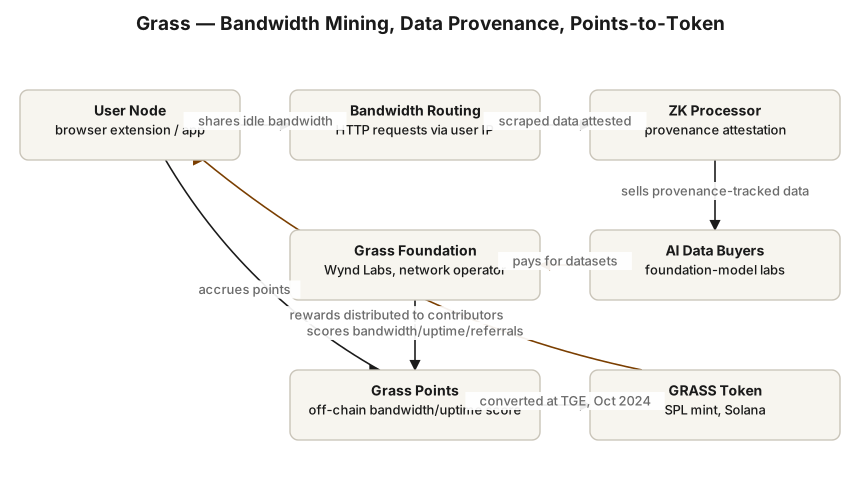
Grass's mechanism has three layers. First, a bandwidth-mining layer: users run a lightweight client that lets Grass's infrastructure route HTTP requests through the user's network connection, harvesting public web pages the user never visits, without (per Grass's claims) accessing personal data or slowing the user's own traffic materially. Second, a provenance/attestation layer: Grass says it uses a "ZK Processor" to cryptographically attest that scraped data was collected as claimed (unmodified, from a real network edge) before it is packaged and sold, aiming to give AI buyers verifiable data lineage rather than opaque scraped dumps. Third, a token-incentive layer: contribution is scored as off-chain "Grass Points" (bandwidth shared, uptime, referrals), which accrued for roughly a year before being converted into GRASS, an SPL token on Solana, with the first tranche (10% of the 1B total supply) airdropped in October 2024 and further distribution continuing through node-reward and points-program epochs. GRASS functions as the reward/settlement currency for the data marketplace and nominally as a governance token for the Grass Foundation. The overall design is a two-sided marketplace coordination problem: it needed millions of individually low-value bandwidth contributors and a small number of high-value AI-lab data buyers, bridged by a token that could be pre-sold as future upside to bootstrap the supply side before real buyer revenue existed.
Outcome
Grass reached meaningful scale on the supply side: reported user/node counts grew from an initial points-program cohort into the millions (sources cite 2.5M+ nodes across 190 countries by 2025, and 8.5M+ registered users by the official site's own account in 2026), making it one of the largest consumer-facing DePIN distributions to date. It raised institutional backing across a 2023 seed (led by Polychain Capital) and a 2024 Series A plus a later $10M bridge round (Polychain and Tribe Capital), pushing disclosed funding into the tens of millions of dollars. GRASS launched on major exchanges alongside the October 2024 TGE, hit an all-time high near $2.89 within two weeks of listing, then substantially deflated with the broader token market — trading roughly an order of magnitude lower ($0.70, ~$218M market cap) by September 2025, a pattern typical of DePIN/points-airdrop tokens that front-loaded speculative demand ahead of proven buy-side revenue. As of this writing the network remains operational and continues to market itself as an "AI data engine," with the project claiming foundation-model-lab customers, but Wynd Labs/Grass has not published transparent, audited disclosures of actual data-sale revenue, making it hard to independently verify whether the demand side of the marketplace has caught up to the enormous points-driven supply side.
Why it worked
- The "get paid for something you weren't using anyway" pitch (idle bandwidth) is extremely low-friction and required no capital outlay or technical skill from users, letting Grass acquire millions of nodes purely through a points-farming incentive loop.
- Riding the 2023-2024 AI data scarcity narrative gave Grass a plausible, timely buyer story (foundation-model labs need fresh, IP-diverse web data) that was easier to raise venture capital around than a generic DePIN pitch.
- Tying rewards to a deferred, uncapped-seeming future token (rather than immediate cash) let Grass bootstrap a large user base cheaply before it had to prove out real data-sale revenue.
Limitations and criticisms
- Grass sits close to a well-known adversarial pattern (residential-proxy botnets used to route scraping traffic through unwitting or under-informed users' IPs), inviting comparisons to earlier bandwidth-sharing services (e.g., Honeygain-style services and malware-adjacent proxyware) and drawing scrutiny about whether participants fully understand what their bandwidth is being used for.
- Like most points-to-airdrop DePIN tokens, GRASS's price action shows the airdrop-dump pattern: a post-listing spike followed by a roughly 75%+ drawdown within a year, suggesting the token's price has been driven far more by speculative airdrop-farming demand than by cash flows from actual AI-data sales.
- The core economics remain opaque: Grass has not published verifiable figures tying data-marketplace revenue to token value accrual, so it is not possible to confirm whether the model is a sustainable data business wrapped in a token, or primarily a token-distribution vehicle wrapped in a plausible-sounding data business.
Lessons
- A frictionless, capital-free contribution mechanism (unused bandwidth) is one of the most effective levers for rapidly bootstrapping a large DePIN user base, but scale of contributors says nothing about scale of paying demand.
- DePIN projects that monetize by reselling users' passive infrastructure carry a specific trust/consent burden (residential-proxy scraping) that pure compute- or storage-DePIN projects don't face, and that burden shows up as reputational risk rather than technical risk.
- Points-program-to-token-airdrop is a powerful, now-standardized bootstrapping mechanism, but it systematically front-loads speculative demand into the token price at TGE, and post-airdrop price decay is the default outcome unless real, disclosed buy-side revenue arrives fast enough to replace farming-driven demand.
Redesign (EDITORIAL)
EDITORIAL / hypothesis, not fact: Grass's core two-sided-marketplace concept is sound, but the current design conflates "user growth" with "data-buyer demand" via an opaque token. A redesigned version could separate the two more cleanly: (1) publish an on-chain, auditable revenue-share contract that streams a fixed percentage of actual data-sale invoices to GRASS stakers in real time (rather than inflationary node-reward emissions), so the token's price is anchored to disclosed cash flow instead of points-farming expectations; (2) require explicit, per-session informed consent and a visible "your bandwidth is currently being used for X" indicator in the client, addressing the residential-proxy trust gap directly rather than relying on background operation; and (3) replace or supplement the ZK "provenance" claims with a public, third-party-auditable data-quality/compliance report (robots.txt and ToS handling, PII-filtering results) published per quarter, since AI-lab buyers ultimately care about legal and compliance risk in their training data at least as much as raw volume.
Sources
- Grass — official site — primary (official)
- Grass Docs (GitBook) — primary (docs)
- Grass Raises $10 Million to Expand Its Decentralised Internet and AI Data Infrastructure (news)
- What Is Grass (GRASS)? Decentralized AI Data Collection Explained — Gate Learn (explainer)
- Grass Token Surges Following Airdrop and New Incentivized Program — CoinMarketCap Academy (news)
- Grass (GRASS) Tokenomics & Vesting Schedule — Tokenomist (data)
Related experiments
Last verified: 2026-07-27 · Spot an error? Suggest a correction