Nym
A token-incentivized decentralized mixnet that pays independent node operators to shuffle encrypted 'sphinx' packets, aiming to protect network-level metadata against even nation-state surveillance.
▶ Run interactive simulation animated mechanism with editable parameters
How it works onchain
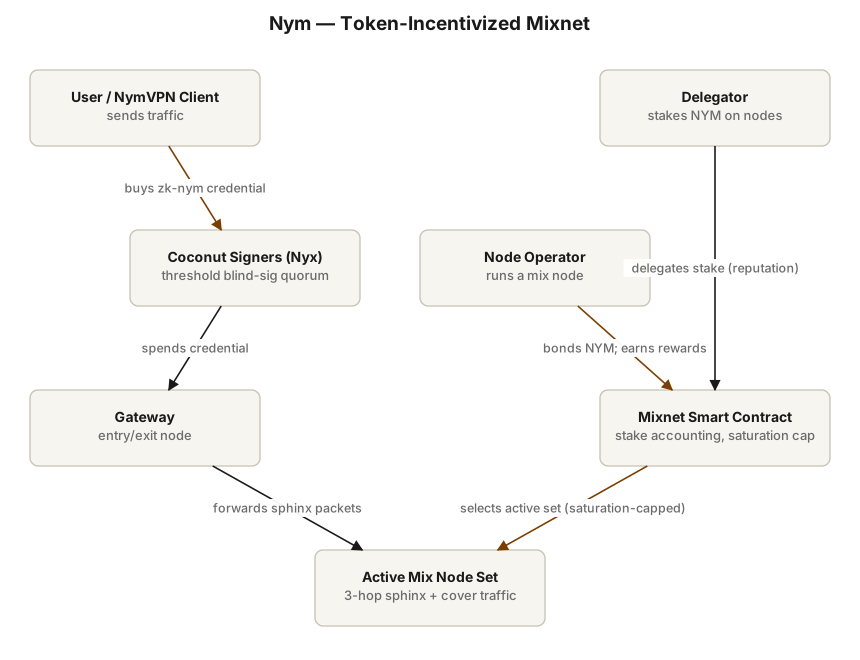 Open full-size diagram
Summary
Nym is an attempt to solve the oldest incentive problem in privacy tech: Tor-style anonymity networks depend on volunteers, so they chronically under-provision capacity and cannot defend against global passive adversaries who watch traffic timing. Nym Technologies SA (Swiss company, founded 2018) grew out of the EU-funded PANORAMIX mixnet research project, with Harry Halpin as CEO and mixnet researchers including Ania Piotrowska (whose Loopix design underpins the network) and advisors George Danezis and Aggelos Kiayias. Nym's answer is a mixnet — packets are encrypted into uniform "sphinx" packets, routed through three layers of mix nodes, delayed and mixed with cover traffic ("noise") — combined with a cryptocurrency incentive layer: node operators bond NYM tokens, users delegate stake to nodes as decentralized reputation, and rewards flow to nodes based on measured quality of service. Coordination (node registry, delegations, rewards, credential issuance) runs on Nyx, a Cosmos SDK appchain, while the NYM token also exists as an ERC-20 on Ethereum. The token sold publicly on CoinList in February 2022; the flagship consumer product, NymVPN, launched in March 2025 and remains actively developed as of 2026.
Design (Mechanism)
- Mixnet core: Client traffic is split into identically-sized, layer-encrypted sphinx packets, routed through a stratified three-hop mix topology with per-hop random delays plus loop/cover traffic, defeating traffic-correlation analysis that VPNs and Tor cannot resist against a global observer.
- Bonding and delegated staking as reputation: Operators bond NYM to register a node in the Mixnet smart contract on Nyx. Token holders delegate NYM to nodes they judge reliable; a node's total stake (self-bond + delegations) determines its probability of selection into the active set. Staking thus doubles as sybil resistance and a decentralized reputation signal.
- Stake saturation cap: Each node has a saturation point; stake beyond it yields decreasing returns for the operator and all delegators, pushing stake to spread across many operators rather than concentrating on a few winners — an explicit anti-centralization mechanism.
- Performance-based rewards: Rewards are a function of stake, uptime/quality-of-service measurements, and declared profit margin, so delegators are incentivized to chase well-run nodes, not just large ones.
- zk-nym anonymous credentials: Payment is unlinked from usage via zk-nyms, a practical deployment of the Coconut threshold blind-signature credential scheme: users pay for bandwidth, receive rerandomizable anonymous credentials from a quorum of signers on Nyx, and spend them at gateways without linking identity to traffic.
- Two-chain token plumbing: NYM exists natively on Nyx (Cosmos) for staking/rewards and as an ERC-20 (0x525A8F6F...E3990e1) for liquidity, bridged between the two.
Outcome
Ongoing. Technically, Nym is arguably the most successful mixnet deployment ever: it went from EU research project to a live, permissionless network of hundreds of independently operated nodes, and FOSDEM 2026 material describes it as the first real-world decentralized noise-generating mixnet offering anonymity against nation-state adversaries. The company raised roughly $18M in venture rounds (a16z, Polychain, Binance Labs, DCG and others) plus a ~$25M+ CoinList public sale (Feb 2022). NymVPN, the consumer wrapper, launched March 2025 with a two-mode design (fast 2-hop WireGuard mode vs. anonymous 5-hop mixnet mode), added post-quantum encryption, ad-blocking, and censorship-evasion features through 2026, and accepts NYM at a steep discount to drive token utility. Commercially, however, the picture is weaker: NYM trades around $0.02 in 2026 versus a 2022 all-time high in the multi-dollar range (sources vary between ~$1 and ~$5), a >97% drawdown, and reviewers consistently describe NymVPN as a niche, slower, pricier product for a privacy-maximalist audience. Independent demand for mixnet bandwidth beyond the VPN app remains limited.
Why it worked
- Real cryptography, real pedigree: Loopix/Sphinx/Coconut are peer-reviewed designs by leading anonymity researchers; the mechanism wasn't invented to justify a token — the token was bolted onto a genuine provisioning problem.
- Incentives fixed the volunteer bottleneck: Paying operators produced a large, geographically distributed node set far faster than volunteer recruitment ever did for mixnets, with delegated staking providing permissionless quality curation.
- Stake saturation worked as designed: capping effective stake per node measurably spread delegations across operators instead of letting a few nodes absorb everything.
- Shipping a consumer product: Unlike most crypto middleware, Nym converted its network into a recognizable product (a VPN) with fiat and crypto payment, giving the token an actual demand sink via zk-nym credentials.
Limitations and criticisms
- Latency is a hard sell: Mixing requires delay and cover traffic; mainstream users comparison-shop VPNs on speed and price, where Nym structurally loses. The privacy premium market is small.
- Token demand has lagged token supply: rewards emissions and unlocks flowed continuously while credential-driven buy-pressure stayed tiny, producing a >97% price decline that erodes the security budget the staking model depends on.
- Circular early economics: for years the main use of NYM was staking NYM to earn NYM; real fee revenue arrived only with NymVPN in 2025, three years after the token.
- Infrastructure invisibility: "metadata privacy" is abstract; Nym has struggled, as FOAM, Handshake, and other infra experiments did, to make an invisible network legible to buyers rather than speculators.
Lessons
- Token incentives can genuinely solve infrastructure provisioning — Nym stood up a global mixnet that two decades of volunteerism never achieved — but provisioning supply is the easy half; manufacturing paying demand is the experiment that actually decides survival.
- Stake saturation caps are an effective, reusable anti-centralization primitive: making marginal stake yield negative relative returns past a threshold redistributes delegation without any central allowlist.
- Decouple payment from usage cryptographically: zk-nym/Coconut credentials show how a privacy network can charge users without becoming a surveillance chokepoint itself — a pattern applicable to any paid-privacy service.
- Launch the demand sink with the token, not years later: a three-year gap between token sale (2022) and the first real product (2025) meant price discovery happened on pure speculation, and the subsequent collapse now taxes the network's credibility and security budget.
Redesign (EDITORIAL — hypothesis, not fact)
This section is editorial hypothesis, not fact. A redesigned Nym might invert the sequencing: launch the VPN first with fiat billing, and only introduce the token once credential redemption volume exists, sizing emissions to a multiple of observed fee revenue rather than a fixed schedule. Rewards could be denominated partly in stable-value credit claims on future bandwidth, insulating operator income from token volatility. To escape the consumer-VPN speed trap, the network could pivot its wedge to B2B latency-tolerant flows — wallet RPC broadcasts, validator/DA gossip, voting and messaging apps — where metadata protection is worth paying for and delay is acceptable, letting a handful of protocol integrations (paying in credentials) anchor baseline demand. Finally, publishing an onchain "coverage dashboard" tying emissions to measured anonymity-set quality (not just uptime) would make the subsidy buy the thing that actually matters: entropy, not merely nodes.
Sources
- Nym Docs — Nyx Blockchain & Mixnet Contract — primary (docs)
- Nym Docs — Tokenomics (rewards, stake saturation) — primary (docs)
- Nym Docs — What are zk-nyms? — primary (docs)
- Nym team page (leadership + X links) — primary (docs)
- NYM ERC-20 token on Etherscan — primary (contract)
- nymtech GitHub (open-source mixnet code) — primary (contract)
- Messari — Understanding Nym (analysis)
- Wikipedia — Nym Technologies (PANORAMIX origins, funding) (archive)
- FOSDEM 2026 — NymVPN: The First Real-World Decentralized Noise-Generating Mixnet (retrospective)
- TechRadar — NymVPN is now live (consumer launch, March 2025) (news)
Related experiments
Last verified: 2026-07-26 · Spot an error? Suggest a correction