FOAM
A crypto-spatial protocol that used a token-curated registry and staked radio beacons to build a decentralized map and GPS-independent 'proof of location' on Ethereum.
▶ Run interactive simulation animated mechanism with editable parameters
How it works onchain
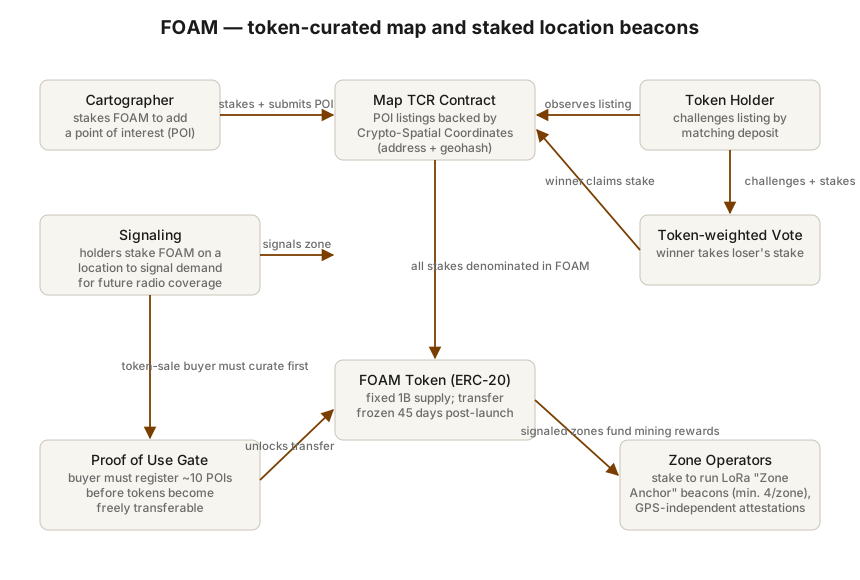 Open full-size diagram
Summary
FOAM (built by Foamspace Corp, New York) set out to put location on the blockchain: an open, consensus-driven map of the world and, eventually, a decentralized alternative to GPS. Announced in September 2017 by Ryan John King, Ekaterina Zavyalova, and Kristoffer Josefsson, it raised $16.5M in a token sale that closed in August 2018 and launched its map on Ethereum mainnet in September 2018, with 500+ points of interest added in the first 24 hours. FOAM is canonical for two reasons: it was the highest-profile production deployment of the token-curated registry (TCR) mechanism, and it pioneered the "DePIN before DePIN" idea of token-incentivized radio hardware ("Dynamic Proof of Location" via LoRa Zone Anchors). The mapping TCR worked as designed but attracted only trivial usage (~140 monthly participants by April 2019), and the radio network remained a small pilot program (e.g., Brooklyn Navy Yard zone, Trust Zone beta) for years afterward.
Design (Mechanism)
FOAM combined several mechanisms around a fixed-supply 1B ERC-20 token (FOAM, 0x4946...c121):
- Crypto-Spatial Coordinates (CSC): an open standard giving smart contracts a shared geographic addressing scheme — an Ethereum address paired with a geohash, so any contract could be anchored to a physical location.
- Static Proof of Location — the TCR: "Cartographers" staked FOAM deposits to add points of interest (POIs) to the map. Any token holder could challenge a listing by matching the deposit; challenges were resolved by token-weighted votes, with winners taking the loser's stake. Listings persisted only while backed by stake, so map quality was intended to be maintained by continuous economic pressure rather than a central moderator.
- Proof of use: to filter out pure speculators, token-sale buyers had to actually use the token (register ~10 POIs) before tokens became freely transferable, and all transfers were frozen for 45 days after launch.
- Signaling: token holders could stake FOAM on map locations to "signal" demand for future coverage, spatially weighting where mining rewards for radio infrastructure should flow.
- Dynamic Proof of Location: the long-term goal — a permissionless network of time-synchronized LoRa radio beacons ("Zone Anchors," minimum four per zone with line-of-sight) run by staked Zone Operators, generating fault-tolerant location attestations independent of GPS, which is unencrypted, spoofable, and centrally operated.
Outcome
Mixed, with a long tail. The token sale ($16.5M) and mainnet TCR launch (September 2018) both succeeded operationally; the map accumulated thousands of POIs and the challenge/vote game functioned as specified. But engagement was tiny — roughly 140 monthly TCR participants in April 2019 — and by May 2019 FOAM had shifted to community token grants (≈10% of supply earmarked) to stimulate usage. Dynamic Proof of Location never reached a permissionless mainnet: it progressed through the "GeoPickle" incentivized testnet, a four-anchor sandbox zone at Brooklyn Navy Yard (deployed June 2020), and an invite-style "Trust Zone" beta program with prototype hardware and token rewards; the team continued small deployments as late as 2024 (new Brooklyn installations posted during Onchain Summer). The token fell from ~$0.03 (2019) to fractions of a cent, with a market cap in the tens of thousands of dollars by 2026. The team persisted far longer than most 2018 ICOs — GitHub activity (PureScript/Haskell tooling like purescript-web3, chanterelle, kepler) extends into 2025 — but the protocol never achieved meaningful adoption. Status of the current website is minimal, and no permissionless location-mining network exists. Verdict: technically successful, commercially unsuccessful.
Why it worked
- Coherent cryptoeconomic design: FOAM was one of the most rigorous 2017-era projects — a real mechanism (deposit/challenge/vote TCR) shipped to mainnet, not vaporware. Placeholder VC's thesis praised its work-token model where usage, not speculation, drove value.
- Proof of use was a genuinely novel anti-speculation device: forcing buyers to curate the map before tokens unlocked produced 500+ POIs on day one and unusual early price stability (~$0.03 through early 2019, attributed to functional holding).
- Real problem selection: GPS spoofability and centralized location oracles are legitimate weaknesses; FOAM's diagnosis prefigured the entire DePIN wireless category (Helium et al.).
- Engineering seriousness: the team produced durable open-source infrastructure (purescript-web3, Chanterelle) used beyond FOAM itself.
Why it failed or underperformed
- No consumer of the data: the TCR curated a map that no application demanded. Without paying consumers of POI data or location attestations, staking rewards were purely reflexive — cartographers earned only from other cartographers' slashed deposits.
- TCR incentive weakness: curating "is this café really here?" is low-stakes and unpaid; honest listing rarely gets challenged, so there was little to earn and little to do. Participation collapsed to ~140 people/month.
- Token-first sequencing: the token and curation game launched years before the actual product (radio-based location attestation) existed; by the time Zone Anchor hardware was in beta, the treasury-fueled attention window had closed.
- Hardware is slow and capital-intensive: four line-of-sight LoRa anchors, LTE backhaul, and rooftop access per zone is a heavy ask versus Helium's plug-in hotspot — and Helium (2019) captured the token-incentivized-radio narrative with a simpler onboarding story.
- Bear-market timing: launching a usage-dependent token in September 2018 meant the speculative subsidy evaporated almost immediately.
Lessons
- A curation market needs a buyer. TCRs fail when the registry's output has no paying consumer; verification work must be subsidized by demand, not only by slashing other participants.
- Sequence product before token games. Selling and activating a token years ahead of the core service (radio proof of location) burned community energy on a placeholder activity (map curation) with no durable retention.
- Proof-of-use gating works — briefly. Transfer restrictions conditioned on usage demonstrably filtered speculators and stabilized price, but manufactured usage does not convert to organic usage once restrictions lift.
- In hardware networks, deployment friction is the mechanism. Helium's one-device, one-owner hotspot beat FOAM's four-anchor, line-of-sight zones despite FOAM's earlier start and arguably sounder security model.
- Longevity is not success. FOAM avoided rug status and kept shipping for 7+ years, yet without an adoption flywheel the outcome converged to the same place as abandonment.
Redesign (EDITORIAL — hypothesis, not fact)
This section is editorial hypothesis, not established fact. A modern FOAM would invert the order of operations: start from a paying demand side — e.g., proof-of-presence attestations for RWA logistics, parametric insurance, or sybil-resistant "proof of physical personhood" for airdrops — and sell attestations for stablecoin fees from day one, with the token earned only by supplying verified coverage where fees are actually generated. Replace the POI TCR with optimistic attestation: listings and location claims are accepted by default, bonded, and only adjudicated on challenge (the Kleros/UMA pattern), which eliminates the dead-weight voting workload that killed participation. Keep FOAM's genuinely good ideas — proof-of-use unlocks and demand signaling — but make signaling a real futures market: stakers who signal a zone earn a share of that zone's future attestation fees, so coverage prediction is compensated, not symbolic. Deploy on an L2 with cheap attestations, use smartphone-grade radio (BLE/UWB/WiFi RTT) before dedicated LoRa hardware to bootstrap density, and graduate zones to dedicated anchors only where fee volume proves demand. The core bet: location attestation is an oracle business, and oracle businesses live or die on paying integrations, not on map completeness.
Sources
- FOAM Whitepaper (Foamspace Corp, May 2018) — primary (docs)
- FOAM Token (FOAM) — Etherscan token tracker — primary (contract)
- FOAM GitHub organization (f-o-a-m, verified foam.space domain) — primary (docs)
- FOAM Trust Zone Program FAQ (foamspace.eth on Mirror) — primary (docs)
- FOAM Is Live: Decentralized World Map Launches on Ethereum — CoinDesk (Sep 13, 2018) (news)
- Foam Turns to Token Grants to Build Out Decentralized Mapping Platform — CoinDesk (May 6, 2019) (news)
- FOAM Thesis — Placeholder VC (Feb 2019) (analysis)
- What is FOAM? — Messari profile (analysis)
- Proof of Location with FOAM in Brooklyn Navy Yard — Voltaic Systems (analysis)
- Foam — DePIN Hub project page (analysis)
Related experiments
Last verified: 2026-07-26 · Spot an error? Suggest a correction