Helium
Token-incentivized decentralized wireless network (DePIN pioneer) that paid people in HNT to deploy LoRaWAN and 5G/Wi-Fi hotspots, migrated from its own L1 to Solana in 2023.
▶ Run interactive simulation animated mechanism with editable parameters
How it works onchain
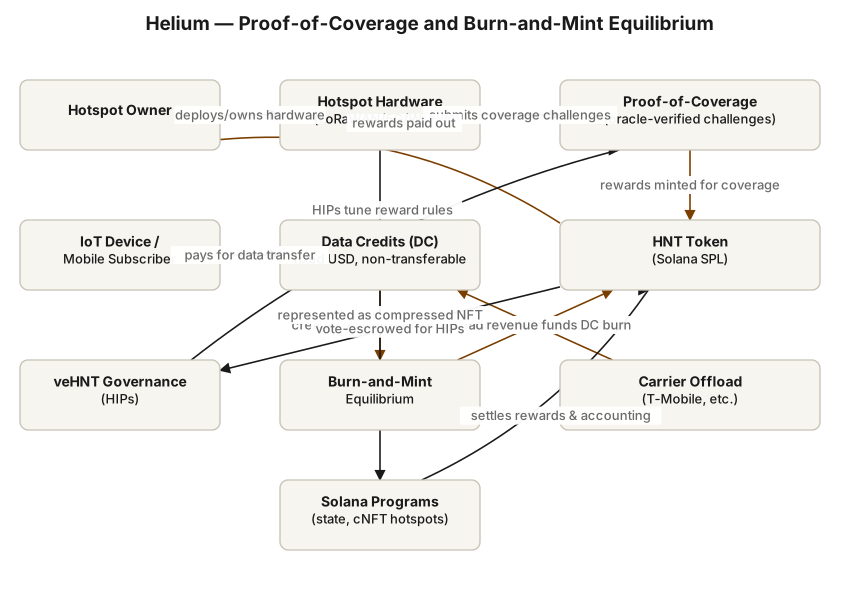 Open full-size diagram
Summary
Helium is the canonical DePIN (decentralized physical infrastructure network) experiment: pay ordinary people in tokens to deploy wireless hardware, and let a cryptoeconomic mechanism — not a telecom — bootstrap network coverage. Founded in 2013 by Amir Haleem, Napster's Shawn Fanning, and Sean Carey as Helium, Inc. (renamed Nova Labs in 2022 after a $200M Series D), the project launched its own layer-1 blockchain in July 2019. Hotspot owners earned HNT via "Proof-of-Coverage" for providing LoRaWAN IoT coverage. The supply-side flywheel was explosive — hotspot deployments grew into the hundreds of thousands worldwide by 2022 — but demand for actual data transfer lagged badly, and a 2022 Forbes investigation documented heavy insider token capture. In September 2022 the community approved HIP-70, and on April 18, 2023 Helium executed one of crypto's most complex migrations, moving its entire chain state (tokens, governance, and every hotspot as a compressed NFT) onto Solana. A second act around Helium Mobile — a cellular offering built on community Wi-Fi/CBRS hotspots plus T-Mobile offload — plus carrier offload deals drove genuine usage growth through 2025. In June 2026 Haleem moved to a chairman role and Helium Mobile was sold, with the network continuing as connectivity infrastructure.
Design (Mechanism)
- Proof-of-Coverage (PoC). Hotspots cryptographically challenge each other over radio to prove they provide legitimate wireless coverage at their asserted location. Rewards are weighted so honest, well-placed coverage earns more. Originally run on Helium's own L1; after HIP-70, PoC verification moved to off-chain oracles that settle results on Solana.
- Burn-and-mint equilibrium (BME). Network usage is paid in Data Credits (DC), a non-transferable unit with a fixed USD price, created only by burning HNT. Demand for connectivity therefore burns HNT while emissions (halving on a schedule) mint it — a two-token design intended to link token value to real usage rather than speculation.
- Hardware mining. Users buy third-party hotspots (~$400–$500 at peak) and earn HNT for coverage and data transfer — shifting capex for network buildout onto the crowd.
- SubDAO tokens (HIP-51/52/53, 2022–2023). The network split into IOT and MOBILE subnetworks with their own reward tokens redeemable against HNT via a treasury-backed mechanism; HIP-138 (January 2025) reversed this, returning to HNT as the sole reward token after the multi-token structure proved confusing and illiquid.
- Governance. Helium Improvement Proposals (HIPs) voted with vote-escrowed HNT (veHNT) after migration; major pivots (HIP-70, HIP-138) went through community votes.
- Solana migration (April 18, 2023). Every hotspot became a compressed NFT; token accounting, rewards, and governance moved into Solana programs, eliminating the cost of maintaining a bespoke L1.
Outcome
Supply-side bootstrapping succeeded beyond any precedent: nearly a million LoRaWAN hotspots were deployed globally at peak, financed by an estimated ~$500M of community hardware spending. But demand collapsed the story: Forbes reported only ~$92K of data-transfer revenue between July 2021 and August 2022, and identified ~30 insider-linked wallets that mined roughly half of circulating HNT in the network's first three months, including "closet clusters" gaming PoC. HNT fell from ~$55 (2021 peak) to single digits, and IoT hotspot earnings dropped from tens of thousands of HNT/month per device in 2019 to ~2 HNT/month by 2022. The pivot to mobile changed the trajectory: Helium Mobile grew from ~100K sign-ups (mid-2024) to 600K+ by end of 2025, carrier offload agreements (T-Mobile, AT&T, Telefónica/Movistar, and others) generated real data demand, and burning 100% of Helium Mobile subscriber revenue lifted annualized burn-based revenue to ~$18.3M by Q3 2025, with the network reporting 2M+ daily connected users by year-end 2025. Still, HNT remained down ~96% from its peak when Haleem stepped back to chairman in June 2026 and Helium Mobile was divested. Verdict: ongoing — a genuine infrastructure network with real usage, but one whose early token holders overwhelmingly lost money.
Why it worked
- Token incentives solved the cold-start problem for physical infrastructure. No telecom could have deployed hundreds of thousands of coverage nodes in three years at near-zero capex to the company; HNT emissions did.
- Burn-and-mint gave a legible demand signal. Fixed-USD Data Credits made "is anyone actually using this?" answerable on-chain — an honesty mechanism many token models lack.
- Willingness to make hard pivots via governance. Killing its own L1 (HIP-70), collapsing subDAO tokens (HIP-138), and pivoting from IoT to mobile/offload were each ratified by token votes and executed — rare institutional adaptability.
- Carrier offload found real product-market fit. Selling bulk coverage to existing carriers matched crowdsourced supply with a customer that already had demand.
Limitations and criticisms
- Supply incentives massively outran demand for years. Emissions paid for coverage that few were buying; early IoT data revenue was negligible relative to ~$500M of community hardware spend, making retail hotspot buyers the de facto exit liquidity until the mobile pivot.
- Insider concentration. Early-mining concentration (~half of early HNT to insider-linked wallets, per Forbes) and PoC gaming ("closet clusters") undermined the "People's Network" legitimacy narrative.
- PoC was gameable. Location spoofing and clustered devices extracted rewards without providing useful coverage, requiring years of anti-gaming HIPs to close the gap.
- A bespoke L1 was a lasting liability. Chain halts and scaling limits consumed engineering effort for years until the network conceded and moved the entire state to Solana.
- Multi-token complexity (HNT/IOT/MOBILE/DC) confused participants and fragmented liquidity for over a year before being reversed by HIP-138.
- Early token holders overwhelmingly lost money even as the underlying network grew — HNT remains down roughly 96% from its 2021 peak, a reminder that "the infrastructure works" and "the token was a good investment" are separate claims.
Lessons
- DePIN token emissions can bootstrap supply, but supply is the easy half; a network that mints rewards faster than it burns usage is transferring wealth from late hardware buyers to early miners.
- Fixed-price, burn-to-use credits (BME) are a powerful transparency device — they made Helium's demand shortfall undeniable and later made its mobile-era recovery measurable.
- Proof-of-physical-work mechanisms will be gamed at exactly the rate rewards exceed honest costs; adversarial design and oracle verification must be assumed from day one.
- Owning your own L1 is rarely worth it for an application network; Helium's migration to Solana (state → compressed NFTs + oracles) became the template for app-chains retiring themselves.
- Selling to existing demand aggregators (carrier offload) beat waiting for a native two-sided market to appear.
Redesign (EDITORIAL — hypothesis, not fact)
This section is editorial hypothesis, not historical fact. A redesigned Helium would (1) cap or demand-gate emissions: coverage rewards should scale with verified nearby usage (offload sessions, DC burn in that hex), not raw existence of coverage, killing the ghost-coverage subsidy; (2) enforce a public, on-chain genesis: no pre-mainnet mining window, insider allocations disclosed and vested in transparent contracts, eliminating the early-capture dynamic Forbes exposed; (3) launch on a general-purpose chain from day one with PoC as an oracle/ZK-attested service, skipping the L1 detour; (4) keep one token plus USD-priced credits — the subDAO token experiment suggests routing new subnetworks through the parent token with revenue-share accounting instead of new tradable assets; and (5) sign anchor demand contracts (carrier offload, enterprise sensors) before scaling supply incentives, so hardware buyers underwrite forecastable revenue rather than a narrative.
Sources
- The Helium Network Token — Helium Documentation — primary (docs)
- HIP 70: Helium Core Team Proposes to Migrate to Solana — primary (governance)
- It's here: The Helium Network Migrates to Solana Today — primary (docs)
- Helium 2025: Year in Review — The Helium Blog — primary (docs)
- Forbes: Crypto Darling Helium Promised A 'People's Network.' Instead, Its Executives Got Rich. (analysis)
- Solana case study: A Technical Deep Dive on Helium (analysis)
- Messari: State of Helium Q3 2025 (analysis)
- Wikipedia: Helium Network (archive)
- crypto.news: Helium CEO Amir Haleem steps down as HNT extends crash (news)
Related experiments
Last verified: 2026-07-27 · Spot an error? Suggest a correction