Ampleforth
An uncollateralized rebasing cryptocurrency whose total supply expands and contracts daily so each holder keeps a fixed fraction of the network while the token targets the CPI-adjusted 2019 US dollar.
▶ Run interactive simulation animated mechanism with editable parameters
How it works onchain
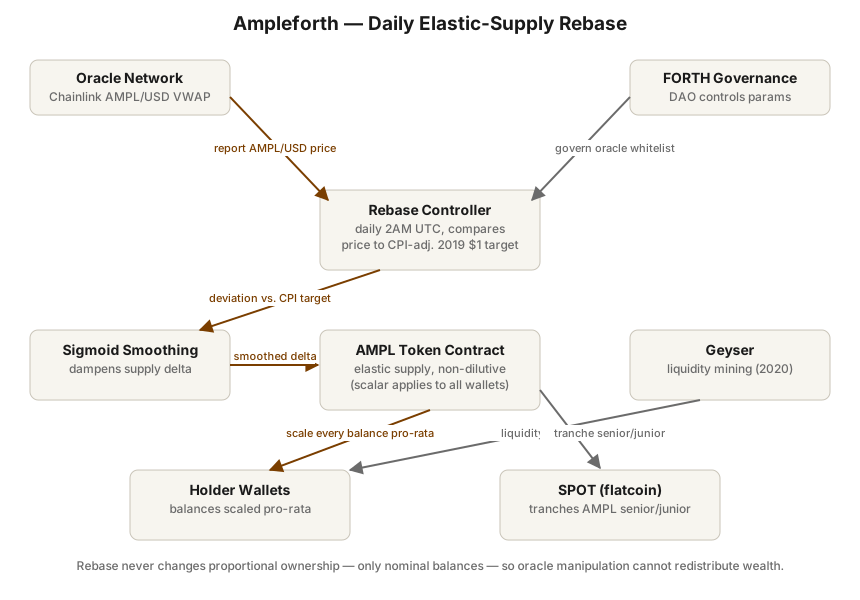 Open full-size diagram
Summary
Ampleforth (AMPL) is an uncollateralized, supply-elastic cryptocurrency on Ethereum that pioneered the "rebase" mechanism. Rather than holding a peg through collateral or bonding markets, AMPL translates price deviation into a daily, protocol-wide adjustment of the token supply. Every holder's balance is scaled by the same global coefficient, so a rebase never changes anyone's proportional ownership — only the nominal count of tokens in each wallet. The design targets the CPI-adjusted 2019 US dollar, framing AMPL not as a stablecoin but as a "synthetic commodity" or independent unit of account. Conceived in February 2018 by Evan Kuo and Brandon Iles (under the parent company Fragments), the whitepaper was released in May 2019 and the network went live in mid-2019. AMPL became one of DeFi Summer 2020's most visible experiments before a dramatic supply collapse. The team later shipped the FORTH governance token (April 2021) and the SPOT "flatcoin" (2022) built on top of AMPL.
Design (Mechanism)
AMPL's core is a single daily "rebase" executed at 2AM UTC. The protocol reads a volume-weighted average AMPL/USD exchange rate from a network of oracles (later integrated with Chainlink) and compares it to the CPI-adjusted 2019 dollar target.
- If price is above target beyond a deviation threshold (currently ~5%), the protocol expands supply, minting new AMPL into every wallet pro-rata.
- If price is below target, it contracts supply, reducing every balance pro-rata.
- Within the deviation band, no rebase occurs.
Supply changes are smoothed by a sigmoid curve so the protocol does not attempt to close the entire gap in one day; it applies a fraction (approaching the full deviation over roughly a multi-day window) to dampen oscillation. Because the adjustment is a global scalar applied to all addresses simultaneously, it requires no peer-to-peer transactions and is O(1) per day. Crucially, the policy is "non-dilutive": an oracle attack could distort supply but cannot steal or redistribute tokens, since every holder's fraction of the whole is preserved. Governance over the oracle whitelist and protocol parameters was later handed to FORTH holders via a DAO. SPOT is a downstream product that tranches AMPL into senior/junior claims to produce a supply-stable, inflation-resistant "flatcoin" without external collateral.
Outcome
Ampleforth is best classified as technically successful but commercially unsuccessful. The mechanism has run continuously since 2019 without being exploited or halted — the rebase engine, oracle integration, and non-dilutive accounting all worked as designed. Its Geyser liquidity-mining program (launched June 23, 2020) briefly made AMPL the top pair on Uniswap during DeFi Summer, and market cap swelled. But in late July 2020 AMPL lost roughly 75% of its dollar value in days, pushing the protocol into an extended run of negative rebases that shrank holders' nominal balances night after night. AMPL never established durable demand as a unit of account. It saw a speculative revival in late 2023–2024 (market cap reportedly rising from ~$22M in Sept 2023 to ~$304M by April 2024) tied to renewed "flatcoin" interest and the SPOT launch, but SPOT adoption stayed tiny (only a few million tokens minted as of mid-2024) and the ecosystem's prominence faded again afterward. The FORTH airdrop (April 2021) distributed governance to ~75,000+ wallets that had ever touched AMPL.
Why it worked
- The rebase mechanism is elegant and robust: a single daily scalar update is cheap, simple to reason about, and non-dilutive, sidestepping the theft vectors that plague collateralized and seigniorage-bond designs.
- It genuinely introduced a new DeFi primitive — supply-elastic tokens — that influenced a wave of imitators and remained live and unexploited for years.
- Liquidity mining (Geyser) with a time-multiplier for longer deposits was an effective bootstrapping tool that demonstrated how to attract deep on-chain liquidity quickly.
Where the design broke
- Rebasing converts price risk into supply risk but does not eliminate it. When price fell, holders watched their balances shrink daily, producing a reflexive "negative rebase spiral" that punished holders and destroyed confidence.
- AMPL is highly volatile in the short-to-medium term; the CPI-dollar target is only approached over long horizons, so it failed to function as the stable unit of account it aspired to be, and few applications adopted it as money.
- Demand was overwhelmingly speculative and momentum-driven (chasing positive rebases), so the system oscillated between manias and painful contractions rather than settling into equilibrium.
- Later products (SPOT, the "flatcoin" thesis) never achieved meaningful adoption, leaving the protocol technically alive but economically marginal.
Lessons
- Non-dilutive elastic supply is a real safety property: making supply policy a proportional scalar means oracle manipulation cannot redistribute wealth — a genuinely reusable design idea for on-chain money.
- Moving volatility from price to supply does not create stability; it relocates the pain. Users experience shrinking balances as loss, and reflexivity (buying into expansions, fleeing contractions) can turn the mechanism into a boom-bust oscillator.
- A "unit of account" needs organic transactional demand, not just speculative holders. Without applications denominating real obligations in the token, an algorithmic money has no anchor beyond narrative.
- Liquidity mining can manufacture TVL and attention overnight but not durable product-market fit; incentives bootstrap liquidity, not utility.
Redesign (EDITORIAL — hypothesis, not fact)
The following is the researcher's editorial analysis, not established fact. Ampleforth's central flaw is that rebasing makes volatility legible and painful at the wallet level while doing nothing to dampen the reflexive demand that drives it. A redesign might (1) decouple the "spendable" surface from the volatile supply layer — essentially what SPOT attempts — but make the stable tranche the default user-facing asset from day one, so ordinary holders never watch their balances shrink; (2) replace naive daily oracle-driven rebases with a demand-aware controller that slows expansion during euphoric momentum (leaning against reflexivity) rather than mechanically chasing price, reducing the mania phase that seeds the subsequent collapse; and (3) pair the elastic layer with a productive sink — protocol-owned liquidity or a savings vault that pays yield in the stable tranche — to convert speculative flow into sticky demand. The deeper hypothesis is that "elastic supply" works best as invisible plumbing beneath a stable consumer asset, not as the asset users are asked to hold directly; Ampleforth's core insight (non-dilutive proportional supply) may be more valuable as infrastructure for other stable instruments than as a standalone currency.
Sources
- About the Ampleforth Protocol | Ampleforth Docs — primary (docs)
- Ampleforth: AMPL Token contract | Etherscan — primary (contract)
- Ampleforth Governance (FORTH) token | Etherscan — primary (contract)
- Ampleforth: SPOT Token | Etherscan — primary (contract)
- Ampleforth official website — primary (docs)
- 5 Lessons Learned in Liquidity Mining | Ampleforth Blog — primary (retrospective)
- The Rise and Fall (and Rise and Fall) of Ampleforth — Part I | Collab+Currency (analysis)
- Ampleforth Is Giving Governance Tokens to Every Wallet That Ever Held AMPL | CoinDesk (news)
- Decentralizing Ampleforth's Rebasing Mechanism | Chainlink case study (analysis)
- Crypto Flatcoin Pioneer Ampleforth Surged 1,280% In 7 Months | Forbes (news)
Related experiments
Last verified: 2026-07-26 · Spot an error? Suggest a correction