mStable
A stablecoin meta-asset protocol that fused same-peg baskets, zero-slippage swaps, native yield (SAVE), and an MTA-staking recollateralization backstop into one standard — technically sound, but out-competed until its DAO voted to be acquired by dHEDGE in 2023.
▶ Run interactive simulation animated mechanism with editable parameters
How it works onchain
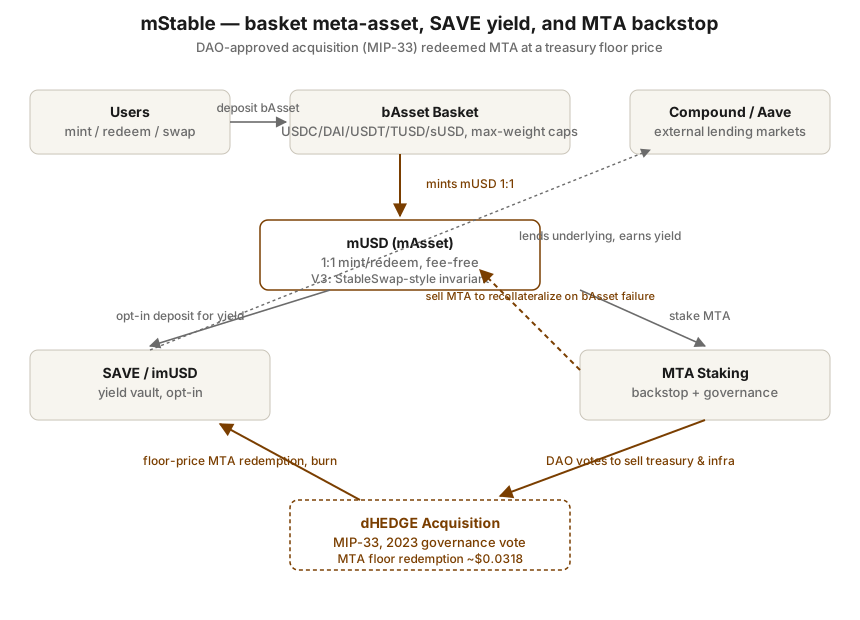 Open full-size diagram
Summary
mStable (started in Melbourne in late 2018; protocol live on Ethereum mainnet in May 2020) attempted to solve stablecoin fragmentation by bundling same-peg assets into "meta-assets." Users minted mUSD 1:1 against a basket of major USD stablecoins (at various times USDC, DAI, USDT, TUSD, sUSD), swapped between basket assets, and earned a "native interest rate" via the SAVE contract (imUSD), which routed underlying collateral into Compound and Aave and recycled swap fees to savers. The Meta (MTA) governance token — 2.66M of which were sold in a public auction on 18 July 2020 — served triple duty: governance, liquidity incentives ("Earn"), and a staked backstop meant to recollateralize the basket if a constituent stablecoin failed. The system was audited (ConsenSys Diligence, July 2020), extended to mBTC, Feeder Pools, and Polygon in 2021, and never suffered a protocol hack. But revenue could not sustain the organization: after fee income collapsed and a co-founder departed, the DAO passed MIP-33 in April 2023, selling the protocol, treasury (~$2.1M), and infrastructure to dHEDGE, with MTA redeemable at a $0.0318 floor price. The mStable brand survives today as a dHEDGE-aligned yield-vault product; the original meta-stablecoin experiment is over.
Design (Mechanism)
- mAsset / bAsset baskets. Each meta-asset (mUSD, later mBTC) was a fully-collateralized claim on a basket of "bAssets" sharing the same peg. Minting was 1:1 and fee-free against any accepted basket asset.
- Basket weight constraints. V1/V2 used a "max weight" system: each bAsset had a governance-set ceiling; mints/swaps pushing an asset past its cap were blocked, forcing rebalancing pressure. mUSD V3 (early 2021) replaced rigid caps with a StableSwap-style invariant AMM, making pricing continuous rather than binary.
- Zero-slippage swaps. Because basket assets were treated as equal-value within weight limits, swaps between them initially executed 1:1 minus a small fee — attractive for large stablecoin trades, but it meant the protocol (not the trader) absorbed depeg risk.
- SAVE / imUSD. Deposited collateral was lent out on Compound/Aave; that yield plus swap fees accrued to mUSD holders who opted into the SAVE contract, giving mUSD a headline-grabbing native APY.
- MTA as backstop and coordination asset. Staked MTA was designed as recollateralization capital of last resort: if a bAsset collapsed, governors could purge it and sell staked MTA to buy and burn mUSD until the peg was restored. MTA also powered liquidity mining (Earn) and governance (mStableDAO, later Staked MTA with vote-locking).
- Exit by acquisition. MIP-33 (March–April 2023) formalized a governance-approved M&A process: dHEDGE acquired treasury, multisigs, and infrastructure; the liquid treasury was bridged to Optimism into a redemption vault; MTA holders could redeem at a floor of treasury/circulating-supply (~$0.0318), with redeemed MTA burnt.
Outcome
Technically the protocol performed: audited contracts, near-100% test coverage noted by auditors, no protocol exploit, and successful product launches (mUSD, mBTC, SAVE, Feeder Pools, Polygon deployment). TVL reached the hundreds of millions during the 2020–21 DeFi cycle (per DeFiLlama) but bled continuously afterward. Curve's deeper liquidity and superior gauge incentives won the stablecoin-swap market; mUSD never achieved meaningful exchange listings or payments adoption as a stablecoin in its own right. By early 2023, falling revenue and contributor attrition (including a co-founder) forced a strategic review; four DeFi teams (including Index Coop, Idle, Origin, Spool) reportedly bid, and dHEDGE won. The acquisition completed in April 2023; the treasury (~$2.1M) funded MTA floor-price redemptions. mStable was relaunched as a yield-vault aggregator under dHEDGE stewardship (today mstable.com markets Pendle/Aave-based vaults). Outcome: technically successful, commercially unsuccessful.
Why it worked
- Coherent product bundle. Mint–swap–save in one standard gave users a single yield-bearing stablecoin wrapper over the whole stablecoin market — genuinely novel in mid-2020.
- Engineering quality. ConsenSys Diligence found high code quality and outstanding test coverage; the protocol operated for years without a smart-contract exploit, and the V3 migration to a StableSwap-like invariant fixed the worst V1 pricing pathologies.
- Honest failure mode. The MTA-staking backstop was an early, explicit design for socializing depeg losses — a precursor to safety-module patterns — and the eventual wind-down protected token holders with a transparent, on-chain floor-price redemption rather than a rug or silent abandonment.
Where the design broke
- Structural adverse selection. Zero-slippage 1:1 swaps and 1:1 minting made mUSD a dumping ground for the weakest basket asset: arbitrageurs deposited whatever stablecoin traded cheapest, concentrating the basket in the riskiest collateral until max-weight caps froze activity.
- Out-competed on its core market. Curve did stablecoin swaps with deeper liquidity and stronger incentive flywheels (veCRV bribes); yield aggregators (Yearn) did the yield-routing job at larger scale. mStable's bundle was worse than the sum of specialized rivals.
- Token demand never matched token duty. MTA was asked to be backstop capital, incentive budget, and governance stake simultaneously; with thin protocol revenue, emissions diluted holders faster than value accrued, and the backstop promise (sell MTA in a crisis) was reflexively weak — exactly when it would be needed, MTA would be least valuable.
- Revenue could not cover a full-time team. Swap-fee income on commodity stablecoin swaps compressed toward zero; by 2023 the treasury (~$2.1M liquid) was small relative to obligations, forcing the sale.
Lessons
- A basket stablecoin with fixed 1:1 internal pricing inherits the risk of its worst constituent; without dynamic pricing or depeg-sensitive haircuts, arbitrage guarantees adverse basket drift.
- "Backstop token" designs (sell governance tokens to recapitalize) are reflexive: the token crashes precisely when the backstop is invoked, so the insurance is thinnest at the moment of need.
- Bundling several mediocre-scale products rarely beats the best specialized protocol in each vertical; DeFi liquidity network effects (Curve gauges) compound against generalists.
- Governance-run wind-downs can be dignified: MIP-33's treasury-backed floor price and competitive bidding process is a reusable template for DAO M&A and orderly exits.
- Fee-free minting and low-margin swaps are growth subsidies, not business models; protocol revenue must be stress-tested against bear-market volumes before staffing a full organization.
Redesign (EDITORIAL — hypothesis, not fact)
This section is editorial hypothesis, not historical fact. A redesigned mStable would abandon fixed 1:1 internal parity entirely: bAsset deposits and swaps should price through a depeg-aware curve (oracle-conditioned bands plus invariant pricing) so the minter, not mUSD holders, pays for bringing in a wobbling asset — turning adverse selection into a revenue source. The backstop should be exogenous capital, not the protocol's own governance token: a tranched insurance vault (senior mUSD savers / junior yield-seeking underwriters) whose junior tranche earns most swap fees in exchange for first-loss exposure, so recapitalization does not depend on selling MTA into a crash. MTA itself should be collapsed to a pure fee-claim-plus-governance asset with emissions capped to realized revenue. Finally, rather than competing with Curve for swap volume, the protocol should lean into what SAVE actually was — a neutral, yield-bearing stablecoin index share (an early sDAI/sUSDe-shaped product) — and distribute it as a treasury and fintech primitive. Whether any of this would have overcome 2021-era Curve incentive gravity is unknowable; it is a hypothesis about the mechanism, not a claim about the counterfactual.
Sources
- mStable-contracts (core protocol repo) — primary (contract)
- mUSD token on Etherscan — primary (contract)
- MTA token on Etherscan — primary (contract)
- mStable Docs (Save, Swap) — primary (docs)
- MIP-33: dHEDGE Acquisition of mStable — primary (governance)
- mStable Acquisition Completed by dHEDGE (mStable Medium) — primary (retrospective)
- ConsenSys Diligence: mStable 1.1 audit (July 2020) — primary (audit)
- mStable Explained — interview with co-founder James Simpson (DeFi Prime) (analysis)
- CoinDesk: DeFi Stablecoin Exchange mStable Expects 4 Buyout Bids (news)
- The Block: dHedge to acquire DeFi protocol mStable following governance vote (news)
- mStable TVL history (DeFiLlama) (analysis)
Related experiments
Last verified: 2026-07-26 · Spot an error? Suggest a correction