Platypus Finance
Avalanche's single-sided stableswap AMM that hit $1.2B TVL on a novel coverage-ratio design, then was hollowed out by three 2023 exploits — including an $8.5M flash-loan attack days after launching its USP stablecoin.
▶ Run interactive simulation animated mechanism with editable parameters
How it works onchain
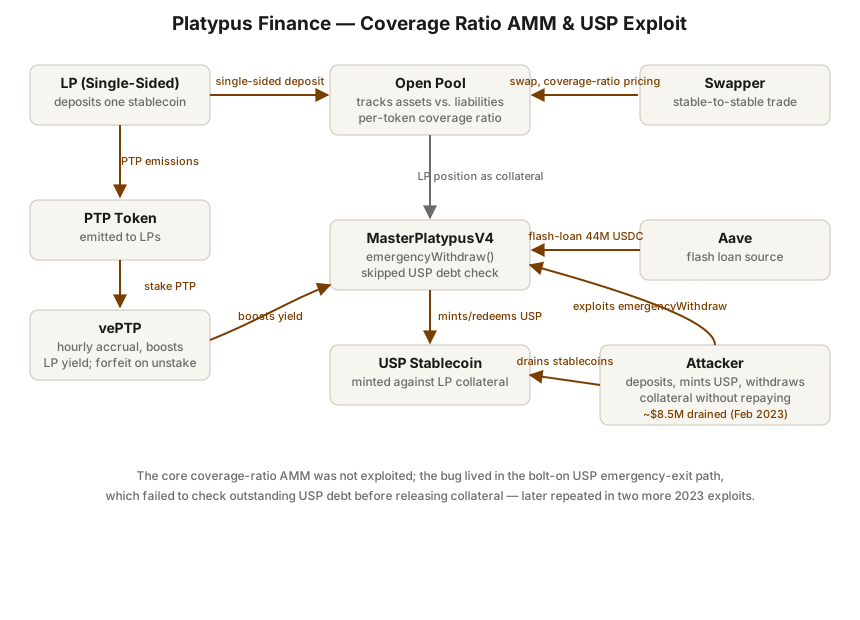 Open full-size diagram
Summary
Platypus Finance was a stableswap AMM on Avalanche that replaced Curve's paired-pool model with a "single-sided" open liquidity pool: LPs deposited one asset (e.g., only USDC), and the protocol tracked each asset's assets-vs-liabilities via a per-token coverage ratio rather than a constant-function invariant. Launched on alpha mainnet on November 29, 2021 and backed by Three Arrows Capital, DeFiance Capital, and Avalaunch (a ~$3.3M private round), it rode the Avalanche bull cycle to a peak TVL of roughly $1.2B in March 2022 and a top-five position on the chain. Its trajectory reversed violently in 2023: an $8.5–9M flash-loan exploit in February (days after launching its USP stablecoin), a ~$51K exploit in July, and a ~$2.2M triple flash-loan attack in October. TVL fell below $10M, the PTP token was migrated/renamed (to "JACK") in mid-2024 with exchange delistings, and the website is no longer reachable as of 2026.
Design (Mechanism)
- Single-sided liquidity with asset-liability management. Instead of requiring balanced pairs, Platypus treated each stablecoin as its own account with recorded "liabilities" (LP deposits) and "assets" (actual cash on hand). The coverage ratio (assets ÷ liabilities) per token drove pricing: swaps that pushed a token's coverage down incurred slippage penalties; swaps that restored coverage received positive slippage. This let all stablecoins share one open pool, improving capital efficiency and eliminating impermanent loss in the classic sense (LPs stayed denominated in their deposit asset, bearing "coverage risk" instead).
- PTP / vePTP incentives. The PTP token (300M supply) was emitted to LPs. Staking PTP accrued non-transferable vePTP over time (a Curve-inspired but distinct design: continuous hourly accrual per staked PTP rather than time-locking, fully forfeited on unstake), which boosted LP yields — spawning a mini "Platypus war" of aggregators (e.g., Vector, Echidna) competing for boost.
- USP stablecoin. In February 2023 Platypus launched USP, an over-collateralized stablecoin minted against LP positions, intended to add a money-market layer atop the swap pool.
- The fatal flaw: the USP MasterPlatypusV4 contract's
emergencyWithdrawperformed an incorrect solvency check that ignored a user's outstanding USP debt. The attacker flash-loaned 44M USDC from Aave, deposited it as LP collateral, minted ~41.7M USP, then emergency-withdrew the collateral without repaying — walking away with ~$8.5M in stablecoins.
Outcome
Exploited (protocol effectively dead). After peaking at ~$1.2B TVL (March 2022), the February 16–17, 2023 exploit broke USP's peg and user confidence. Recovery was partial and unusually colorful: much of the loot was stuck in the attacker's contract (it lacked a withdrawal function), Tether froze USDT, and BlockSec assisted a counter-recovery of a large USDC tranche; a compensation plan followed. Two further exploits followed: ~$51K in July 2023 (stablecoin price-gap logic) and ~$2.23M on October 12, 2023 (flash-loan-induced sAVAX/WAVAX price imbalance with faulty slippage logic), of which ~90% was returned, leaving a net loss of ~18,000 AVAX. TVL never recovered (<$10M by late 2023); in June 2024 exchanges processed a PTP migration/rename to "JACK," and the official site is offline as of mid-2026.
Why it worked
- Real capital-efficiency gains. The asset-liability/coverage-ratio model genuinely delivered lower slippage per dollar of TVL than paired pools for stable-to-stable swaps, and single-sided deposits removed the biggest UX barrier to LPing.
- Right chain, right time. Launching on Avalanche during the Avalanche Rush incentive era with marquee backers (3AC, DeFiance, Avalaunch) gave it immediate liquidity and attention.
- veTokenomics flywheel. The vePTP boost created a secondary ecosystem of yield aggregators locking PTP, temporarily reinforcing demand for the token and stickiness of TVL.
Where the design broke
- One unaudited-in-practice code path destroyed the system. The novel core AMM survived; the bolt-on USP stablecoin's
emergencyWithdrawsolvency check was the hole. Complexity added at the periphery, days old, carried systemic risk to the whole pool. - Three logic bugs in one year, not one. Distinct flaws (a solvency check, a price-gap handler, and a slippage sign error) surfaced across the same protocol within twelve months — evidence that new modules were shipped without invariant testing adequate to a system holding nine figures of TVL.
- Novel invariants have novel attack surfaces. Coverage-ratio pricing and single-sided accounting had no battle-tested reference implementation; flash loans weaponized every mispriced edge case.
- Token design amplified the downside. vePTP's forfeit-on-unstake accrual concentrated reflexive sell pressure once confidence broke — there was no reason to hold PTP when boosted yields on a drained pool were worthless.
Lessons
- A protocol's risk is the max over all its modules, not the average. LPs in the "safe" stableswap pool were exposed to a brand-new stablecoin contract's bug; shared-collateral architectures need strict blast-radius isolation between products.
- Solvency checks must be computed against full liabilities at the exact state of withdrawal. The canonical Platypus bug — an emergency exit path that skipped debt accounting — recurs across DeFi; emergency functions deserve more scrutiny than happy paths, not less.
- Flash loans convert any logic error into a full-size drain. Any invariant that can be temporarily distorted by a large atomic position (coverage ratios, staked/liquid price gaps) must be validated under adversarial max-size assumptions.
- On-chain forensics can trace an attacker fast, but tracing is not recovery. Sleuthing (ZachXBT/Binance) identified the flow of funds quickly, yet identification alone did not make victims whole — code-level prevention remains the only dependable defense.
- Recovery theater can't rebuild trust. Even with most funds frozen/returned across incidents, cumulative reputational damage compounded: TVL declined monotonically after each exploit regardless of recovery percentage.
Redesign (EDITORIAL — hypothesis, not fact)
This section is editorial hypothesis, not established fact. A revived Platypus-style design should keep the coverage-ratio AMM — it was genuinely capital-efficient and was not the root failure — but change three things. First, module isolation: the stablecoin (USP) should have minted only against segregated vault collateral, never against live AMM LP positions, so a CDP bug cannot drain swap liquidity; each product gets its own capped collateral domain. Second, invariant guards at the exit: every withdrawal path (including emergency paths) should enforce a single shared solvency invariant ("post-withdrawal assets ≥ liabilities including user debt") checked by one audited library, plus circuit breakers that pause withdrawals when per-block outflows or coverage-ratio deltas exceed thresholds — this would have blunted all three 2023 attacks, which each required large atomic state distortion. Third, incentive hardening: replace forfeit-on-unstake vePTP with time-decaying locks whose emissions scale with protocol fee revenue rather than raw TVL, dampening the mercenary-liquidity flywheel that made the peak TVL (and thus the honeypot) far larger than organic demand justified. The deeper hypothesis: single-sided, asset-liability AMMs are viable (Wombat and others iterated on the model), but they must be engineered like banks — with a balance-sheet invariant enforced globally — rather than like pools with local checks.
Sources
- Platypus Finance GitHub organization (links official site and X) — primary (docs)
- Platypus Testnet is Here (official Medium) — primary (docs)
- Platypus: PTP Token contract on Snowtrace — primary (contract)
- Immunefi — Hack Analysis: Platypus Finance, February 2023 (analysis)
- BlockSec — Platypus Finance: Surviving Three Attacks with a Stroke of Luck (analysis)
- DL News — How third hack of the year walloped Platypus Finance investors for $1.6m (news)
- Cointelegraph — Platypus Finance recovers 90% of assets lost in exploit (Oct 2023) (news)
- DefiLlama — Platypus Finance TVL (analysis)
- CoinEx — Will Support PTP Token Migration and Rename (June 2024) (news)
- Avalaunch — Platypus AMA #1: Project Overview with Mr. Duckbill, Founder (archive)
Related experiments
Last verified: 2026-07-26 · Spot an error? Suggest a correction