Humanode
A Substrate-based, EVM-compatible Layer 1 where Sybil resistance comes from private biometric proof-of-uniqueness: one living human = one validator node = one vote, with equal rewards and a cost-based fee system.
▶ Run interactive simulation animated mechanism with editable parameters
How it works onchain
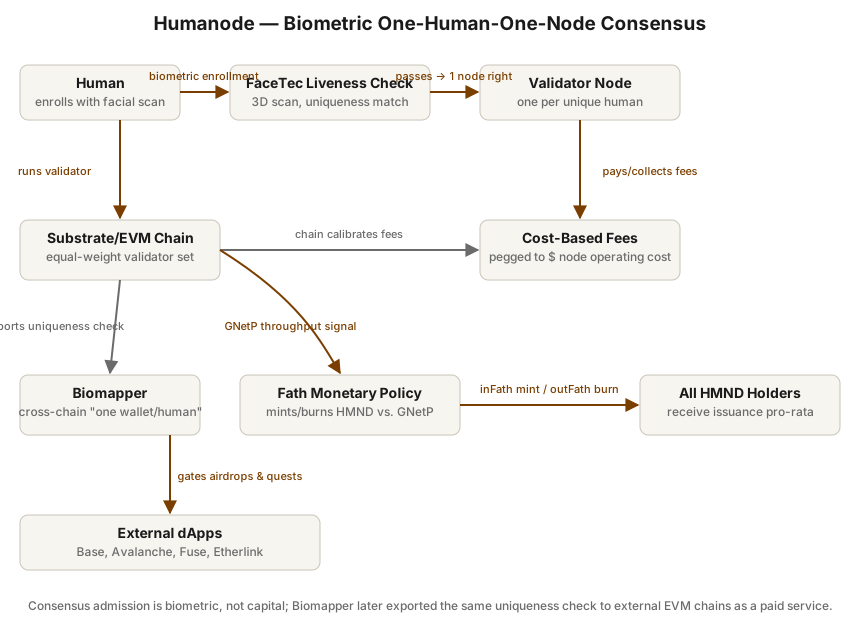 Open full-size diagram
Summary
Humanode is an attempt to replace capital-weighted Sybil resistance (proof-of-work hardware, proof-of-stake tokens) with biometric proof of unique human existence. Conceived around September 2020 by Dato Kavazi and Victor Smirnov (previously of the Paradigm research institute) and specified in a November 2021 whitepaper titled "You are [not] a bot," the project launched its mainnet on November 15, 2022 as an EVM-compatible Substrate chain. Any living, biometrically unique human can pass private facial scan + liveness verification (using FaceTec's technology, with encryption/ZK/secure-enclave protections so raw biometrics never touch the chain) and become a validator — one human, one node, one equal vote and one equal share of rewards. The network launched with 100 validators and targeted 1,000 within weeks (its long-term goal was one million human nodes). The stack was later extended with Biomapper, a service letting dApps on external EVM chains (Base, Avalanche, Fuse, Etherlink, Shardeum) check "one human = one wallet" without KYC. The chain runs and the biometric mechanism has held up, but the HMND token collapsed (down ~99.7% from all-time high; market cap around ~$0.5M in mid-2026), making it a case of a working mechanism without a working economy.
Design (Mechanism)
- Consensus admission via biometrics, not capital. To run a validator, a person completes crypto-biometric enrollment: 3D facial scan with liveness detection (FaceTec), matched against existing enrollments to guarantee uniqueness. Passing grants the right to launch exactly one node. Raw biometric data is claimed never to leave the user's device unencrypted; matching uses cryptographically secure comparison, with ZK proofs and confidential-computing enclaves in the design.
- Egalitarian validation. Every human node has identical voting weight and receives an identical share of validator rewards — there is no stake-weighting, no delegation market, no mining arms race. Sybil resistance of consensus is exactly the false-accept rate of the biometric pipeline; the project maintained an unclaimed Sybil bounty over multiple years.
- Cost-based fees. Instead of demand-driven fee auctions, the protocol targets fees pegged to the real (dollar-denominated) operating costs of running nodes: it estimates average validator expenses and calibrates fees/rewards to cover them, aiming for predictable, stable transaction pricing.
- Fath monetary policy. Supply is algorithmic and reflexive: if Gross Network Product (on-chain economic throughput) grows, tokens are minted ("inFath"); if it contracts, supply burns ("outFath"). Issuance is distributed proportionally to all holders rather than to a privileged validator/staker class, so monetary expansion does not dilute non-validators.
- EVM + Substrate. The chain is a standalone Substrate L1 with an EVM execution layer, so ordinary Solidity contracts deploy on a human-powered validator set.
- Biomapper (expansion product). A cross-chain attestation layer: a user biomaps a wallet via Humanode's biometric check, and dApps on integrated EVM chains query an on-chain contract to enforce one-wallet-per-human for airdrops, quests, and governance — privacy-preserving Sybil resistance as a service, competing with Worldcoin/Proof-of-Humanity-style personhood systems but with no PII stored and no hardware orb.
Outcome
Technically operational and long-lived: mainnet has run continuously since November 2022, scaled from 100 toward ~1,000 human validator nodes (fee distribution in later cycles was calibrated for 1,000 nodes), and the biometric uniqueness layer has not suffered a publicized Sybil breach. The team raised roughly $2–3M (Republic Capital lead, with Shima, Tribe, Crypto.com Capital, Wintermute and others) — modest by L1 standards. Biomapper achieved real third-party integrations (Base, Avalanche, Fuse, Etherlink, Shardeum airdrop protection). Commercially, however, HMND failed to find demand: the token fell from a $0.5294 all-time high to fractions of a cent, with 2025 alone taking the price from ~$0.096 to ~$0.0058, and a mid-2026 market cap around $0.5M on ~205M circulating supply — effectively microcap status. The chain never attracted a meaningful dApp economy of its own, which also starves the Fath mechanism (GNetP-linked issuance) of the growth signal it was designed around. Status: ongoing as software, but commercially unsuccessful to date.
Why it worked
- The core mechanism did what it promised. Biometric one-human-one-node consensus is genuinely novel and it ran in production for years without a demonstrated Sybil compromise — validating that liveness-checked facial biometrics can gate a permissionless validator set.
- Outsourcing the hardest part. Licensing FaceTec's battle-tested 3D liveness (used in banking KYC) rather than building biometrics in-house gave credible false-accept rates from day one.
- Egalitarian economics attracted validators. Equal rewards with near-zero capital requirements made running a node accessible globally, which is why validator growth (100 → ~1,000) was the project's fastest-moving metric.
- Pivot to Biomapper found the actual market. Sybil resistance is more valuable as a service to other chains (airdrop/quest gating) than as a property of a new L1 — the integrations on Base, Avalanche, Fuse, etc. were the project's clearest product-market signal.
Where the design broke
- Sybil-resistant consensus is not a user-facing feature. Developers and users choose chains for liquidity, tooling, and ecosystem — not for how egalitarian the validator set is. Humanode's differentiator solved a problem (validator plutocracy) that few dApp builders were paying for.
- Cold-start L1 economics. With no flagship applications, GNetP stayed low, fees stayed negligible, and equal validator rewards were spread thin — the elegant monetary design had almost no economic activity to govern.
- Personhood market squeeze. Worldcoin (massive funding, hardware distribution) and lighter-weight attestation stacks (Gitcoin Passport, etc.) compressed the proof-of-personhood niche from both ends.
- Vendor and infrastructure dependencies. Reliance on a proprietary vendor (FaceTec) and confidential-computing infrastructure means uniqueness verification runs through centralized technical chokepoints outside the validator set's control — a structural feature shared by other biometric PoP designs.
- Token collapse became self-reinforcing: a ~$0.5M market cap makes validator rewards economically meaningless, weakening the incentive loop that was supposed to grow the human-node count toward one million.
Lessons
- A Sybil-resistance mechanism is a feature, not a chain. The market rewarded Humanode's capability only when it was repackaged as a cross-chain service (Biomapper); launching a sovereign L1 around it added the entire cold-start burden of an ecosystem for little marginal benefit.
- Egalitarian reward schemes need an economy to distribute. Equal pay per validator is only meaningful if fee revenue is substantial; cost-based fees on a low-activity chain converge to paying everyone approximately nothing.
- Novel monetary policy (Fath) cannot bootstrap demand; it can only shape it. Reflexive, GNetP-indexed issuance is a thermostat — it needs a fire (real usage) before it has anything to regulate.
- Proof-of-personhood competes on distribution, not elegance. Worldcoin's orb logistics were cruder but its distribution (capital, app, airdrop) dominated; the technically cleaner privacy story did not win users by itself.
- Vendor-dependent biometrics create a decentralization asterisk. If uniqueness verification depends on one company's proprietary liveness SDK, the validator set is permissionless in theory but supply-chain-centralized in practice.
Redesign (EDITORIAL — hypothesis, not fact)
The following is editorial hypothesis, not fact. A redesigned Humanode would skip the sovereign L1 entirely and launch as what Biomapper eventually became: a chain-agnostic personhood attestation protocol with the biometric verification set (the "human nodes") acting as a decentralized oracle/attestation committee rather than as block producers. Revenue would come from per-attestation fees paid by integrating dApps and chains (airdrops, quests, one-person-one-vote governance), distributed equally among verifier nodes — preserving the egalitarian ethos where it matters while attaching it to demand that actually exists. The FaceTec dependency should be mitigated by a multi-vendor liveness scheme (2-of-3 independent biometric pipelines must agree) plus a standing, publicly auditable Sybil bounty as a live security metric. Fath-style reflexive issuance could be retained but indexed to attestation volume rather than chain GNetP, so token supply tracks the one metric the protocol truly controls. If a chain is still desired later, it can be an appchain settling attestation proofs — launched only after the attestation business demonstrates recurring demand.
Sources
- Humanode Mainnet is Live! (official blog) — primary (docs)
- Humanode Whitepaper — Fath: A Reflexive, Egalitarian Monetary Protocol — primary (docs)
- Humanode Fee Distribution mechanism (official blog) — primary (docs)
- Private On-chain Biomapping (Biomapper) for enabling Sybil checks on EVM — primary (docs)
- Humanode Whitepaper: You are [not] a bot (2021) — primary (docs)
- What is Humanode? An Overview of the Human-Powered Blockchain — Republic (analysis)
- Humanode selects FaceTec biometrics and liveness — Biometric Update (news)
- Humanode (HMND) price and market cap — CoinGecko (analysis)
- Humanode: The First Crypto-Biometric Network (ACM paper) (analysis)
Related experiments
Last verified: 2026-07-26 · Spot an error? Suggest a correction