Solayer
Solana-native restaking protocol that monetized stake-weighted quality of service (blockspace priority) instead of Ethereum-style slashable security, then pivoted into a hardware-accelerated SVM L1 (InfiniSVM) as restaking demand faded.
▶ Run interactive simulation animated mechanism with editable parameters
How it works onchain
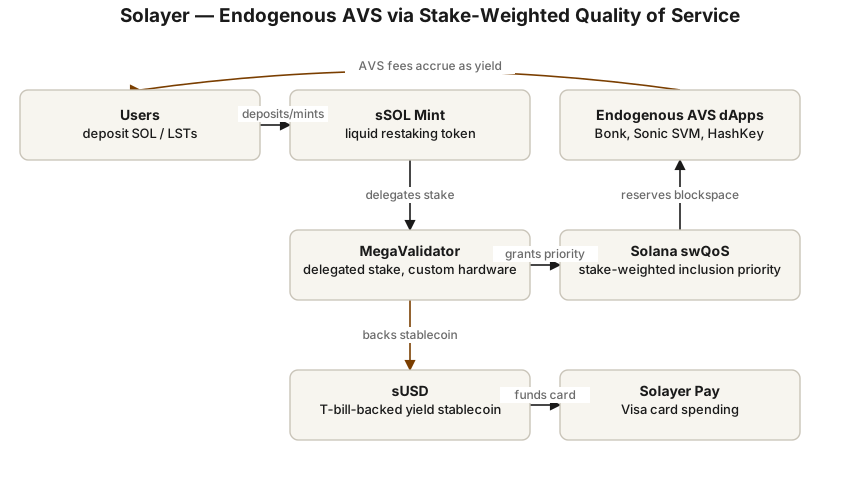 Open full-size diagram
Summary
Solayer was the first significant attempt to port Ethereum's restaking narrative to Solana — and, notably, the first to admit that a literal port made no sense. Founded in early 2024 by Rachel Chu (ex-Sushiswap core developer, ex-Sequoia scout) and Jason Li, Solayer Labs raised a $12M seed led by Polychain (with Binance Labs and Solana co-founder Anatoly Yakovenko among backers) and opened restaking deposits in May 2024, pulling in over $24M within hours of its soft launch. Instead of selling slashable cryptoeconomic security to external networks the way EigenLayer does, Solayer invented the "endogenous AVS": restaked SOL is delegated to Solayer's high-performance validator, and the resulting stake weight is rented out to Solana dApps as guaranteed blockspace via Solana's stake-weighted quality of service (swQoS) mechanism. The product suite grew to include sSOL (liquid restaking token), sUSD (a T-bill-backed yield stablecoin), a Visa card (Solayer Pay), and the LAYER governance token, which listed on Binance in February 2025 at a $1.3B FDV. As Solana restaking demand plateaued, Solayer pivoted hard into building InfiniSVM, a "hardware-accelerated" SVM Layer 1 claiming 300k+ TPS on devnet, with an alpha mainnet live since January 2026 and a $35M ecosystem fund. The protocol survives with meaningful TVL ($150M+ reported in 2026), but LAYER trades roughly 97% below its May 2025 all-time high.
Design (Mechanism)
Restaking without slashing. Users deposit SOL or supported LSTs and receive sSOL (mint: sSo14endRuUbvQaJS3dq36Q829a3A6BEfoeeRGJywEh), which accrues native staking yield, MEV rewards, and AVS payments while remaining composable across Solana DeFi. The deposited stake is delegated to Solayer's MegaValidator, a validator optimized with custom hardware and MEV strategies.
Endogenous AVS + swQoS. Solana natively allocates transaction-inclusion priority to validators proportionally to stake (stake-weighted quality of service). Solayer's insight was that this made stake itself a bandwidth commodity: dApps ("endogenous AVSs" — early adopters included Bonk, Sonic SVM, and HashKey) attract sSOL delegation and in exchange get prioritized transaction landing through Solayer's validator during congestion — effectively reserving blockspace. Because these AVSs are ordinary Solana programs rather than external networks borrowing security, slashing is disabled; the "service" sold is throughput priority, not honest-behavior collateral.
sUSD. A yield-bearing stablecoin fully backed by U.S. Treasury bills, paying roughly 4–5% APY, integrated with Solayer Pay for card spending — an RWA leg bolted onto the restaking stack.
LAYER token. 1B supply; launched February 11, 2025 via Binance's HODLer Airdrop program (12% of supply allocated to airdrops) with a large majority of supply subject to multi-year vesting.
InfiniSVM pivot. From its 2025 roadmap onward, Solayer repositioned as an L1: InfiniSVM disaggregates the SVM execution pipeline across specialized hardware clusters connected by RDMA/InfiniBand, claiming 300k+ sustained TPS and sub-second finality, with sSOL and sUSD as native assets.
Outcome
Ongoing, with a sharply bifurcated record. The restaking product was an immediate commercial success by deposit metrics — $24M in hours, TVL reportedly reaching the hundreds of millions at peak, and roughly $150M+ still locked in 2026 — making Solayer the dominant Solana restaking venue. The token was not: after listing at $1.3B FDV and touching an all-time high near $3.39 in May 2025, LAYER collapsed ~97% to roughly $0.08 ($39M market cap) by spring 2026, pressured by heavy unlock overhang (~79% of supply still vesting) and fading restaking narrative demand. The company itself kept shipping: InfiniSVM devnet (2025), alpha mainnet with reported 330k TPS (January 2026), and a $35M ecosystem fund. Whether the L1 pivot finds real demand remains open.
Why it worked
- It adapted the mechanism to the chain rather than copying it. Ethereum restaking sells slashable security to external networks; Solana has no comparable AVS demand, but it does have congestion. Selling swQoS bandwidth turned an existing, native protocol property into a rentable resource with real buyers (dApps that need transactions to land).
- Narrative timing. It launched at the peak of the 2024 restaking meta with EigenLayer as the reference point, first-mover branding on Solana, and top-tier backers (Polychain, Binance Labs, Yakovenko), which converted directly into deposits.
- No-slashing design lowered depositor risk. Because endogenous AVSs carry no external fault conditions, restakers faced essentially LST-like risk for extra yield — an easy sell.
Limitations and criticisms
- The core service is thin. swQoS priority is valuable during congestion, but it is a commodity any large validator can sell, and Solana's own performance improvements (plus priority fees) shrink the willingness to pay. "Restaking" branding implied a security marketplace that never really existed on Solana.
- Token–product disconnect. TVL and revenue have not mapped to LAYER value accrual, and a ~13% initial float with ~79% of supply vesting created structural sell pressure; the token has lost ~97% from its high even as the product kept operating — a stark reminder that deposit metrics and token price can diverge completely.
- Rapid product-line changes compress the time available to prove any one of them out. Restaking → stablecoin/payments card → hardware-accelerated L1 in under two years means each new line launches before the prior one has established a defensible position, and InfiniSVM enters an extremely crowded high-TPS L1 field where benchmark claims are cheap and unproven demand remains the open question.
Lessons
- Restaking is not one mechanism but a family: what is actually being resold — slashable collateral, blockspace priority, validator reputation — depends on the host chain's architecture. Solayer's endogenous-AVS/swQoS framing is the clearest existence proof that "restaking" must be re-derived per chain.
- Deposits follow airdrop expectations; only fees prove demand. Nine-figure TVL secured in a points meta says little about whether AVSs/dApps will pay recurring, market-rate fees for the service.
- A token launched at billion-dollar FDV with ~80% supply locked converts future unlocks into a permanent price ceiling — and a collapsing token chart taxes every subsequent product launch, however solid.
- Pivoting from middleware to an L1 raises the difficulty level enormously: middleware inherits its host chain's users; an L1 must bootstrap them, which is why the $35M ecosystem fund exists.
Redesign (EDITORIAL — hypothesis, not fact)
This section is editorial hypothesis, not a factual account. A tighter design would treat swQoS bandwidth as an explicit, priced market rather than a yield wrapper: an on-chain auction where dApps bid for guaranteed transaction-inclusion capacity per epoch, with proceeds streamed pro-rata to sSOL holders — making the yield legible as fee revenue instead of subsidized points. Slashing could be reintroduced narrowly as a service-level bond: the validator posts stake that is forfeited to AVS customers if promised inclusion latency is missed, giving the "restaking" label real teeth. Token design should have deferred TGE until fee revenue existed, launched at a small fraction of the FDV with float above 50%, and tied emissions to bandwidth actually sold. Finally, rather than a standalone InfiniSVM L1, the hardware-acceleration work might have been more defensible as a network extension of the MegaValidator business — selling ultra-low-latency execution lanes to Solana-native trading apps — keeping the moat (stake + hardware + Solana distribution) intact instead of competing with every high-TPS chain simultaneously.
Sources
- Solayer official site — primary (docs)
- Solayer Docs (sSOL, MegaValidator, sUSD, InfiniSVM, swQoS) — primary (docs)
- sSOL token mint on Solscan — primary (contract)
- LAYER token mint on Solscan — primary (contract)
- Solayer's Solana restaking platform is live (news)
- Solayer launches Solana's first restaking protocol, securing $24.2M in deposits (news)
- Solana restaking protocol Solayer closes $12M round led by Polychain (news)
- Binance announces Solayer (LAYER) HODLer Airdrop and listing (Feb 11, 2025) (news)
- Solayer launches InfiniSVM devnet (PR Newswire) (news)
- Solayer and Hack VC: InfiniSVM breaking 300,000+ TPS with <50ms finality (news)
- SVM-powered Solayer launches $35M ecosystem fund on heels of alpha mainnet launch (news)
- Solayer project review (Solana Compass) (analysis)
- What Is Solayer (LAYER)? (Binance Academy) (analysis)
- Rachel Chu (IQ.wiki) (analysis)
Related experiments
Last verified: 2026-07-27 · Spot an error? Suggest a correction