Kaito (InfoFi)
AI-powered 'InfoFi' platform that quantified crypto social attention as 'Yaps' and 'mindshare,' distributed a token airdrop and launchpad allocations against those scores, then had to sunset its post-to-earn engine when X banned pay-to-post apps in January 2026.
▶ Run interactive simulation animated mechanism with editable parameters
How it works onchain
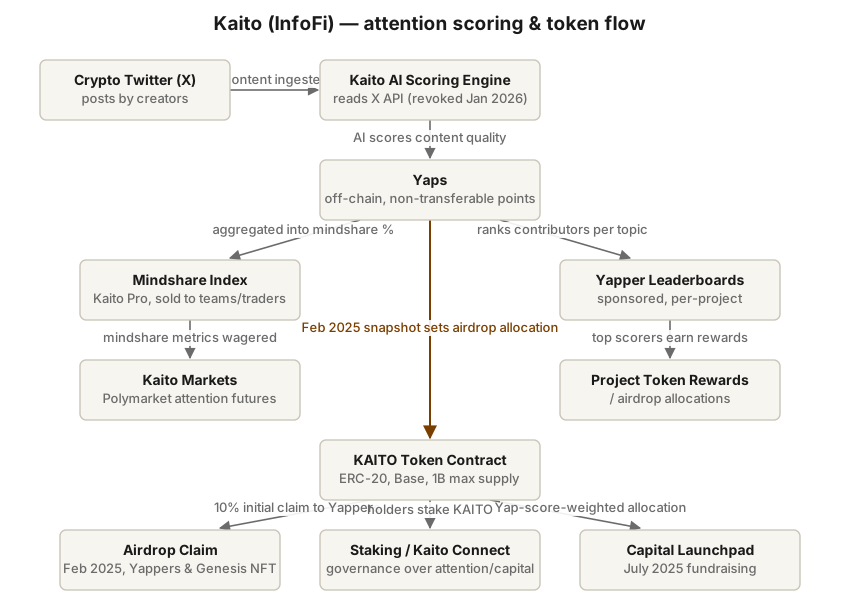 Open full-size diagram
Summary
Kaito began around 2021–2022 as an AI-powered search and market-intelligence engine for crypto (Kaito Pro), founded by Yu Hu, a former Citadel portfolio manager. In December 2024 it launched Yaps, a "tokenized attention" points system that used AI to score the quality and reach of crypto content on X, and coined the category name InfoFi (information finance): the idea that attention itself can be measured, ranked, priced, and paid for by market mechanisms rather than opaque platform algorithms. Yaps leaderboards became the dominant coordination layer for crypto marketing in 2025 — projects paid for "Yapper Leaderboard" campaigns, and the KAITO token (ERC-20 on Base, launched February 20, 2025) was airdropped to scorers of attention rather than performers of tasks. In January 2026, X changed its developer policy to ban apps that pay users to post and revoked API access, forcing Kaito to sunset Yaps and pivot to Kaito Studio (cross-platform creator marketing), a Capital Launchpad, and attention prediction markets with Polymarket.
Design (Mechanism)
- Yaps (AI-scored attention points). Kaito's models ingested Crypto Twitter and scored posts on volume, engagement, semantic quality, and the author's position in the social graph, attempting to reward "smart followers" and insight over raw engagement farming. Scores were public, non-transferable points ("Yaps") accruing to X accounts.
- Mindshare. Kaito aggregated attention into per-project "mindshare" percentages — a share-of-voice index for narratives and tokens — sold to teams and traders via Kaito Pro (reported at roughly $33M annualized revenue by the time of the Yaps sunset).
- Yapper Leaderboards. Projects ran sponsored leaderboards where top-scored contributors on a topic earned that project's token rewards or airdrop allocations — effectively a two-sided attention marketplace with Kaito as scorer and clearinghouse.
- KAITO token and airdrop. 1B max supply on Base (contract 0x98d0…7553). The February 2025 airdrop allocated 10% to the initial community (Yappers, Genesis NFT holders, ecosystem partners), with Yu Hu describing the design as using "AI as the true, unbiased arbiter of alignment" — rewarding pre-existing quality contribution rather than farmable tasks. Docs-published allocation: 32.2% ecosystem/network growth, 25% core contributors, 10% foundation, 10% initial claim, 8.3% early backers, 7.5% long-term creator incentives, 5% liquidity, 2% Binance HODLer.
- Staking and governance (Kaito Connect). Voting rights derive from staked KAITO; the stated goal was a market-governed network deciding where attention and capital flow. Yu Hu personally bought and staked 1M KAITO.
- Capital Launchpad (July 2025). Community crowdfunding where allocations weighted social reputation and Yap scores; early sales (Espresso, Theoriq) raised ~$6M combined.
Outcome
Yaps grew to roughly 157,000 scored "Yappers" and made Kaito the de facto pricing layer for crypto attention in 2025; dozens of major token launches routed marketing budgets through leaderboards. But the whole scoring engine depended on X's API. In mid-January 2026, X revised developer policies to prohibit rewarding users for posting — a rule aimed squarely at InfoFi — and revoked access. On January 15, 2026, Yu Hu announced the sunsetting of Yaps; KAITO fell ~17% to about $0.57 that day (well below its early-2025 highs). The company pivoted: Kaito Studio (selective, cross-platform creator marketing across X, YouTube, TikTok), Kaito Markets with Polymarket (wagering on mindshare metrics, ~$1.3M in pilot volume by spring 2026), plus the Launchpad and the still-revenue-generating Kaito Pro. The company survives and remains well-capitalized (backers include Dragonfly, Sequoia China, and Jane Street per the founder's own bio), but the original permissionless post-to-earn experiment is dead.
Why it worked
- It priced something everyone already traded implicitly. Crypto marketing budgets, airdrops, and KOL deals were being allocated by vibes; Kaito offered a legible, comparable score, and both sides (projects and creators) adopted it because it reduced search costs.
- Airdrop-by-merit was a genuine innovation. Rewarding retrospectively measured contribution instead of farmable checklists made the KAITO airdrop unusually hard to sybil in advance and generated enormous goodwill and mindshare of its own.
- Real underlying business. Unlike most points programs, the scores were a byproduct of a paid intelligence product (Kaito Pro), so the token sat on top of actual revenue rather than pure reflexivity.
Where the design broke
- Fatal platform dependency. The entire measurement substrate was X's API. When X banned pay-to-post apps, the core loop died overnight — a risk that was structural, not incidental, since Kaito monetized X's content without controlling it.
- Goodhart's law at scale. Public scores plus liquid rewards made low-quality, AI-generated "yapping" individually rational; the resulting spam wave on X was arguably what provoked the platform crackdown. The mechanism manufactured its own regulator.
- Attention inflation. As every launch bought a leaderboard, the signal value of mindshare degraded, and creator rewards concentrated among professionalized yappers rather than the emerging voices the system claimed to elevate.
Lessons
- A mechanism that measures activity on a platform it does not control inherits that platform's policy risk as an existential, uninsurable dependency.
- Making a reputation score public and directly monetizable converts it into a target; scoring systems need either private components, stake-at-risk, or diminishing returns to survive Goodhart pressure.
- Retrospective, AI-judged reward distribution is a stronger sybil filter than prospective task-based farming — but only for the first round, before participants learn the judge.
- "InfoFi" as a category can outlive any one venue: pricing attention via prediction markets (attention futures) is more platform-robust than paying for posts.
- A token layered on a real revenue-generating product degrades more gracefully than a pure points token when the incentive loop breaks.
Redesign (EDITORIAL — hypothesis, not fact)
This section is editorial speculation. A more robust InfoFi design would (1) diversify measurement across many venues (X, YouTube, Farcaster, onchain activity) from day one so no single API revocation is fatal, and prefer open or self-hosted social graphs for the scoring substrate; (2) keep raw scores private or coarse-grained, exposing only campaign-specific rankings, to blunt spam optimization; (3) require creators to stake against their own scores, with slashing for content later flagged as AI-spam, converting pure subsidy into a skin-in-the-game attestation market; and (4) route rewards through the prediction-market layer — pay creators from the settlement of attention futures they demonstrably moved — so the payment is for verified impact rather than volume of posting. Kaito's post-2026 pivot (Studio + Polymarket attention markets) is, in effect, a partial concession to exactly this architecture.
Sources
- Kaito Docs — InfoFi introduction — primary (docs)
- Kaito Docs — KAITO Tokenomics — primary (docs)
- KAITO token contract on BaseScan — primary (contract)
- Yu Hu — 'Sunsetting Yaps & Introducing Kaito Studio' — primary (retrospective)
- Yu Hu — on the Kaito airdrop's AI-arbiter design — primary (retrospective)
- The Block — Kaito token airdrop claims for 'Yappers' go live on Base (news)
- BlockEden — Kaito After YAPS: How X Killed Crypto's First Attention Economy (analysis)
- OAK Research — Kaito: complete overview of the first attention market (analysis)
- CoinGecko Learn — What Is Kaito? 2026 Guide to Studio, Markets & KAITO Token (analysis)
- crypto.news — Kaito to launch Capital Launchpad (news)
Related experiments
Last verified: 2026-07-27 · Spot an error? Suggest a correction