Karak Network
A universal restaking protocol letting any asset (not just ETH/LSTs) secure a marketplace of 'Distributed Secure Services,' which later rebranded/pivoted into 'OpenGDP,' a base layer for tokenizing real-world economies.
▶ Run interactive simulation animated mechanism with editable parameters
How it works onchain
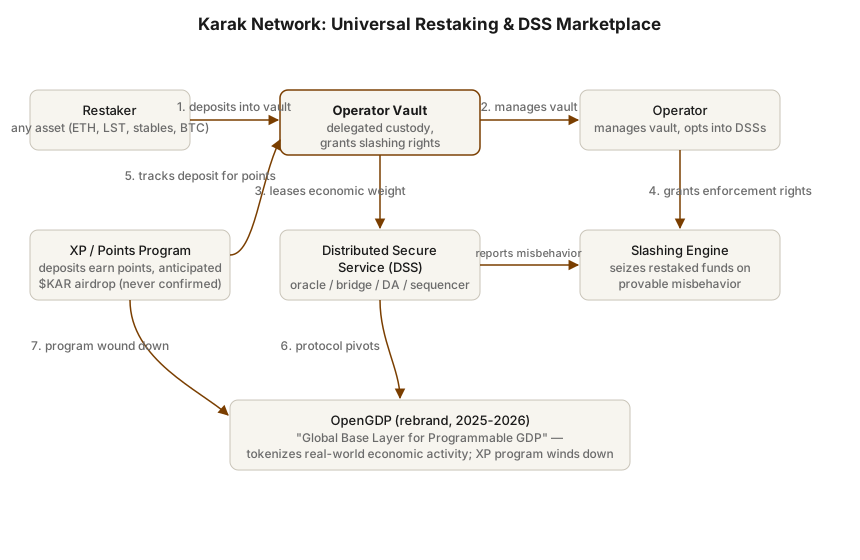 Open full-size diagram
Summary
Karak Network was a "universal restaking" protocol built by Andalusia Labs, positioning itself as a broader alternative to EigenLayer: instead of restaking only ETH and liquid staking tokens, Karak let users deposit almost any asset — stablecoins, LP tokens, LSTs, BTC-pegged assets — into operator-run vaults, whose pooled economic weight could then be leased out to secure third-party infrastructure (oracles, bridges, data availability layers, sequencers). The team raised over $48M in a Series A from Coinbase Ventures, Pantera Capital, Lightspeed, Framework, Mubadala Capital, and Digital Currency Group, and ran a large points/XP farming campaign starting in April 2024 ahead of an anticipated $KAR token airdrop. By 2025-2026 the project rebranded to "OpenGDP," repositioning itself from a narrow restaking marketplace to a broader "base layer for programmable GDP" aimed at tokenizing and settling real-world economic activity, while continuing to wind down the original restaking XP program.
Design (Mechanism)
Karak's core primitive was the vault: restakers deposit an asset into a vault run by an "operator," who then opts that vault's economic weight into one or more Distributed Secure Services (DSS) — the Karak term for any protocol that wants pooled crypto-economic security (e.g., an oracle network, a bridge, a data-availability layer, or an AI-inference verification service). By supporting a "basket" of arbitrary assets rather than just ETH/LSTs, Karak aimed to widen the collateral base available to new protocols and to reduce the systemic risk of any single asset's depeg or failure compromising a DSS.
Security was enforced via slashing: restakers granted operators/DSSs additional enforcement rights over their staked capital, so misbehavior (double-signing, downtime, invalid attestations, etc., depending on the DSS's own rules) could be penalized by seizing part of the restaked funds. This mirrors EigenLayer's actively-validated-services model but generalizes the collateral type and marketed itself as multi-chain from the outset (Ethereum mainnet plus L2s such as Arbitrum and Base), rather than Ethereum-mainnet-only.
Ahead of a token launch, Karak ran an Early Access/XP program: depositing assets into vaults earned points, which were widely assumed (though never contractually guaranteed) to translate into a future $KAR airdrop — the same points-farming growth loop used by EigenLayer, Symbiotic, and most other 2024-era restaking protocols.
Outcome
Karak reached meaningful scale during the 2024 restaking wave, with TVL reported near $1B at points in its growth cycle, driven substantially by points-farming deposits rather than organic DSS demand. The V2 mainnet and public restaking contracts shipped (github.com/karak-network/v2-contracts). However, no $KAR token generation event with confirmed tokenomics/date was found in this research pass ("Unknown / not found"), and by the time of this write-up the project had rebranded/pivoted to "OpenGDP," describing itself as "The Global Base Layer for Programmable GDP" — a materially different, broader positioning than "universal restaking," with the original XP program explicitly stated to be winding down. This makes the original restaking experiment's endpoint ambiguous: it neither clearly failed (contracts shipped, capital was raised and deployed) nor clearly delivered on its original restaking thesis as an independent, durable category leader — it pivoted before that thesis was fully proven out in the market.
Why it worked
- Riding the 2024 restaking narrative (post-EigenLayer mainnet) let Karak bootstrap significant TVL quickly via points/airdrop-farming incentives, a proven growth loop in that cycle.
- Broadening restakeable collateral beyond ETH/LSTs to "any asset" was a genuine differentiation angle versus EigenLayer, appealing to protocols/users who did not hold ETH-denominated assets.
- Strong VC backing (Coinbase Ventures, Pantera, Mubadala, DCG) provided capital and credibility during the fundraising and points-farming phase, and the team's prior track record (RiskHarbor) gave some domain credibility in DeFi risk management.
Where the design broke
- Karak entered a crowded field (EigenLayer, Symbiotic, and others) competing for the same restaking narrative and the same pool of yield/points farmers, making durable differentiation hard.
- "Universal" multi-asset restaking is harder to reason about from a security standpoint than ETH-only restaking — heterogeneous, less liquid, or more volatile collateral complicates slashing design and DSS risk assessment, a general critique leveled at multi-asset restaking designs industry-wide.
- Points-farming-driven TVL is mercenary capital; without clear, durable DSS revenue/demand independent of the airdrop incentive, TVL growth does not necessarily translate into a sustainable business — one plausible read of the eventual pivot away from "restaking" as the primary brand.
- The rebrand to "OpenGDP" and winding-down of the original XP program is consistent with the restaking-marketplace positioning proving insufficiently differentiated or sized to sustain a long-term core product, with scope broadened into real-world-economy tokenization instead.
Lessons
- "Universal" collateral support (any asset, not just ETH) trades away some of the security legibility that made EigenLayer's ETH-only restaking easier to reason about — broader is not automatically better for a security marketplace.
- Points/XP programs are effective at bootstrapping TVL quickly but attract capital that is loyal to the incentive, not the protocol; sustained demand from actual DSS customers is a separate, harder problem than farming-driven deposits.
- A project can raise substantial capital, ship working contracts, and accumulate real TVL, and still pivot its core positioning entirely before its original thesis is conclusively validated or invalidated by the market — outcomes in this space are not always resolved cleanly into "success" or "failure."
- Rebrands executed via clean domain redirects (karak.network → opengdp.network) and "nothing changes for users" messaging are a common pattern for repositioning a project without an explicit admission that the original narrow thesis underperformed.
Redesign (EDITORIAL — hypothesis, not fact)
EDITORIAL: One could hypothesize that Karak's restaking-marketplace design might have differentiated more durably by explicitly not competing head-on with EigenLayer on breadth of collateral, and instead focusing narrowly on a small number of high-value, hard-to-secure DSS use cases (e.g., cross-chain intent settlement, or AI-model-output verification) where multi-asset collateral is a genuine requirement rather than a marketing point — pairing that focus with revenue-sharing terms that reward long-term restakers over point-farmers (e.g., time-weighted or lock-up-weighted point accrual) to reduce mercenary-capital churn once the airdrop incentive expired.
Sources
- Karak Overview – Karak Docs — primary (docs)
- Karak V2 restaking contracts (GitHub) — primary (code)
- OpenGDP (formerly Karak) official site — primary (official site)
- Hello, GDP! — OpenGDP blog (rebrand announcement) — primary (blog)
- What is Karak Network? Multi-Chain Restaking Platform Explained — Gate Learn (explainer)
- Karak wants to introduce 'universal restaking' for everyone — Blockworks (news)
Related experiments
Last verified: 2026-07-27 · Spot an error? Suggest a correction