Symbiotic
A permissionless, modular restaking / shared-security protocol that lets networks rent economic security from vaults of arbitrary collateral, and the first restaking protocol to ship slashing in production.
▶ Run interactive simulation animated mechanism with editable parameters
How it works onchain
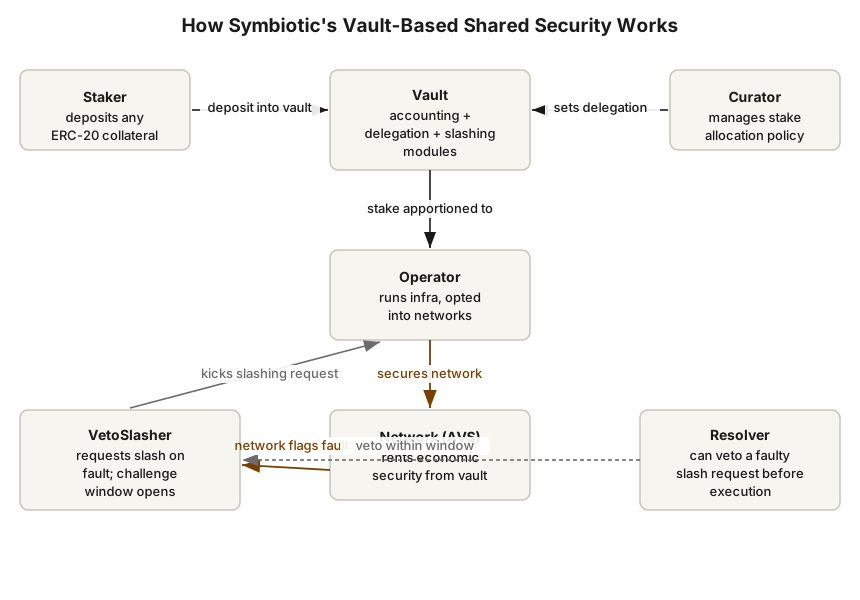 Open full-size diagram
Summary
Symbiotic is a shared-security ("restaking") protocol on Ethereum built by the team behind audit firm Statemind — co-founders Misha Putiatin (CEO, previously CEO of MixBytes) and Algys Ievlev (previously MixBytes CTO). It positions itself as a thin, permissionless coordination layer between three parties: stakers who deposit collateral into vaults, operators who run infrastructure, and networks that rent economic security backed by that collateral. Its core differentiators against EigenLayer were (1) any ERC-20 can serve as collateral, not just ETH derivatives; (2) fully modular, immutable core contracts with risk parameters pushed to the edges; and (3) being the first restaking protocol to ship working slashing in production. Backed by Paradigm and cyber.Fund in a $5.8M seed (June 2024) and a reported $29M Series A (January 2025, total funding $34.8M), Symbiotic opened collateral deposits in June 2024, hit roughly $1.4B TVL within weeks, and launched its full permissionless mainnet with slashing on January 28, 2025. By 2025–2026 it repositioned from "restaking" toward general "collateral markets" (Core V2, July 2026), underwriting insurance (Nexus Mutual), credit (Cap), and tokenized-asset settlement alongside PoS security.
Design (Mechanism)
The atomic unit is the vault: an on-chain container holding a single collateral token, composed of three swappable modules — accounting (deposits, withdrawal epochs, penalty processing), delegation (how stake is apportioned across networks and operators, often managed by a third-party curator), and slashing (validating and executing penalties). Key mechanisms:
- Epoch-based withdrawals. A withdrawal request stays slashable until the next epoch boundary, so networks get stable stake guarantees within an epoch while stakers retain predictable exit liquidity.
- Delegation topologies. Four delegator types trade capital efficiency against isolation: network-restake (max reuse across networks/operators), full-restake with per-operator limits, operator-specific, and operator-network-specific (max isolation).
- Slashing with veto. Two slasher types: an instant slasher, and a VetoSlasher that inserts a challenge window in which designated resolvers can veto faulty slash requests — a three-step request → veto → execute flow that lets networks bring their own fault definitions rather than conform to a protocol-wide standard.
- Collateral abstraction. Because slashing rights are separated from the underlying asset, collateral can be represented and even held outside the protocol, enabling multi-asset (LSTs, stablecoins, BTC derivatives like LBTC) and cross-chain security.
- Immutable, permissionless core. Anyone can deploy a vault, register a network, or onboard as an operator through factories/registries (VaultFactory, NetworkRegistry, OperatorRegistry) with no governance gatekeeping — Putiatin explicitly pitched "we don't have political influence" as the sales argument versus EigenLayer.
No token exists as of mid-2026; participation is incentivized by a points program with no contractual airdrop guarantee.
Outcome
Ongoing and substantial, though well behind the category leader. Deposits filled caps almost immediately in summer 2024 ($1.4B TVL vs EigenLayer's ~$15.5B at the time). The full mainnet with slashing arrived January 28, 2025 with over a dozen networks (Chainbound's Bolt, Router, Ethena components, etc.). By September 2025 it was the third-largest restaking platform ($1.28B TVL). It then pivoted its framing from restaking to "collateral markets": Nexus Mutual integrated Symbiotic for DeFi insurance capacity (November 2025), Cap for credit guarantees, plus Chainlink/Lombard collaboration for cross-chain LBTC security. Core V2 launched July 1, 2026, adding shared collateral for insurance, credit, and tokenized-asset settlement, claiming 80+ vaults, ~74,000 stakers, and 111 operators. The absent token remains a persistent overhang for point farmers.
Why it worked
- Credible security pedigree. Founders ran a top audit shop (Statemind); the core was built small, modular, and immutable — the right posture for a protocol whose product literally is credible slashing.
- Genuine differentiation. Multi-asset collateral and bring-your-own-slashing gave networks flexibility EigenLayer initially could not, and shipping slashing first made "economic security" more than a narrative.
- Aligned distribution. Paradigm plus cyber.Fund (ex-Lido founders) connected Symbiotic to the Lido/LST ecosystem, whose stETH-heavy deposits seeded TVL instantly; deposit caps manufactured scarcity and demand signaling.
- Pivot ahead of narrative decay. As "restaking" cooled, reframing the same primitive as generalized collateral underwriting (insurance, credit, RWAs) found real fee-paying demand.
Limitations and criticisms
- Well behind the category leader: roughly an order of magnitude behind EigenLayer in TVL; restaking demand overall proved smaller than 2024 hype implied, with AVS/network revenue thin relative to secured capital.
- Early capability gap: for months after the June 2024 deposit launch, only deposits worked — rewards and slashing were conceptual (per LlamaRisk), meaning early "security" was largely notional TVL rather than live enforcement.
- Token ambiguity: two years of points without a token bred skepticism (openly discussed in 2026 coverage) and mercenary-capital risk if incentives disappoint.
- Multi-asset collateral cuts both ways: volatile or thin ERC-20s as security collateral can make a network's claimed economic security fragile exactly when it is needed.
Lessons
- Shipping the enforcement mechanism (slashing) is the product in shared security; TVL without live slashing is marketing collateral, not economic security.
- Permissionless, immutable cores with modular risk at the edges let a smaller player compete against an incumbent whose curation becomes a political liability.
- Restaking's durable business turned out to be generalized collateral underwriting (insurance, credit, settlement) rather than securing app-chains alone — mechanism reuse beats narrative loyalty.
- Points programs defer, but do not remove, the incentive-alignment reckoning; capital sourced on implied airdrops is unstable security.
Redesign (EDITORIAL — hypothesis, not fact)
Editorial hypothesis. The protocol's weakest link is the mismatch between notional TVL and dependable security. A redesign could price security explicitly: networks post continuous fee streams into vaults, and vault epochs auction slashable coverage (like insurance underwriting with an order book), so "security bought" equals premiums paid rather than points farmed. Collateral quality could be handled by haircut oracles — volatile assets contribute security at steep, dynamically-marked discounts — making multi-asset support safe by construction. Finally, resolver veto committees are a trust wedge; replacing them with staked, slashable resolver sets or proof-based fault verification (where networks commit fault predicates as verifiable programs) would shrink the human-judgment surface that permissionlessness is supposed to eliminate. A day-one utility token used solely for resolver bonding and fee routing — not emissions — would have replaced the points overhang with a legible flywheel.
Sources
- Symbiotic Docs — Collateral / Vault modules — primary (docs)
- Symbiotic Docs — Mainnet deployments — primary (contract)
- symbioticfi/core — Symbiotic Core Smart Contracts — primary (contract)
- Symbiotic resources / blog hub (official) — primary (docs)
- Paradigm — From Staking to Restaking (Symbiotic investment) — primary (analysis)
- cyber.Fund — Symbiotic: permissionless restaking for crypto — primary (analysis)
- The Block — Symbiotic launches first fully permissionless and modular restaking protocol on Ethereum mainnet (Jan 28, 2025) (news)
- The Block — Paradigm-backed Symbiotic unveils restaking protocol (news)
- The Block — Symbiotic raises $29 million Series A (news)
- LlamaRisk — Current State of Symbiotic (analysis)
- Blockworks — Can Symbiotic revive the restaking narrative? (analysis)
- GlobeNewswire — Symbiotic Launches Core V2 (Jul 1, 2026) (news)
Related experiments
Last verified: 2026-07-27 · Spot an error? Suggest a correction