EigenLayer
Ethereum restaking protocol that let staked ETH be re-pledged as collateral securing third-party services (AVSs), spawning a multi-billion-dollar shared-security market before repricing sharply once real slashing and fee economics arrived.
▶ Run interactive simulation animated mechanism with editable parameters
How it works onchain
 Open full-size diagram
Summary
EigenLayer is the protocol that invented "restaking": letting ETH that is already staked on Ethereum's Beacon Chain (or held via liquid staking tokens like stETH) be simultaneously pledged as slashable collateral to secure additional services — data availability layers, oracles, bridges, keeper networks — called Actively Validated Services (AVSs). Conceived by Sreeram Kannan, a University of Washington associate professor who founded Eigen Labs in 2021, EigenLayer proposed a marketplace for "pooled cryptoeconomic security": instead of every new network bootstrapping its own validator set and token, it could rent Ethereum's. Stage 1 launched on Ethereum mainnet on June 14, 2023 with deposit caps; the full operator/AVS system and the EigenDA data-availability service went live in April 2024. Deposits peaked near $20B in mid-2024, making it briefly the second-largest DeFi protocol, backed by a $100M a16z investment. The May 2024 EIGEN token airdrop, delayed slashing (live April 17, 2025), thin AVS fee revenue, and a 2025 rebrand into "EigenCloud" (a broader "verifiable cloud" with EigenCompute and EigenDA) mark it as a category-creating success whose original economic flywheel underperformed: TVL fell from ~$15–20B to roughly $7B by late 2025 and EIGEN lost ~91% of its value in 2025.
Design (Mechanism)
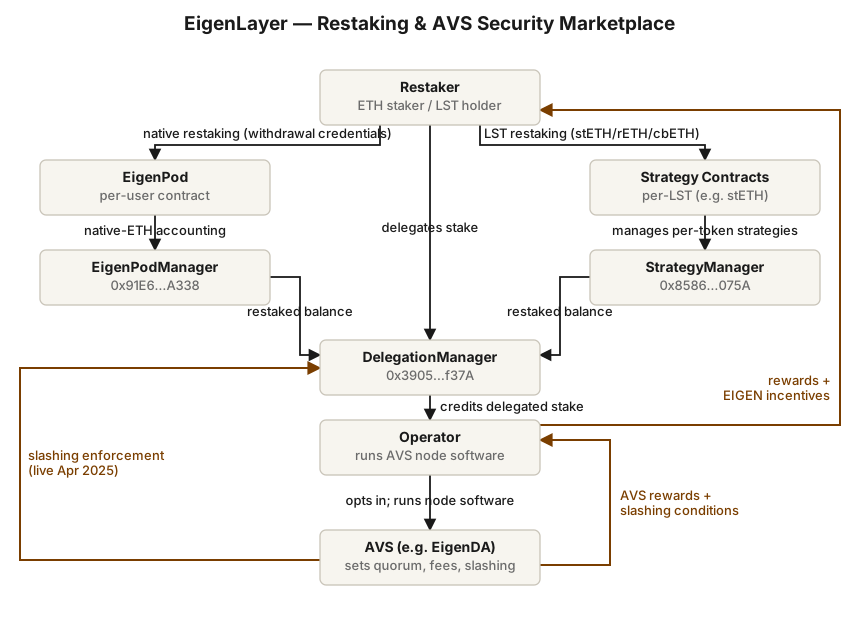
- Restaking via opt-in slashing contracts. Stakers grant EigenLayer additional slashing rights over their stake. Two paths: (1) native restaking — validators point their Beacon Chain withdrawal credentials at a per-user "EigenPod" contract, so exit proceeds route through EigenLayer's enforcement logic; (2) LST restaking — deposit stETH/rETH/cbETH (later many assets) into per-token Strategy contracts managed by the StrategyManager (0x8586…075A).
- Delegation and operators. Restakers delegate to operators through the DelegationManager (0x3905…f37A); operators run AVS node software and opt in to each AVS's registry and slashing conditions. The EigenPodManager (0x91E6…A338) handles native-ETH accounting. Withdrawals carry a delay (7 days at launch) as a safety buffer.
- AVS marketplace. AVSs define their own quorums, payment terms, and slashing conditions; restakers earn AVS rewards (plus, in practice, EIGEN incentives) atop base staking yield. EigenDA, built by Eigen Labs, was the flagship AVS; dozens more (oracle, ZK-prover, interop services) followed.
- EIGEN token and "intersubjective forking." The April 2024 EIGEN whitepaper proposed a novel mechanism: EIGEN backs claims that are "intersubjectively" verifiable (observable by humans but not provable on-chain, e.g., data withholding), with a forkable token design allowing the community to socially fork EIGEN to punish colluding malfeasance that on-chain slashing can't reach.
- Phased risk rollout. Caps at launch, no slashing for nearly two years (deposits were effectively risk-free points farming), then live slashing plus operator-set commitments from April 2025; ELIP governance proposals (e.g., a fee on AVS rewards) attempted to route value to the token.
Outcome
Category-defining but economically incomplete so far. EigenLayer single-handedly created the restaking sector, spawned a liquid-restaking-token (LRT) industry (Ether.fi, Renzo, etc.), and attracted ~$20B TVL at peak (June 2024) with 100+ AVSs announced and 20+ live. Eigen Labs raised ~$150M+ (Blockchain Capital Series A; $100M from a16z in Feb 2024). But the May 2024 "stakedrop" — 5% of supply for season one, initially non-transferable, geo-blocking ~30 countries including the US and Canada, with >50% to team and investors — triggered severe backlash and hundreds of millions in outflows. Slashing went live April 17, 2025; once yields had to be earned rather than farmed, TVL slid to roughly $7B by late 2025 and EIGEN fell ~91% that year. In June 2025 the company rebranded around EigenCloud, repositioning restaking as one primitive inside a "verifiable cloud" for AI-agent-era applications. The protocol remains live, solvent, and un-exploited at the core-contract level — a partial success: massive technical and narrative achievement, unproven fee economics.
Why it worked
- Genuine mechanism innovation with a clear buyer and seller. New networks need security; ETH stakers want more yield on idle trust. Restaking matched them without new base-layer changes.
- Credible academic founder and phased engineering. Kannan's consensus-research pedigree, audited contracts, deposit caps, and withdrawal delays gave institutions comfort to deposit billions pre-slashing.
- Points meta-perfection. Restaking points (and LRT points on top) made deposits feel like a free option on an airdrop, generating explosive reflexive TVL growth before any risk was live.
- Composability. EigenPods and LST strategies plugged directly into existing Ethereum staking infrastructure, so supply-side onboarding was nearly frictionless.
Where the design broke
- Demand side never matched supply side. Billions in security collateral chased AVSs that paid little; most AVS "rewards" were subsidized by EIGEN emissions rather than organic fees, so restaking yield premiums were small once points ended.
- Airdrop design destroyed goodwill. Non-transferable tokens, 5% community allocation vs. majority insider allocation, and aggressive geo-blocking converted its most engaged users into critics; TVL dropped ~$350M within days.
- Risk arrived after the rewards. Two years of slash-free farming set expectations; when real slashing launched in 2025, risk-adjusted returns pushed capital out rather than in.
- Systemic-risk overhang. Persistent critiques (including from Ethereum researchers) about rehypothecated stake, LRT depeg cascades, and consensus-overloading concerns capped conservative adoption.
Lessons
- A two-sided security marketplace fails on the demand side first: it is far easier to attract collateral with points than to find services willing to pay sustainable fees for that collateral.
- Sequencing risk after reward (no slashing for ~22 months) maximizes launch TVL but manufactures a cliff — capital acquired risk-free repricess or leaves the moment real risk activates.
- Token distributions are mechanism design too: a technically sophisticated protocol lost enormous social capital to a 5%, non-transferable, geo-blocked airdrop that contradicted its decentralization narrative.
- "TVL as product" is a vanity metric for security protocols; the binding constraint is fee-paying demand per unit of stake, not stake itself.
- Novel constructs like intersubjective forking are intellectually elegant but hard to make load-bearing; markets valued EIGEN on cash flows, not forkability.
Redesign (EDITORIAL — hypothesis, not fact)
This section is editorial hypothesis, not established fact. A redesigned EigenLayer might launch demand-first: onboard a small cohort of fee-paying AVSs with binding minimum-fee commitments before opening unlimited deposits, capping restaked TVL to (say) a multiple of annualized AVS fees so security supply tracks real demand and yields stay honest. Slashing should be live — even in a minimal form — from day one, so early capital prices risk correctly and no cliff forms. The token distribution could allocate 15–20% to restakers/operators vesting against continued participation after slashing activation, transferable at TGE, with insider unlocks contingent on protocol fee milestones. Finally, systemic-risk limits (per-LST concentration caps, LRT-leverage lookthrough limits) could be protocol-enforced rather than left to social pressure, addressing the rehypothecation critique structurally instead of rhetorically.
Sources
- EigenLayer Stage 1 Mainnet Launch (official blog) — primary (docs)
- Layr-Labs/eigenlayer-contracts (verified core contracts + docs) — primary (contract)
- EigenCloud documentation — primary (docs)
- EigenLayer, After Touching Off Restaking Frenzy, Plans Own EIGEN Token (news)
- EigenLayer's EIGEN Airdrop Might Signal Demise of Once-Popular 'Points' (news)
- Risks Around EigenLayer's Seasonal Airdrops (LlamaRisk) (analysis)
- EigenLayer moves past the drama with $11bn in deposits — Sreeram Kannan on what comes next (DL News) (news)
- EigenCloud TVL, Fees & Revenue (DefiLlama) (analysis)
Related experiments
Last verified: 2026-07-27 · Spot an error? Suggest a correction