Babylon
Self-custodial Bitcoin staking protocol that turns native BTC into slashable economic security for proof-of-stake chains using Bitcoin script timelocks and extractable one-time signatures, without bridges or wrapping.
▶ Run interactive simulation animated mechanism with editable parameters
How it works onchain
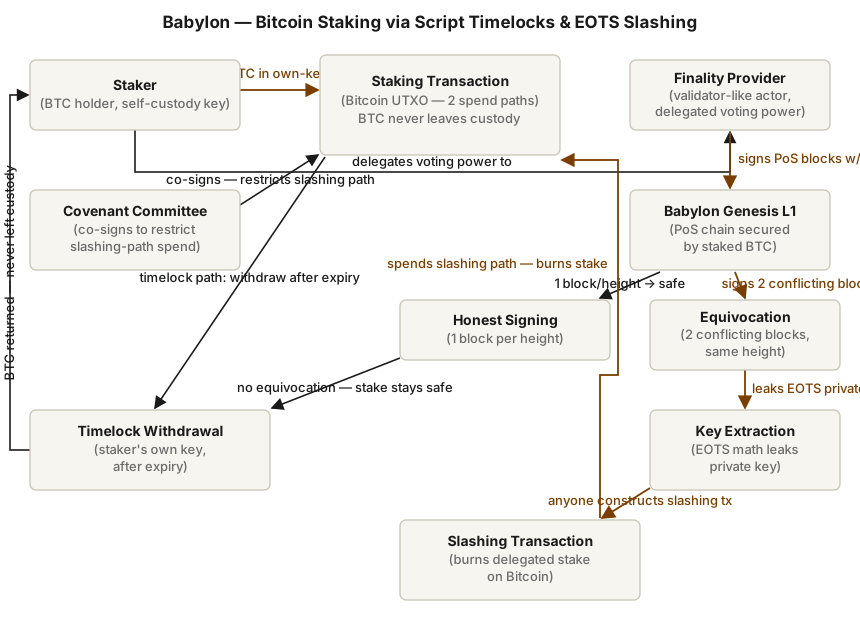 Open full-size diagram
Summary
Babylon is the most ambitious attempt to date to make idle Bitcoin productive as economic security. Founded around 2021–2022 by Stanford professor David Tse and telecommunications engineer Fisher Yu, Babylon lets BTC holders "stake" native bitcoin — locked in a Bitcoin script UTXO under the staker's own key, with no bridge, wrapping, or custodian — so that it can be slashed if the proof-of-stake system it secures suffers a safety violation. The cryptographic core is the extractable one-time signature (EOTS): sign two conflicting blocks with the same key and anyone can mathematically extract your secret key and burn your stake on Bitcoin itself. Phase-1 mainnet (lock-only staking) launched August 22, 2024 and its 1,000 BTC cap filled in roughly 74 minutes, briefly spiking Bitcoin fees. The Babylon Genesis L1 — the first PoS chain secured by staked BTC — went live April 10, 2025 with the BABY token. By 2026 Babylon reported roughly 57,000 BTC (about $5.6B) staked from 140,000+ stakers, making it the largest Bitcoin staking protocol, even as the BABY token fell ~93% from its April 2025 high.
Design (Mechanism)
Babylon's insight is that slashing — the thing that makes proof-of-stake security "cryptoeconomic" — can be enforced on Bitcoin without smart contracts, using only script primitives and clever cryptography:
- Staking transaction. A staker creates a UTXO with two spending paths: (1) a timelock path allowing withdrawal with the staker's own key after expiry, and (2) a slashing path spendable via an extractable one-time signature. The BTC never leaves Bitcoin and never leaves the staker's custody.
- EOTS slashing. Finality providers (validator-like actors that stakers delegate voting power to) sign PoS blocks with Schnorr-based one-time keys. Signing one block per height is safe; signing two conflicting blocks at the same height leaks the private key, letting anyone construct the slashing transaction that burns the delegated stake. Equivocation is thus punished by the laws of arithmetic rather than by a trusted committee's discretion.
- Covenant emulation. Because Bitcoin lacks native covenants, a covenant committee co-signs to restrict how the slashing path can be spent — an acknowledged trust-minimized (not trustless) component that Babylon intends to remove if Bitcoin ever adopts covenant opcodes.
- Bitcoin timestamping. Babylon's earlier protocol checkpoints PoS chain state onto Bitcoin, giving secured chains Bitcoin-grade resistance to long-range attacks and enabling fast unbonding.
- Phased rollout. Phase-1 (Aug 2024) accepted locked BTC in three capped rounds with no live chain to secure — points accrued instead. Phase-2, the Genesis chain (April 2025), activated actual security provision, BABY rewards, and a dual-staking model where both BTC and BABY secure the network; a multi-staking roadmap lets one BTC position secure many chains at once (the "EigenLayer for Bitcoin" analogy).
Outcome
Ongoing, with strong adoption and unresolved value-capture questions. Cap-1 (1,000 BTC) filled in 74 minutes with ~12,700 stakers paying over 50 BTC in fees; Cap-2 (Oct 2024) switched to a time-window model after criticism of the fee auction; TVL passed $2B by late 2024. Genesis launched April 10, 2025 with an airdrop, and the ecosystem attracted liquid-staking wrappers (Solv, Lorenzo, Bedrock, PumpBTC, etc.) that dominate deposits. Babylon Labs raised over $96M (including a Paradigm-led $70M round in 2024). By mid-2026 the site reports ~56,853 BTC ($5.6B) staked — the largest BTC staking protocol — and the roadmap added EVM support and Trustless Bitcoin Vaults for borrowing against BTC. The BABY token, however, collapsed from its $0.166 April 2025 high to ~$0.011 by March 2026 ($60M market cap versus multi-billion TVL), reflecting weak fee capture and heavy emissions relative to demand for the Genesis chain itself.
Why it worked
- It answered a massive latent demand: Bitcoin holders want yield without surrendering custody, and every prior route (CeFi lending, wrapped BTC bridges) had produced catastrophic failures (Celsius, BlockFi, Multichain). Self-custodial, bridge-free staking was a genuinely new trust profile.
- The cryptography is elegant and legible: slashing-by-key-extraction requires no honest majority to punish equivocation, and the design degrades gracefully (worst case for a passive staker is opportunity cost, not principal loss to a bridge hack).
- The capped, phased launch manufactured scarcity and proved demand (74-minute fill) while limiting protocol risk during the no-yield "points" era.
- Credible academic founders plus top-tier backing (Paradigm, Polychain) made large custodians and institutions comfortable integrating early.
Limitations and criticisms
Strong adoption has not resolved three structural gaps. First, value capture: BTC TVL secured the brand but the BABY token's ~93% drawdown shows the market doubts that fees from chains renting Bitcoin security will justify the valuation — the same demand-side problem EigenLayer hit with ETH restaking. Second, real security demand is thin: for most of Phase-1 the locked BTC secured nothing and earned points, and even post-Genesis the roster of paying consumer chains is small. Third, trust asterisks remain — the covenant committee and the dominance of liquid-staking intermediaries reintroduce some of the custodial and centralization risk the base protocol was designed to eliminate.
Lessons
- Slashing can be exported to a chain with no smart contracts: one-time signatures plus timelocked UTXOs emulate a covenant, showing "programmability" can live in cryptography rather than in the settlement layer's VM.
- Supply of security is easy to bootstrap; demand is the hard part. Points and caps can fill a vault in 74 minutes, but sustainable yield requires chains actually willing to pay for Bitcoin-backed security.
- Capped launches on a fee-market chain become fee auctions — Babylon's Cap-1 burned 50+ BTC in miner fees and priced out small stakers, forcing a redesign to time-window caps in Cap-2.
- Self-custody at the protocol layer gets re-intermediated at the product layer: most BTC arrived via liquid-staking wrappers, so the effective trust model is only as good as those issuers.
Redesign (EDITORIAL — hypothesis, not fact)
This section is editorial speculation. A redesign could attack the demand problem before the supply problem: rather than launching with points and no consumer chains, gate BTC deposits to underwritten security demand — chains post BABY- or fee-denominated security budgets first, and staking caps expand only against contracted demand, keeping realized BTC yield above a floor and avoiding the points-then-dump token dynamic. The covenant committee could be pushed toward one-honest-member trust using threshold BitVM-style fraud proofs, or made explicitly temporary via a sunset tied to a covenant soft fork. To counter LST re-intermediation, the protocol could natively issue a minimal, non-transferable staking position receipt with in-protocol delegation switching, reducing the pull of third-party wrappers. Finally, aligning BABY value with usage — burning a share of security fees rather than emphasizing emissions — would give the token a claim on the thing Babylon actually proved: that people will lock billions in BTC when custody is not the price of participation.
Sources
- Bitcoin Staking: Unlocking 21M Bitcoins to Secure the Proof-of-Stake Economy (litepaper) — primary (docs)
- Babylon Docs — Bitcoin Staking overview — primary (docs)
- Babylon's Bitcoin Staking Contract (Babylon Labs engineering post) — primary (docs)
- Babylon Bitcoin Staking Mainnet Launch: Phase-1, Cap-2 — primary (docs)
- Babylon Phase 2 (Genesis) Launch Official Announcement — Babylon Foundation — primary (docs)
- Bitcoin staking protocol Babylon rolls out Genesis mainnet in second stage of its phased launch — The Block (news)
- Babylon Phase-1 Mainnet Staking Cap Extended to 10 Bitcoin Blocks Following High Demand (PR Newswire) (news)
- Exclusive: Stanford professor raises $15 million for Babylon — Fortune/Yahoo Finance (news)
- Babylon Genesis Tokenomics — Babylon Docs — primary (docs)
- Babylon in 2024: Numbers, Key Achievements, Analysis — Everstake (analysis)
Related experiments
Last verified: 2026-07-27 · Spot an error? Suggest a correction