La'Zooz
An open-source, community-owned ride-sharing app that minted 'Zooz' tokens to drivers and riders via a 'Proof of Movement' scheme built on the Bitcoin blockchain's Mastercoin/Counterparty layer.
▶ Run interactive simulation animated mechanism with editable parameters
How it works onchain
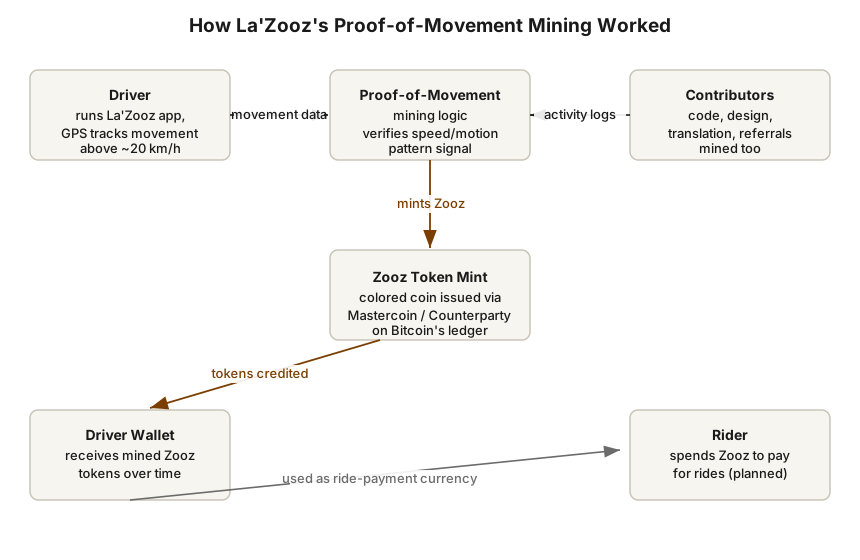 Open full-size diagram
Summary
La'Zooz was an early (2014) attempt to build a decentralized, community-owned alternative to Uber and Lyft on top of Bitcoin's "colored coins" infrastructure (issued via the Mastercoin/Counterparty protocol stack). Rather than raising money through a traditional token sale to investors, La'Zooz distributed its native "Zooz" token to the people who actually built and used the network: drivers who logged real-world movement with the app, riders who used the service, and volunteers who contributed code, design, translation, or community-building work. The project called this distribution mechanism "Proof of Movement" — a riff on Bitcoin's Proof of Work, substituting physical travel (GPS-tracked driving above roughly 20 km/h) for computational effort as the basis of token issuance. The team publicly unveiled the concept at the Inside Bitcoins conference in Tel Aviv on October 19, 2014, having previously placed second in the 2014 Mastercoin Hackathon. The project describes itself as run by "over 50 La'Zooz contributors" operating as a decentralized collective rather than a conventional company.
Design (Mechanism)
La'Zooz's core idea was to bootstrap a two-sided ride-sharing marketplace without a centralized company owning the network or extracting rents from it. Mechanically:
- Proof of Movement mining: Users installed the La'Zooz Android app and left it running with GPS enabled while traveling. Once a user's speed and movement pattern indicated they were in a moving vehicle (roughly above 20 km/h), the app would mint Zooz tokens to that user's wallet. The idea was to reward the "critical mass" of drivers needed to make real-time ride-matching viable, since a ride-sharing network is worthless without enough supply-side liquidity.
- Non-driving contribution mining: Recognizing that a pure movement-mining model would only reward people already driving (largely irrelevant to non-drivers or early urban testers), La'Zooz also minted tokens to people who contributed code, design, translations, community organizing, or who referred new users — an attempt to bootstrap the software and community side of the network alongside the supply side.
- Token as access + governance: Zooz tokens were intended to function as the currency riders would eventually spend to pay for rides, and also as a claim on the network's future value, aligning early contributors' incentives with the network's success rather than a company's equity value.
- Issuance layer: Zooz was issued as a "colored coin" on top of the Bitcoin blockchain, using the Mastercoin (later Omni) and/or Counterparty protocols that were, at the time, the primary way to create non-Bitcoin tokens on Bitcoin's ledger — this predates the ERC-20 standard on Ethereum, which only became the dominant token-issuance mechanism later in 2015-2017.
- No conventional ICO: Unlike the wave of ICOs that would follow in 2016-2018, La'Zooz explicitly avoided selling tokens to outside investors for capital; token purchases (where they occurred) were framed as supporting development rather than as an investment offering, consistent with the project's community-ownership ethos.
Outcome
Reporting and archival sources place La'Zooz as an active, publicized experiment through 2014-2016, with beta app availability, hackathon participation, and coverage in outlets like Cointelegraph and Shareable. Available public sources contain no evidence of the project ever reaching meaningful ride volume, a live functioning marketplace at scale, or a token with active trading liquidity comparable to contemporaneous crypto assets. The project's official site (lazooz.org) is unreachable as of 2026, and there is no evidence in public sources of ongoing development, a surviving app, or an active community past the mid-2010s. No acquisition, formal wind-down announcement, or public post-mortem was found in available sources. Given the site's disappearance and absence of any activity signal in roughly the past decade, this entry classifies the outcome as "abandoned" rather than claiming a formal failure event, since no primary source documenting an explicit shutdown was located.
Why it worked
- La'Zooz was conceptually ahead of its time: it anticipated "move-to-earn" and decentralized physical infrastructure network (DePIN) mechanics that would become a major crypto category (e.g., Helium, various rideshare/mobility DePIN projects) roughly 8-10 years later.
- The project generated meaningful press coverage and community interest in 2014-2016 as an alternative that distributed tokens to drivers, riders, and contributors rather than external investors, showing the "proof of X real-world activity" framing resonated with parts of the crypto community even in Bitcoin's colored-coins era.
- Distributing tokens to contributors and users rather than only to investors was a genuinely novel governance/incentive design for its time, predating most later fair-launch and airdrop-to-users patterns.
Where the design broke
- Chicken-and-egg marketplace problem, unsolved by tokens alone: Ride-sharing requires dense, geographically concentrated liquidity of both drivers and riders in the same city at the same time. Token incentives could reward movement, but could not manufacture the driver density, dispatch reliability, or safety/trust infrastructure that centralized incumbents (Uber, Lyft) had built with large capital investment.
- Weak/primitive tooling for the token layer: Building on Bitcoin colored coins (Mastercoin/Counterparty) in 2014 meant working with clunky, low-throughput, high-friction infrastructure years before smart-contract platforms like Ethereum matured — this likely limited the sophistication of what the token/app stack could actually do.
- No capital to compete on subsidized pricing: Uber and Lyft won early market share partly through massive VC-funded rider/driver subsidies. La'Zooz's anti-ICO, community-funding-only approach meant it had essentially no capital to compete on price or marketing reach.
- GPS/speed-based "proof of movement" is gameable and imprecise: Detecting genuine ride-sharing driving (versus a bus, train, or a bored person driving in circles) from GPS/speed alone is a weak signal, and available sources do not describe robust anti-gaming or verification mechanisms.
Lessons
- Token incentives can bootstrap contributor engagement and press attention, but cannot substitute for the operational density, trust/safety systems, and capital-intensive subsidies required to win a two-sided marketplace against well-funded incumbents.
- "Proof of real-world activity" mechanisms (movement, location, physical work) need robust anti-gaming verification; naive GPS/speed thresholds are easy to spoof or produce false positives, which undermines token integrity.
- Building critical infrastructure on token-issuance rails that are technically immature (2014-era Bitcoin colored coins) constrains what the product can ultimately deliver, independent of how sound the incentive design is on paper.
- Explicitly avoiding an investor-funded ICO preserves community ownership ideals but leaves a project without capital reserves to survive multi-year go-to-market timelines that consumer marketplaces typically require.
Redesign (EDITORIAL)
EDITORIAL — hypothesis, not fact. A modern retry of La'Zooz's core idea could plausibly work better today given DePIN patterns proven by projects like Helium and Hivemapper. Rather than minting tokens for undifferentiated "movement," the protocol could reward geographically-targeted supply: token emissions weighted toward specific city/time "liquidity gaps" (e.g., dynamically higher rewards where rider demand signals exist but driver supply is thin), verified via a combination of GPS, accelerometer, and cross-checked witness data from nearby devices to reduce spoofing. Payments and settlement would run on a low-fee L2 rather than Bitcoin colored coins, enabling sub-cent microtransactions per ride segment. Critically, the project would likely need a modest, transparent treasury (e.g., a fair-launch token with vesting for a core team, not a return to a VC-controlled cap table) to fund safety/insurance infrastructure and driver background checks — a cost center token incentives alone cannot replace, since consumer trust in physical safety is a harder problem than pure liquidity bootstrapping.
Sources
- La'Zooz: The Decentralized Proof-of-Movement 'Uber' Unveiled — primary (news)
- Lazooz - P2P Foundation Wiki (wiki)
- Proof-of-Movement - P2P Foundation Wiki (wiki)
- Need a Ride? Share it on blockchain. (article)
- La'Zooz: The Decentralized, Crypto-Alternative to Uber - Shareable (article)
- Lazooz - Mastering Blockchain, Second Edition (book excerpt)
Related experiments
Last verified: 2026-07-27 · Spot an error? Suggest a correction