Protocol Guild
A collective funding mechanism that channels donated tokens to Ethereum's core protocol contributors via immutable vesting contracts and a time-weighted onchain membership registry.
▶ Run interactive simulation animated mechanism with editable parameters
How it works onchain
 Open full-size diagram
Summary
Protocol Guild is a collective funding mechanism that channels donated crypto assets directly to the individuals who build and maintain Ethereum's Layer 1 core protocol — client-team engineers, researchers, and coordination staff who historically had no direct claim on the value their work secures. It grew out of an October 2021 discussion (originated by Danny Ryan) about DAOs directing tokens to L1 infrastructure, formalized by Trent Van Epps and other core contributors, with Tim Beiko among the early stewards. It launched as a one-year Pilot in May 2022 with roughly 110–111 members.
The core insight is credible neutrality: rather than any single foundation, client company, or protocol project paying core devs directly (which creates capture and dependency risk), donors give to a shared, immutable set of onchain contracts that split funds across a broad membership according to a transparent, longevity-based formula. Donations vest slowly, giving contributors durable income assurances and giving donors a Schelling point for supporting "the Ethereum commons." By 2025 the Guild had grown to roughly 190 contributors across ~30 teams and had received more than $100M in cumulative donations, distributing tens of millions to core developers — making it the largest sustained funding effort for Ethereum's core workforce.
Design (Mechanism)
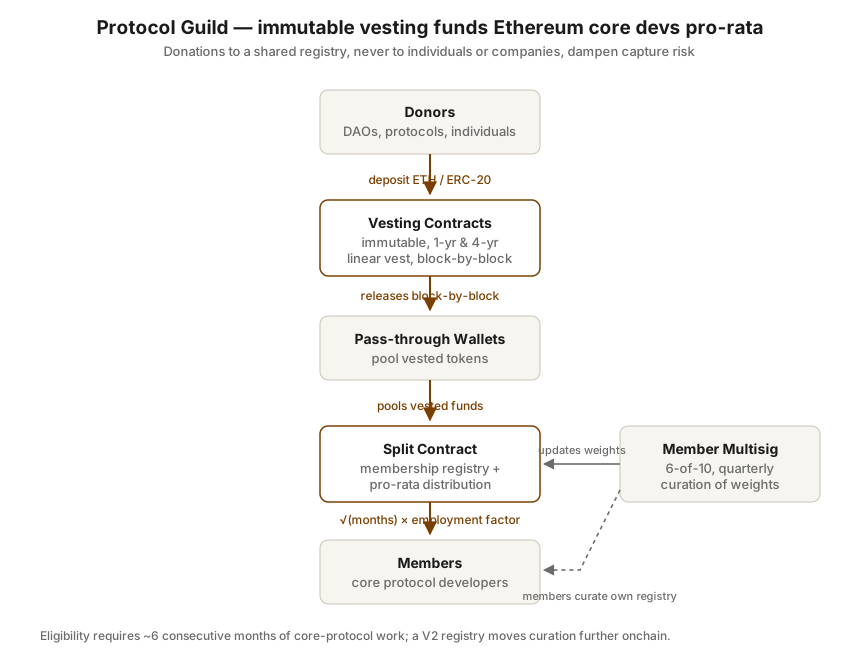
Protocol Guild's onchain plumbing is built on the Splits (0xSplits) protocol and comprises three contract layers, deployed on Ethereum mainnet plus Arbitrum, Base, and Optimism:
Vesting contracts (immutable). Donors deposit assets (ETH, ERC-20s, and historically vesting token grants) into immutable vesting contracts. The Guild runs two tracks — a 1-year linear vest and a 4-year linear vest — that release funds block-by-block. On mainnet these are
0x4EA8…8399(1-year) and0x2594…77e9(4-year). Immutability means neither the Guild nor donors can claw funds back, which is what makes the promise of future income credible.Pass-through wallets. As funds vest, they flow into pass-through wallets (mainnet
0x2E1A…265E) that pool vested tokens before distribution.Split contract (the registry). A single Splits V2.1 split (
0xd982…1d66) both distributes pooled funds pro-rata to members and serves as Protocol Guild's canonical onchain membership registry.
Allocation formula. Each member's share is proportional to the square root of the number of months they have contributed to Ethereum's core protocol, multiplied by an employment factor: full-time = 1.0, part-time = 0.5. The square root dampens the advantage of the longest-tenured members (marginal weight decreases over time), balancing "reward experience" against "don't let founders capture everything." Eligibility requires roughly 6 consecutive months of core-protocol work with an expectation of continuation; members may pause for up to about one quarter without losing standing.
Curation. Membership was historically curated off-chain by members themselves and enacted via a member multisig (a 6-of-10 signer set) that updated the split's addresses and weights quarterly. Over time governance moved toward a more onchain, DAO-scoped process (proposals with quorum and voting/grace periods) to reduce trust in the multisig, with a V2 registry aimed at further minimizing custodial assumptions.
The Pilot was seeded by ecosystem DAOs — notably an ENS DAO grant of 200,000 $ENS (EP1.9) — and by direct contributions from projects, protocols, and individuals.
Outcome
By the metrics reported through 2025, Protocol Guild is a clear success. The Pilot (May 2022–2023) with ~110 members attracted roughly $30M in cumulative donations at then-current prices. Post-Pilot it institutionalized, growing to ~190 members across ~30 teams and surpassing $100M in cumulative donations, with cumulative distributions to core developers reported in the tens of millions (the Guild and press cite figures around $20M–$40M distributed over its life, depending on date and asset prices).
It became a normalized line item for major protocols and DAOs seeking a credibly neutral way to support Ethereum's base layer, and its "donate to the commons" framing is now a recognizable Schelling point. Its own 2025 analysis, however, flags a structural shortfall: against an estimated ~$30M/year need for competitive core-dev compensation, the Guild has averaged closer to ~$10M/year of realized distributions, leaving a gap that stewards openly discuss. Outcome status: major_success, with an unresolved sustainability question rather than a failure.
Why it worked
- Credible neutrality via immutability. Donors fund contracts, not people or companies. No one can redirect or claw back vested assets, so the "future income" promise is trustworthy and no single donor gains leverage over core devs.
- A legible Schelling point. Instead of dozens of bilateral grant negotiations, the ecosystem got one obvious address to support "the people who maintain Ethereum," lowering coordination cost for both donors and recipients.
- Slow vesting aligns incentives. 1- and 4-year linear vesting rewards continued contribution and smooths income, discouraging mercenary behavior.
- Member-curated legitimacy. Because contributors curate their own registry, the membership list carries social legitimacy that a top-down grants committee could not replicate.
- Rode Ethereum's asset appreciation. Donations denominated in ETH and project tokens compounded in value during bull phases, amplifying distributions.
Limitations and criticisms
Protocol Guild underperforms against its own stated need in specific ways:
- Structural funding gap. Realized ~$10M/year vs. a ~$30M/year target leaves core compensation below what stewards consider competitive, keeping the model reliant on episodic large gifts rather than a durable revenue base.
- Donation volatility. Because inflows are voluntary and largely token-denominated, funding is procyclical — strong in bull markets, thin in bear markets — exactly when core work must continue regardless.
- Curation and Sybil surface. Off-chain, member-driven curation plus a multisig introduce trust and social-pressure risks; the move toward an onchain registry (V2) is an explicit response to these limitations.
- Formula debates. Even the simple square-root + full/half-time weighting generates ongoing disputes; stewards have publicly noted the tension between simplicity and perceived fairness.
Lessons
- Fund contracts, not counterparties. Routing money through immutable, transparent vesting contracts converts "trust me" into "verify onchain," which is what unlocked broad, credibly neutral donor participation.
- A concave (square-root) reward curve is a governance tool. Weighting by √(tenure) rewards longevity while structurally limiting whale/founder capture — a reusable pattern for any contributor-allocation scheme.
- Voluntary donation models are procyclical and gap-prone. Relying on gifts creates a persistent shortfall and market-linked volatility; sustainable public-goods funding likely needs a protocol-native or recurring revenue source, not just goodwill.
- Social legitimacy scales better than committees. Letting contributors curate their own membership registry produced durable buy-in that a centralized grants body would struggle to match.
- Start with the fewest parameters possible. Stewards repeatedly noted that even one extra parameter (part-time weighting) multiplied disputes — a strong argument for mechanism minimalism.
Redesign (EDITORIAL — hypothesis, not fact)
The following is the researcher's editorial analysis and speculation, not established fact.
The central unsolved problem is the ~$20M/year gap between voluntary donations and stated need, plus donation procyclicality. A redesign hypothesis:
Add a protocol-native, countercyclical revenue stream. Rather than depending solely on gifts, route a small, capped, opt-in fraction of some recurring value flow — e.g., a portion of L2 sequencer revenue, MEV-smoothing proceeds, or a diversified stablecoin endowment funded during bull markets — into the Guild's vesting contracts. Diversifying out of ETH/token exposure during peaks would blunt the "thin in bear markets" problem.
Endowment tranche with a spending rule. Convert a share of large one-time donations into a permanent endowment that distributes only real yield (a fixed-percentage draw), giving core devs a floor of predictable income independent of market timing.
Onchain-attested membership. Push V2 further toward verifiable contribution attestations (e.g., signed commit/spec-authorship proofs or EAS attestations from client-team leads) so registry curation is auditable and less dependent on a multisig, reducing Sybil and favoritism risk.
Keep the square-root curve but publish it as code. Encode the √(months) × employment-factor formula directly in the registry contract so allocations are deterministic and disputes shift from "who decided" to "what does the code say."
The tradeoff: any protocol-native revenue stream risks compromising the very credible neutrality that made Protocol Guild work. The redesign only holds if the revenue source is broad, opt-in, and no single payer gains leverage — otherwise it recreates the capture problem the Guild was built to avoid.
Sources
- Protocol Guild — Official Website — primary (docs)
- Protocol Guild Documentation — Smart Contract Architecture — primary (docs)
- Protocol Guild Documentation — Membership — primary (docs)
- Protocol Guild funds Ethereum core developers using Splits — primary (analysis)
- Protocol Guild on Splits Help Center — primary (docs)
- [EP1.9] Fund the Protocol Guild pilot with 200,000 $ENS — primary (governance)
- Protocol Guild GitHub org — primary (docs)
- protocol-guild-contracts (HausDAO) — primary (contract)
- Compensation Insights for Ethereum Core Developers (2025) — primary (retrospective)
- Protocol Guild Has Distributed $20M — The Defiant (news)
- ETH Needs $30M For Core Developers — CoinSpeaker (news)
Related experiments
Last verified: 2026-07-26 · Spot an error? Suggest a correction