Roll
Pioneering 'social money' platform that let creators mint fixed-supply ERC-20 social tokens on Ethereum, suffered a $5.7M hot-wallet hack in 2021, and sunset its custodial app in 2025.
▶ Run interactive simulation animated mechanism with editable parameters
How it works onchain
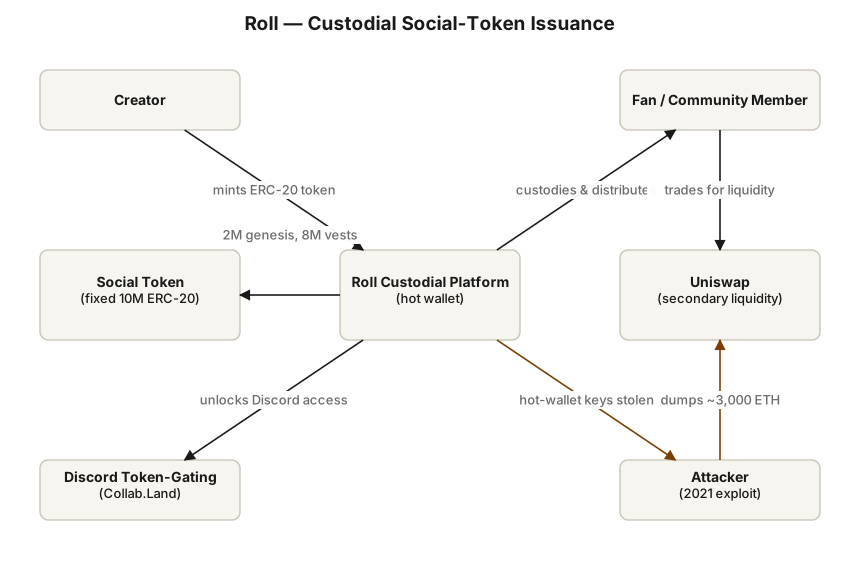 Open full-size diagram
Summary
Roll (tryroll.com) was one of the earliest and most influential social token platforms, founded in 2018 by Bradley Miles (CEO) and Sid Kalla (CTO) in New York and launched in 2019. Roll coined and popularized the category name "social money": personal, branded ERC-20 tokens that creators and communities could mint through Roll's infrastructure and distribute to fans as currency, access passes, and rewards. Roll describes itself as having launched the first social token standard on Ethereum, integrated with Uniswap in 2019 for secondary liquidity, and co-created token-gating patterns with Collab.Land. Prominent tokens minted or hosted through Roll's ecosystem included $WHALE, $FWB (Friends With Benefits), $MORK, $JULIEN, and celebrity tokens such as Terry Crews' $POWER. The platform raised roughly $22M total (per Crunchbase), including a $10M Series A in August 2021. Its defining crisis was a March 14, 2021 hot-wallet compromise in which an attacker drained creator tokens from 400+ creators, dumped them on Uniswap for 3,000 ETH ($5.7M), and crashed token prices across the social token sector. Roll continued operating for four more years before sunsetting its custodial web app and Discord bot (announced for April 15, 2025; app fully closed May 26, 2025), while keeping non-custodial products (Roll Staking, Memberships, Minting, Roll Fun) alive.
Design (Mechanism)
- Standardized fixed-supply issuance. Each social token minted through Roll had a maximum supply of 10 million. Per third-party analysis of Roll's token economics (LongHash Ventures), 2 million tokens were minted at genesis for the creator ("skin in the game") and the remaining 8 million vested to the creator in monthly distributions over three years — a built-in anti-dump vesting schedule intended to align creators with long-term community value.
- Custodial wallets and off-chain UX. Roll provided custodial Ethereum wallets so creators and fans could send/receive social tokens without gas or key management, with the ability to withdraw to the Ethereum mainnet. This was the core UX bet: Web2-grade simplicity in 2019, before smart wallets or L2s were practical.
- Liquidity and utility layers. Uniswap integration (from 2019) gave tokens permissionless secondary markets; token-gating (with Collab.Land) turned tokens into membership keys for Discord communities; later products added memberships, staking, and a launchpad (Roll Fun).
- Platform-as-registry. Roll acted as issuer, wallet operator, and de facto registry of "legitimate" social tokens, giving the category coherence but concentrating operational risk in Roll's own key management.
Outcome
Roll succeeded in creating a category: "social money"/social tokens became a recognized crypto vertical (later folded into "SocialFi"), and tokens born on Roll (notably $FWB and $WHALE) became canonical community-token case studies. Commercially and operationally, the story is harsher. On March 14, 2021, an attacker obtained the private keys to Roll's hot wallet — Roll's postmortem stated it was a key compromise, "not a bug in the Roll smart contracts or any token contracts" — and drained tokens from 400+ creators, swapping them for 3,000 ETH ($5.7M) on Uniswap. Affected tokens (WHALE, FWB, MORK, JULIEN, and others) fell 50–100% intraday. Roll suspended withdrawals and set up a $500,000 creator relief fund, which many creators publicly criticized as inadequate; a week later Roll told TechCrunch it still did not know how the keys were stolen. Despite the reputational damage, Roll raised a $10M Series A in August 2021 and pivoted toward non-custodial infrastructure. In 2025 it sunset the custodial app entirely. The ERC-20 tokens themselves persist on Ethereum — a genuine benefit of the on-chain design. Outcome: technically_successful_commercially_unsuccessful (with a major 2021 exploit of its custodial layer).
Why it worked
- Category creation and timing. Roll named and standardized a behavior (creator tokens) just before the 2020–2021 creator-economy and DeFi waves, making it the default reference point for social tokens.
- Sensible token economics. The fixed 10M supply and three-year creator vesting were ahead of their time — a real attempt to prevent instant creator dumping.
- Composability. Because tokens were plain ERC-20s, they plugged into Uniswap, Discord gating, and DAO tooling, letting communities like FWB outgrow the platform itself — and letting tokens outlive Roll's app.
Where the design broke
- Custodial single point of failure. Aggregating hundreds of creators' treasuries behind one hot wallet's private keys made Roll a honeypot; one key compromise simultaneously rugged 400+ communities and crashed the whole sector's prices.
- Compensation structure left a trust gap. A $500K relief fund against ~$5.7M in losses, suspended withdrawals, and an intrusion vector that remained unidentified a week later left creator trust unrepaired at the exact moment competitors (and non-custodial norms) were emerging.
- Platform value capture problem. The most successful tokens ($FWB) migrated to their own governance and infrastructure; the ERC-20's portability meant Roll's winners didn't need Roll, leaving the platform with long-tail creators and thin revenue.
- Category decay. Personal creator tokens largely failed to sustain demand beyond speculation; by the time Roll sunset in 2025, the market had moved to NFTs, memecoins, and SocialFi apps with different mechanics.
Lessons
- Custody concentrates correlated risk. A platform holding keys for hundreds of token treasuries converts many small trust relationships into one catastrophic failure mode; hot-wallet exposure should be minimized, tiered, and insured before scale.
- Vesting creators is necessary but not sufficient. Roll's 3-year creator vesting addressed supply-side dumping, but did nothing for demand: tokens need recurring utility sinks, not just issuance discipline.
- Composability cuts both ways for platforms. Open ERC-20s made Roll's tokens valuable and durable, but also made the platform escapable — infrastructure businesses on open standards must capture value in services, not lock-in.
- Incident response is a mechanism, too. Partial, discretionary compensation ($500K vs. $5.7M lost) after an exploit is itself a design choice that reprices platform trust; pre-committed insurance or on-chain proof-of-reserves would have changed the outcome.
- Being first names the category but doesn't own it. Roll defined "social money," yet the durable winners were the communities (FWB) and the pattern (token-gating), not the issuer.
Redesign (EDITORIAL — hypothesis, not fact)
This section is editorial hypothesis, not historical fact. A modern Roll would be non-custodial from day one: creators mint via a factory contract into smart accounts (ERC-4337) on an L2, so the platform never holds keys — eliminating the 2021 failure mode entirely. Keep the good parts: a standardized token template with enforced on-chain creator vesting (streamed via something like Sablier/Superfluid rather than monthly lumps) and a public registry attesting which tokens were minted through the canonical factory. Replace speculation-first liquidity with utility-first distribution: tokens earned through verifiable participation, redeemable against creator commitments (calls, content, access), with small protocol fees on redemptions rather than trading. To solve the value-capture problem, the platform should monetize services that benefit from neutrality — attestations, gating APIs, membership billing — and embrace graduation: successful communities exporting to their own governance should be a paid, celebrated pathway, not churn. Finally, pre-commit an on-chain insurance module (a slashable platform stake or third-party coverage) so any operational failure has a rules-based, not discretionary, compensation path.
Sources
- Sunsetting Roll (official announcement) — primary (retrospective)
- Roll App Is Closed – Thank You for the Journey (official announcement) — primary (retrospective)
- Is Roll on any social media? (official support docs) — primary (docs)
- Why did Roll Build Social Tokens on the Blockchain? (official support docs) — primary (docs)
- Roll still doesn't know how its hot wallet was hacked (TechCrunch) (news)
- A $5.7 Million Crypto Heist Sent Social Tokens into Free Fall (Decrypt) (news)
- Hackers steal 3,000 ETH from Roll (CryptoSlate) (news)
- Roll Raises $10M to Expand Social Tokens Service for Creators (Decrypt) (news)
- Social Token Economics: Token Design, Distribution, and Value Capture (LongHash Ventures) (analysis)
- Roll — Crunchbase profile (funding history) (analysis)
Related experiments
Last verified: 2026-07-26 · Spot an error? Suggest a correction