Ordinals & BRC-20
A satoshi-numbering scheme plus witness-data inscriptions turned Bitcoin into an NFT and token platform, and a deliberately janky JSON 'experiment' (BRC-20) briefly made meme tokens Bitcoin's dominant use of blockspace.
▶ Run interactive simulation animated mechanism with editable parameters
How it works onchain
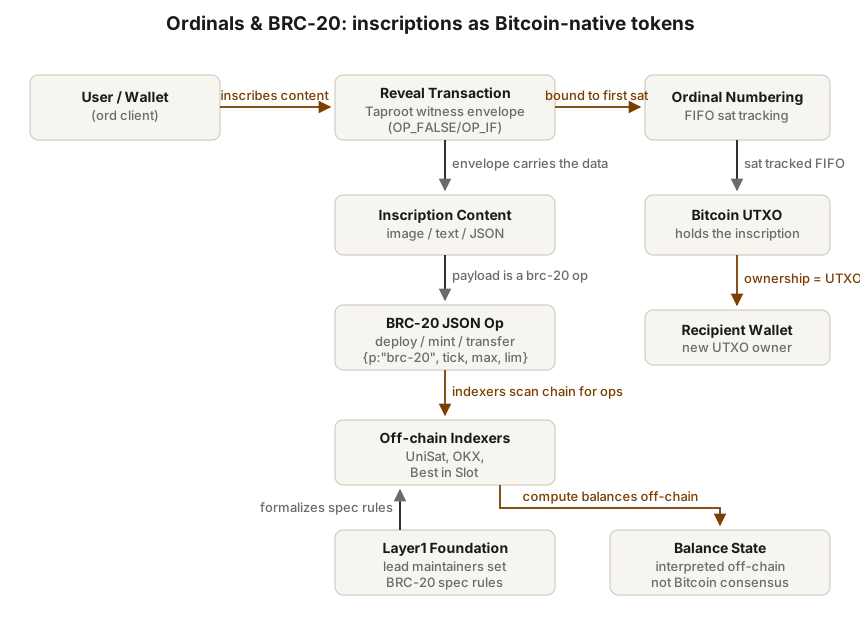 Open full-size diagram
Summary
Ordinals is a metaprotocol created by former Bitcoin Core contributor Casey Rodarmor that assigns a serial number ("ordinal") to every satoshi based on the order it was mined, and tracks those satoshis through transactions under a first-in-first-out convention. Combined with "inscriptions" — arbitrary content embedded in Taproot witness data — this let people create Bitcoin-native digital artifacts (effectively NFTs) without any changes to Bitcoin consensus. Rodarmor inscribed the first artifact (a pixel skull, inscription #0) in December 2022 and released the ord 0.4.0 wallet-enabled client publicly in January 2023 (mainnet launch widely dated January 21, 2023).
In March 2023, a pseudonymous builder known as Domo (@domodata) published BRC-20, a three-operation JSON scheme (deploy, mint, transfer) written on top of inscriptions that creates fungible-token balance states computed entirely off-chain by indexers. Domo explicitly framed it as "an experiment" that "should not be considered THE standard" and discouraged financial decisions based on it. The market ignored the disclaimer: the first deployed ticker, ordi (21M supply, 1,000-per-mint), minted out in under 18 hours, and by early May 2023 the BRC-20 sector had reached roughly $1B in market cap, congesting Bitcoin's mempool badly enough that Binance twice paused BTC withdrawals.
Design (Mechanism)
Ordinal theory. Satoshis are numbered in mined order; numbering survives transactions via FIFO assignment across inputs and outputs. This is pure social convention — Bitcoin consensus knows nothing about it. Rarity tiers (first sat of a block, of a halving epoch, etc.) fall out of the numbering for free.
Inscriptions. Content (images, text, JSON, HTML) is wrapped in an OP_FALSE/OP_IF "envelope" inside a Taproot script-path witness, exploiting the witness discount (and Taproot's removal of script-size limits) to store data at ~1/4 the cost of ordinary transaction bytes. The inscription is bound to the first sat of the reveal transaction's first output, so the artifact is owned and transferred with normal Bitcoin UTXOs — no smart contracts, no separate token registry.
BRC-20. A token is a text inscription of JSON like {"p":"brc-20","op":"deploy","tick":"ordi","max":"21000000","lim":"1000"}. Tickers are 4 characters, claimed first-come-first-served by deploy inscription order. Minting is permissionless open participation up to lim per inscription until max is reached (a "fair launch" — no premine possible in the base scheme). Transfers are two-step: inscribe a transfer note, then send that inscription to the recipient. Crucially, balances are not enforced by Bitcoin at all: they are an interpretation computed by off-chain indexers (UniSat, OKX, Best in Slot, etc.), which must agree on rules to agree on who owns what.
Governance (later). After ticker-collision and indexer-divergence disputes, Domo founded the Layer 1 Foundation, and in March 2024 appointed UniSat and Best in Slot as BRC-20 "lead maintainers" to formalize spec changes.
Outcome
Explosive, then decaying. Ordinals drove tens of millions of inscriptions in its first year and at points in 2023 inscriptions were a majority of all Bitcoin transactions; miners earned meaningful fee revenue (during 2023 fee spikes and again around the April 2024 halving, per-block fees at times exceeded the block subsidy). The May 2023 BRC-20 frenzy pushed average fees above $30 and forced Binance to halt BTC withdrawals twice; ordi was later listed on major exchanges and reached an all-time high near $95 in March 2024 (market cap peaking well above its ~$928M early-2024 marks) before falling ~85%+ from the top. Rodarmor himself shipped Runes at the April 2024 halving as a cleaner UTXO-native fungible-token design, which cannibalized BRC-20 issuance; by 2025 both BRC-20 and Runes activity had collapsed to a small fraction of Bitcoin fees, while blue-chip Ordinals collections and a professionalized inscription-services industry persisted. The protocol also permanently reignited Bitcoin's blockspace-use culture war (Luke Dashjr and others called inscriptions spam and pushed filters).
Status: Ordinals is ongoing with real but reduced usage; BRC-20 is largely a legacy standard sustained by a few exchange-listed tickers. Verdict: partial_success.
Why it worked
- Zero permission required. Both layers were pure interpretation on top of existing consensus rules (Taproot, witness discount) — no fork, no token, no VC gate. Anyone with a node and the ord client could participate day one.
- Scarcity narratives native to Bitcoin. "The first NFTs on the most secure chain," low inscription numbers, and rare sats gave collectors legible status games; BRC-20's no-premine open mints felt fairer than ICOs and attracted mercenary mint capital.
- Deliberate minimalism. BRC-20's three JSON ops were trivially indexable and copyable; the standard's simplicity was its distribution strategy.
- Fee-market flywheel. Miners got paid, which muted the constituency that could have censored it.
Where the design broke
- Off-chain state on an unaware chain. Bitcoin cannot validate BRC-20 balances; security collapsed onto indexer consensus. Divergent indexer rules and bugs (e.g., UniSat suffered a double-spend incident via an indexing flaw in May 2023) made "who owns what" a matter of social agreement among a handful of companies.
- Terrible UX and dead-weight cost. Two-step transfers, one inscription per mint, and fee-auction mints meant most user spend went to gas, not assets; ordinary Bitcoin users bore the congestion externality.
- No cash-flow anchor. BRC-20 tokens were almost purely memetic; when attention rotated (Runes, then Solana memecoins and AI tokens), liquidity left and did not return.
- Standard fragmentation. BRC-20's off-chain-indexer design (by its creator's own characterization, "cursed" territory) was followed roughly a year later by Runes, a UTXO-native fungible-token design on the same chain — splitting liquidity and developer attention across two competing standards at the moment the category needed consolidation.
Lessons
- A metaprotocol's "consensus" is really its indexers: if balances are computed off-chain, the indexer set is your validator set, with none of the accountability — formalize governance early or inherit chaos.
- Explicit disclaimers do not stop financialization; if a mechanism can be traded, it will be, so design as if real money will arrive on day one.
- Fair-launch open mints are a powerful cold-start mechanism, but they optimize for extraction speed, not retention; almost all value accrued to early minters and fee markets.
- Blockspace neutrality is decided by fee markets, not by ideology — paying miners bought inscriptions a durable, if grudging, license to exist.
- Being first and simple beats being correct at distribution time (BRC-20 vs. later, better-designed Runes), but correctness wins the maintenance era.
Redesign (EDITORIAL — hypothesis, not fact)
If rebuilt today, keep ordinal-theory inscriptions for artifacts but replace BRC-20's off-chain-JSON accounting with a design where token state commitments are periodically anchored on-chain: a canonical indexer federation posts a Merkle root of all balances every N blocks as an inscription, so any client can verify its balance against a compact proof rather than trusting a full indexer. Ticker claims should use a deploy auction or hash-committed reveal instead of pure first-come-first-served to end sniping. Mints should batch (one inscription proving many mints via signature list) to cut fee dead-weight by an order of magnitude. Finally, governance should have been constituted before the first billion dollars arrived: a published rule-change process with indexer supermajority signaling — essentially what Layer 1 Foundation retrofitted in 2024 — would have prevented the balance-divergence scares that eroded trust at the peak.
Sources
- Ordinal Theory Handbook (official docs) — primary (docs)
- ord reference implementation (GitHub) — primary (contract)
- BRC-20 experiment specification by domo — primary (docs)
- Casey Rodarmor personal site (handle + project link verification) — primary (docs)
- Casey Rodarmor: The Quest to Make Bitcoin Fun Again (CoinDesk) (retrospective)
- BRC-20 Creator Domo Addresses Thorny Governance Issues With New 'Lead Maintainer' Appointments (CoinDesk) (governance)
- Layer 1 Foundation — BRC-20 governance hub — primary (governance)
- BRC-20 (Stanford Encyclopedia of Bitcoin) (analysis)
- Runes tamp down BRC-20 activity (The Block) (news)
- Ordinals still make up majority of Bitcoin txs despite price collapse (FXStreet) (news)
Related experiments
Last verified: 2026-07-27 · Spot an error? Suggest a correction