Thales
Synthetix spin-out that turned deprecated binary options into fully collateralized UP/DOWN 'positional markets' and an onchain sports AMM (Overtime), before absorbing itself into the Overtime brand in 2025.
▶ Run interactive simulation animated mechanism with editable parameters
How it works onchain
 Open full-size diagram
Summary
Thales is one of the clearest examples of an "ecosystem spin-out": a protocol born when Synthetix decided its Binary Options module (shipped mid-2020) deserved a dedicated team rather than a corner of a synth-issuance platform. Two long-time Synthetix community members — Danijel Gornjaković, a Java engineer, and the pseudonymous Farmwell, an enterprise-software consultant — met on the Synthetix Discord, pitched to run the product, and were seeded by synthetixDAO in May 2021 (reported as 135k SNX, ~$2M at agreement time), followed by a $2.5M "DAO-first" funding round. Synthetix's SIP-149 formally deprecated its own binary options in Thales's favor.
Thales launched on Ethereum mainnet in 2021 as a peer-to-peer "positional markets" platform: fully collateralized UP/DOWN token pairs settled by Chainlink oracles, initially traded on 0x orderbooks. Late 2021 it moved to Optimism and replaced orderbooks with the Thales AMM. Its flagship pivot came in May 2022 with Overtime Markets, an onchain sports AMM, later joined by Speed Markets and Parlay betting. In April 2025, after unanimous approval of TIP-238, the DAO retired the Thales name entirely: THALES migrated 1:1 into a new OVER token (supply cut from 100M to 69.42M, with 30.58M burned), and the protocol now lives as Overtime, an onchain sportsbook on Optimism, Arbitrum, and Base.
Design (Mechanism)
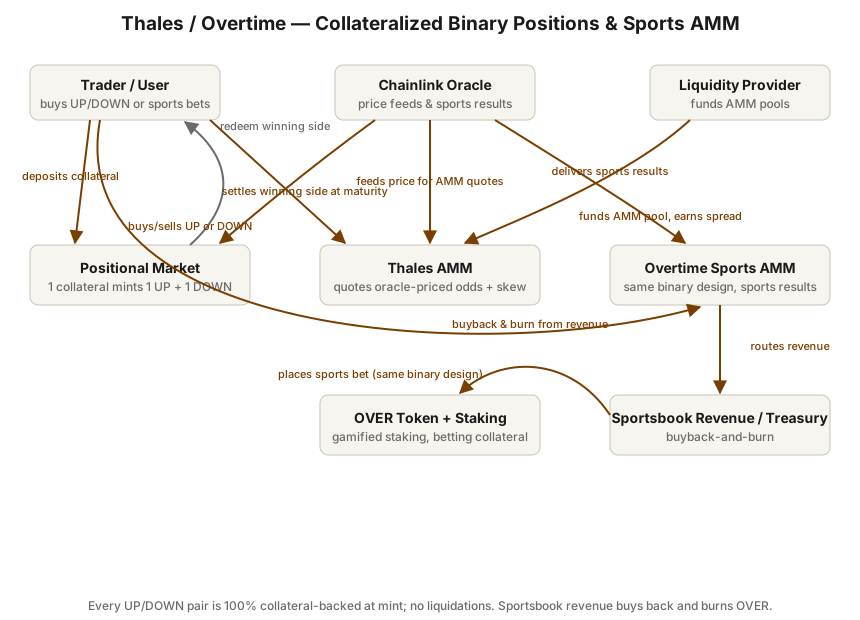
The core primitive is a fully collateralized binary position. For each market ("Will ETH be above $X at time T?"), 1 unit of stablecoin collateral (originally sUSD) mints one UP and one DOWN ERC-20 token; exactly one side redeems for the full unit at maturity, decided by a Chainlink price feed. Because every outcome pair is 100% backed at mint, there is no counterparty solvency risk and no margin/liquidation machinery — losses are capped at the price paid for a position. Markets were permissionless to create against any supported Chainlink feed.
Trading evolved through three regimes:
- P2P orderbook (2021): positions traded pre-expiry on 0x permissionless orderbooks — pure peer-matching, no house.
- Thales AMM (late 2021, Optimism): an automated market maker quotes both sides of each market using oracle-derived implied probabilities plus a skew adjustment, so users always have a counterparty; LPs fund the AMM and earn its spread.
- Overtime Sports AMM (2022) and successors: the same collateralized-binary architecture applied to sports, with Chainlink-delivered sports results as the settlement oracle. Overtime V2 (2024) rebuilt markets around a merkle-tree design for scalability, added live betting, parlays, and multi-collateral support. Speed Markets (TIP-149 within Thales governance, 2023) offered short-duration UP/DOWN positions, and Chained Speed Markets composed sequential predictions for up to ~47x payouts.
Token design: THALES (100M fixed supply, announced September 2021) allocated 35% to SNX stakers (retroactive + ongoing), 30% growth fund/treasury, 20% core contributors, 15% staking rewards — an explicit alignment payment to the parent ecosystem. Staking later became "gamified" (TIP-18 and successors), tying rewards to protocol usage. The 2025 OVER migration added buyback-and-burn from sportsbook revenue and made OVER usable as betting collateral with a 2%-better-odds incentive.
Outcome
Partial success, with the survivor being the pivot rather than the original thesis. Crypto binary/positional markets — the founding product — never became a major category; the digital-options side remained niche and the docs and branding progressively centered on sports. Overtime, by contrast, found genuine usage: by the April 2025 rebrand the team claimed over $200M cumulative trading volume, ~50,000 users, 100+ sports/leagues, and 10,000+ markets. The DAO's decision (TIP-238, unanimous) to bury the Thales name into Overtime, burn ~30% of supply, and relaunch as OVER is best read as an honest admission that the sportsbook was the business. The protocol operated for four-plus years without a notable exploit found in this research (no major hack surfaced in searches; absence of evidence noted rather than asserted). As "Thales," the experiment ended; as Overtime, it is ongoing.
Why it worked
- Full collateralization removed the hardest derivatives problems. No liquidations, no insolvency states, capped downside — a binary pair backed 1:1 is trivially safe to reason about, which let a two-person community team ship a real derivatives protocol.
- Ecosystem spin-out with aligned incentives. synthetixDAO seed funding plus a 35% token allocation to SNX stakers gave Thales a ready-made community, liquidity culture, and distribution at launch — a template later cited for DAO-to-DAO incubation.
- The AMM pivot solved the cold-start problem. P2P orderbooks for long-tail binary markets were illiquid; an oracle-priced AMM meant every market had a quote from day one.
- Willingness to chase product-market fit. Crypto options → sports betting → speed markets → full rebrand: the team repeatedly followed usage rather than the founding narrative.
Where the design broke
- Binary options on crypto prices had thin demand. Perps offered leverage with better capital efficiency and deeper liquidity; the "capped-risk positional market" audience proved small.
- Brand and product sprawl. Thales / Thales AMM / Overtime / Speed Markets across five chains fragmented liquidity, attention, and governance until the 2025 consolidation.
- Token underperformance and complexity. A 100M-supply governance token with layered staking gamification accrued little value from the products; the DAO ultimately had to burn ~30% of supply and re-anchor the token to sportsbook cash flows to make it legible.
- Oracle-priced AMMs carry adverse-selection risk by construction — sharp bettors picking off stale or mispriced quotes is a persistent tax on LPs, and mitigations (skew adjustments, spreads) directly worsen headline odds.
Lessons
- A spin-out with a granted community beats a cold start — inheriting Synthetix's stakers via token allocation was worth more than the seed capital itself.
- Fully collateralized binaries are the "safe subset" of onchain derivatives: they trade capital efficiency for the elimination of liquidation and insolvency risk, and that trade is right for consumer-grade products like betting.
- The settlement oracle is the product boundary. Thales could only expand as fast as reliable oracles existed (Chainlink prices → Chainlink sports results → Pyth-style fast feeds for speed markets); each new oracle class unlocked a new product line.
- Rebrand toward the product people actually use. Keeping a legacy protocol name alive for narrative continuity has real costs; TIP-238's clean merge-and-burn is a rare example of a DAO deliberately killing its own brand.
- House-style AMMs vs. parimutuel pools is a real fork in the road: an AMM gives instant liquidity but eats adverse selection; parimutuel pools socialize it but delay payout certainty. Thales shipped both and the market chose the AMM sportsbook.
Redesign (EDITORIAL — hypothesis, not fact)
This section is editorial hypothesis, not established fact. A redesigned Thales would skip the crypto-binary-options phase entirely and launch as an oracle-settled "binary market OS" with sports as the flagship vertical from day one — the four-year path from options to sportsbook suggests the intermediate products were discovery cost. Liquidity provision would be restructured as a single cross-market vault with explicit adverse-selection pricing: quote spreads dynamically from realized LP loss-versus-rebalancing per market category, rather than static skew parameters, and publish LP expected-edge transparently to attract passive capital. Token design would begin where OVER ended — small supply, fee buybacks, collateral utility — instead of a 100M governance token retrofitted later. Finally, the SNX-staker allocation model could be sharpened: rather than a one-time 35% grant, a standing revenue-share to the parent ecosystem contingent on continued integration would keep alignment alive past the airdrop, which historically decays once distribution ends.
Sources
- History of Overtime — Overtime Documentation — primary (docs)
- Tale of Thales, binary options re-imagined (Thales Medium, May 2021) — primary (docs)
- Thales tokenomics: Introducing THALES token (Sept 2021) — primary (docs)
- Thales Secures Seed Funding From synthetixDAO (Synthetix blog, May 2021) — primary (governance)
- SIP-149: Deprecate Binary Options (Synthetix) — primary (governance)
- Introduction to Thales Protocol — official docs — primary (docs)
- THALES DAO Token on Etherscan — primary (contract)
- Overtime launches $OVER token and full Account Abstraction UX (Chainwire, Apr 2, 2025) (news)
- Thales Uses Chainlink Data Feeds in Binary Options Markets (analysis)
- Founder Fireside Chat with Farmwell of Thales (DeFi Pulse) (analysis)
- Thales: The architecture for parimutuel markets and derivatives (blocmates) (analysis)
Related experiments
Last verified: 2026-07-26 · Spot an error? Suggest a correction