MetaFactory
A MetaCartel-spawned 'digi-physical' fashion DAO that sold limited-edition crypto apparel via bonding-curve auctions and distributed ownership through the fixed-supply ROBOT token, before composting (burning) its v1 DAO in a treasury-claim wind-down.
▶ Run interactive simulation animated mechanism with editable parameters
How it works onchain
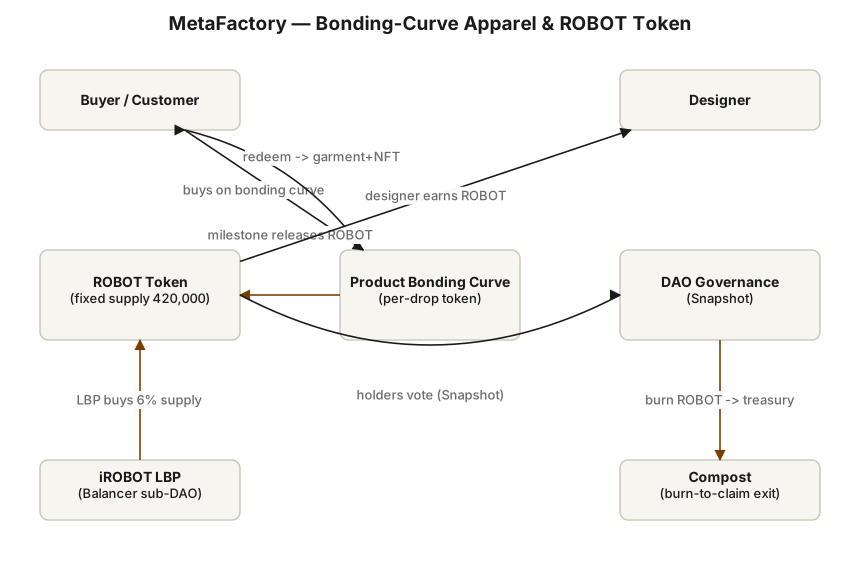 Open full-size diagram
Summary
MetaFactory was one of the earliest attempts to build a community-owned fashion/merchandise brand on Ethereum — a "culture studio" producing limited-edition "digi-physical" apparel (physical garments paired with NFTs and, later, metaverse wearables). It spun out of MetaCartel DAO (itself a Moloch DAO fork); the idea reportedly originated in a Devcon Osaka conversation among MetaCartel members (including co-founder Drew Harding) about the poor quality of crypto swag. Initially known as SwagDAO, it announced publicly on December 31, 2019.
The core economic experiment: represent products as tokens sold on bonding curves, and distribute brand ownership to the people who create and consume the products. In October 2020, after the first ~$25k sales milestone (the "Genesis Bomber" jacket), MetaFactory launched $ROBOT — a fixed-supply (420,000) governance token released to buyers, designers, and contributors as cumulative sales milestones were hit. It produced notable collaborations (YFI hoodies, a Yam Finance tribute, a BanklessDAO collab) and Decentraland wearable integrations. After surviving into the bear market, the DAO ultimately "composted" its v1 structure: the current official site (metafactory.ai, redirecting to compost.metafactory.ai) invites ROBOT holders to burn tokens to claim a pro-rata share of the treasury plus a commemorative onchain record, "making room for a more self-sovereign and agentic model for MFv2." The exact wind-down announcement date could not be confirmed (governance forum unreachable at verification time), but the claim portal was live as of July 2026.
Design (Mechanism)
- Product tokens on bonding curves. Each apparel drop was tokenized; prices started near production cost and rose with each purchase along a bonding curve. Tokens were freely tradeable; redeeming one triggered production and shipping of the physical item plus an NFT with extra benefits. Early conceptual docs also described reverse bonding-curve auctions for fractional ownership of brand IP/governance, with earlier buyers paying a premium for larger shares.
- $ROBOT governance token. Fixed supply of 420,000, all minted to a multisig ("BotYard"/"BotFarm"). Tokens were released against cumulative sales milestones ($25k, $50k, $100k … up to $6.4M), so ownership dilution was tied to real revenue rather than time. Buyers earned ROBOT proportional to spend (later changed by an April 2021 governance vote to a percentage of purchase price); designers earned ROBOT proportional to revenue their products generated; contributors earned via DAO-approved rewards.
- Governance and exit. ROBOT holders voted (Snapshot) on product curation, token mechanics, partnerships, and treasury use; 100+ ROBOT gated Discord membership, 500+ ROBOT unlocked LLC financial transparency. Moloch-style ragequit appeared in the early brand-DAO design.
- iROBOT liquidity coordination. Rather than raise VC money, a sub-DAO of 171 members pooled 1,024 ETH through a Balancer Liquidity Bootstrapping Pool to buy ~25,000 ROBOT (6% of supply, ~$92 cost basis), roughly doubling price and liquidity; LPs earned $GEAR pool tokens.
- Burn-to-claim wind-down ("compost"). v1's terminal mechanism: holders burn ROBOT to claim a share of treasury ETH and a commemorative onchain artifact, dissolving the v1 DAO, legal entity, and token.
Outcome
Partial success. MetaFactory genuinely shipped: dozens of drops over multiple years, real revenue milestones (the token-release schedule was explicitly revenue-indexed), culturally significant collabs (YFI, Yam, Bankless), and a pioneering physical+NFT+metaverse-wearable product format that influenced later "phygital" projects. The iROBOT campaign demonstrated a novel community-capital alternative to VC funding with 89% participant retention. But the model never escaped niche scale; the bear market exposed structural and operational challenges (per the official compost page), and by ~2025–2026 the DAO chose an orderly dissolution — burning ROBOT for treasury shares — rather than continuing v1. A leaner "v2" is described as planned but was not verifiable as launched at research time.
Why it worked
- Revenue-gated token issuance was unusually honest: ROBOT only entered circulation as real product sales milestones were hit, tightly coupling ownership distribution to value creation.
- Buy-to-earn and design-to-earn made customers and designers literal co-owners, generating an evangelist community that doubled as a distribution channel.
- Cultural product-market fit: high-quality crypto-native streetwear was a real unmet demand in 2020–2021, and the MetaCartel network supplied credibility, designers, and first customers.
- Orderly exits at both scales: ragequit-style thinking early on, and a clean burn-to-claim treasury dissolution at the end, meant holders were never trapped.
Where the design broke
- Physical goods don't scale like protocols. Manufacturing, sizing, shipping, and customs are heavy off-chain operations; a DAO added coordination overhead to an already thin-margin apparel business.
- Token demand was tied to crypto sentiment, not apparel demand. ROBOT's value depended on speculative governance premium; when the bear market hit, both merch demand and token liquidity fell together.
- Complexity tax: bonding-curve product pricing, milestone releases, sub-DAOs, LBPs, and Coordinape rewards were a lot of mechanism for what was, operationally, a small fashion label.
- The official wind-down framing cites bear-market "structural challenges" of the v1 DAO/legal-entity model; detailed internal financials were not publicly recoverable (governance forum offline).
Lessons
- Index token emission to revenue, not time. MetaFactory's sales-milestone release schedule remains one of the cleanest solutions to the "tokens outrun traction" problem and deserves wider reuse.
- Digi-physical commerce is operations-bound. Onchain mechanisms can align incentives around a physical brand, but they cannot compress the real-world cost structure of manufacturing and logistics; keep the ops core small and professional.
- Community capital can replace VC — at small scale. The iROBOT LBP showed 171 people can coordinate ~$4M of liquidity provisioning with high retention, but also that such structures (Moloch sub-DAOs) get dissolved for cost reasons.
- Plan the funeral. The compost/burn-to-claim exit gave holders a fair, verifiable liquidation path and preserved community goodwill for a v2 — a template for DAO wind-downs generally.
Redesign (EDITORIAL — hypothesis, not fact)
The following is editorial hypothesis, not fact. A modern MetaFactory would likely invert the stack: keep the brand treasury and revenue-share fully onchain, but drop the governance-token-as-equity framing. Product drops could be preorder escrows with transparent cost floors instead of bonding curves (curves priced hype, not garments, and punished late organic buyers). Designer and buyer rewards could be non-transferable revenue-claim NFTs that stream a fixed percentage of each drop's actual margin, avoiding both securities ambiguity and reflexive token-price dependence. Governance could shrink to a curation council elected by proven purchasers (sybil-resistant via redemption history), with the milestone-release idea retained for council compensation. Finally, the compost mechanism suggests v1's best invention may have been its exit: any consumer-brand DAO should ship with a standing burn-to-claim redemption floor from day one, making the token a claim on something real at all times.
Sources
- An Introduction to MetaFactory (official, Dec 31, 2019) — primary (docs)
- Rise ROBOT Rise! (official token launch post, Oct 1, 2020) — primary (docs)
- MetaFactory Treasury Claim (compost portal, official) — primary (docs)
- iROBOT Season One Recap + Next Steps (official, Jan 5, 2022) — primary (retrospective)
- Decomposing MetaFactory v1, Seeding MetaFactory v2 (governance forum post #499; forum unreachable at verification time) — primary (governance)
- Proposal #2: Balancer Smart Pool for $ROBOT (governance forum) — primary (governance)
- ROBOT token contract (Etherscan) — primary (contract)
- MetaFactory Distributes Ownership Via ROBOT Token (The Defiant, ~Sept 2020) (news)
- Meet Drew Harding: The Product Shaman (MetaCartel DAO Medium, Dec 3, 2019) (analysis)
- MetaFactory: A Marketplace for Digi-physical Apparel (DAOrayaki research) (analysis)
- GitHub: MetaFactoryAI/robot-redemptions (ROBOT rewards claim dapp) — primary (contract)
Related experiments
Last verified: 2026-07-26 · Spot an error? Suggest a correction