Radworks (Radicle)
A peer-to-peer, Git-based alternative to GitHub whose Ethereum-governed DAO (Radworks) funds sovereign code infrastructure and the Drips funding protocol via the RAD token.
▶ Run interactive simulation animated mechanism with editable parameters
How it works onchain
 Open full-size diagram
Summary
Radworks (originally Radicle) is a long-running experiment in pairing an off-chain peer-to-peer protocol with an on-chain funding and governance layer. Radicle itself is a Git-based, local-first code-collaboration stack — a decentralized alternative to GitHub in which repositories, issues, and patches replicate across a gossip network of nodes rather than living on a corporate server. It grew out of Monadic GmbH, a Berlin company founded in 2018 by Alexis Sellier and Eleftherios Diakomichalis (both ex-SoundCloud; the project's precursor was "oscoin"/Open Source Coin). In February 2021 the project launched the RAD token on Ethereum via a Balancer Liquidity Bootstrapping Pool, seeding a token-holder-controlled treasury. Around 2022–2023 the DAO rebranded to Radworks and restructured into independent "Orgs" — Radicle (the code-collaboration stack), Drips (dependency/public-goods funding, covered separately in this Atlas), plus Grants, Foundation, and Integrations & Tooling — each funded through annual on-chain budget proposals (RGPs). Radicle reached its 1.0 release candidate in March 2024 and remains actively developed, though adoption is a small fraction of centralized incumbents.
Design (Mechanism)
- Off-chain protocol, on-chain funder. The core product is deliberately not a blockchain. Radicle's third protocol iteration, "Heartwood," is a P2P stack (CLI
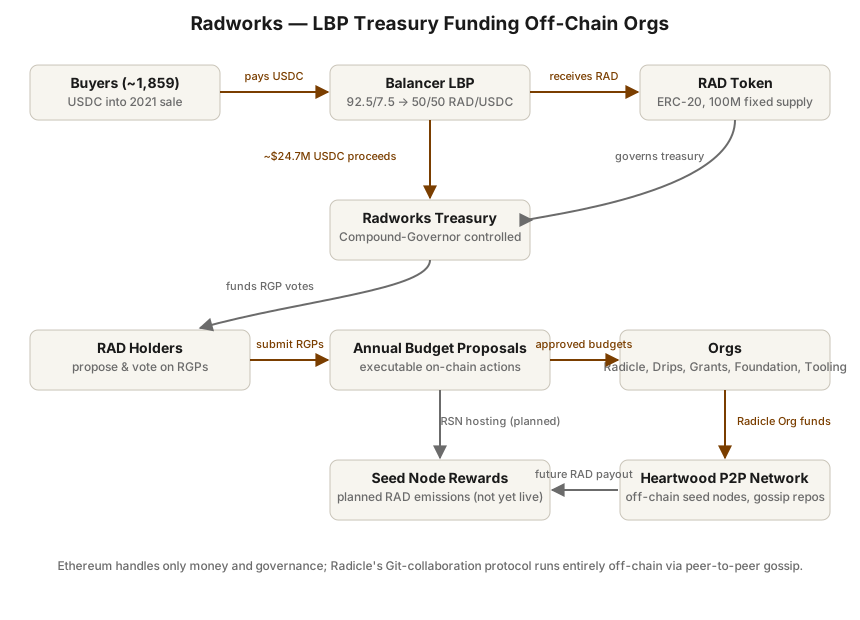
rad+radicle-nodedaemon) where identity is cryptographic keypairs and repository state replicates via gossip among seed nodes. Earlier iterations experimented with Ethereum coupling (e.g., "Orgs"/anchoring repo state on-chain circa 2021), but the team decoupled the protocol from Ethereum in Heartwood, keeping the chain only for money and governance. - Token launch via LBP. RAD (ERC-20, 100M fixed supply, contract 0x31c8eacbffdd875c74b94b077895bd78cf1e64a3) launched February 25–27, 2021 through a Balancer LBP: ~3.75M RAD offered starting at 92.5/7.5 RAD/USDC weights shifting toward 50/50, a design that penalizes early sniping. The sale raised roughly $24.7M USDC from ~1,859 addresses, with all proceeds sent to the token-holder-controlled treasury.
- Compound-Governor treasury. The Radworks treasury is governed by a Compound-Governor-style system: RAD holders create and vote on Radworks Governance Proposals (RGPs) composed of executable on-chain actions.
- Org structure with annual budgets. Rather than one monolithic DAO team, Radworks funds semi-autonomous Orgs — Radicle (RGP-14), Drips, Grants, Foundation, Integrations & Tooling (RGP-23, passed March 2024 with 5.1M RAD in support) — each submitting yearly budget proposals to token holders.
- Planned node incentives. Per official docs, RAD is slated to reward seed nodes providing storage/retrieval for the Radicle network, and a managed Radworks Seed Network (RSN) hosting service was planned for launch around Q2 2025. Token vesting fully unlocked by 2025.
Outcome
Technically, Radicle shipped what it promised: Heartwood reached a 1.0 release candidate in March 2024, with the team reporting on the order of ~160 daily active nodes at the time — a real, functioning sovereign code network, but tiny compared with GitHub's scale. The 2021 LBP was one of the era's cited "fair launch" successes ($24.7M raised, price stabilizing in the $10–15 range during the sale). RAD's market price later fell far below sale levels amid the broader 2022 bear market. The DAO successfully executed multiple annual budget cycles across its Orgs and spun out Drips as an independently significant funding protocol (used by ecosystems to fund open-source dependencies). Radworks continues operating as of 2025–2026; no dissolution or wind-down was found. Its most durable outputs so far are working software (Radicle 1.0, Drips) rather than token value or mass adoption — hence "ongoing," trending toward technically-successful/commercially-modest.
Why it worked
- Separation of concerns. Keeping the collaboration protocol off-chain (fast, free, local-first) while using Ethereum only for treasury and governance avoided forcing developers to touch a blockchain to collaborate — a lesson learned from the abandoned Ethereum-anchoring era.
- Fair-ish distribution. The LBP mechanism dampened whale sniping and funded a genuinely token-holder-controlled treasury, giving governance real resources (tens of millions of dollars) to fund a decade-scale mission.
- Credible builders. Founders with deep open-source and infrastructure backgrounds (SoundCloud engineering leadership; Sellier authored the LESS CSS preprocessor) sustained multi-year development through bear markets.
- Org modularization. Splitting into Radicle/Drips/Grants Orgs with separate budgets made spending legible and let each product find its own users.
Limitations and criticisms
- Distribution remains a small niche. GitHub's network effects (discovery, CI, identity, hiring signal) are the product; a censorship-resistant Git substrate addresses a need most developers feel only rarely. Daily-active-node counts in the low hundreds at 1.0 reflect a base of sovereignty-motivated users rather than mainstream adoption.
- Weak token–product coupling. For most of its life RAD conferred only governance rights over a treasury; node-incentive utility remained "planned" years after launch, leaving the token narrative detached from Radicle usage.
- Multiple pivots consumed years. Three protocol rewrites (Link → Ethereum-coupled Orgs → Heartwood) and a rebrand took time and community mindshare during the window when decentralized-GitHub interest peaked.
Lessons
- Fund off-chain public infrastructure with an on-chain treasury, but do not force the chain into the product's hot path — Radworks' retreat from Ethereum-anchored repos to a pure P2P stack is a canonical example.
- A Balancer LBP can capitalize a DAO treasury broadly and fairly, but a well-funded treasury does not manufacture demand; distribution/network effects need their own mechanism.
- Governance tokens without a live utility loop (node rewards still pending years post-launch) drift into pure treasury-claim assets, inviting apathy and mercenary voting.
- Modular "Org" budgeting with annual renewal proposals is a workable pattern for DAOs funding multiple products with distinct fates (Drips outgrew its parent's shadow).
Redesign (EDITORIAL — hypothesis, not fact)
This section is editorial speculation. A redesigned Radworks might invert the go-to-market: instead of competing with GitHub for everyday collaboration, launch as the canonical mirror-and-attestation layer — every important OSS repo continuously replicated to Radicle with signed provenance, sold as supply-chain-security and censorship-insurance that CI/CD and package registries verify against. Seed-node rewards should have shipped at token launch with usage-metered emissions (RAD paid per verified storage/serving of in-demand repos), tying token demand to network utility from day one. Drips could be woven in natively: funding flows to a dependency automatically route to the nodes hosting it and the maintainers signing it, making one flywheel of hosting, funding, and provenance. Finally, denominating Org budgets in stables with RAD used strictly for slashing-backed node bonds and governance would reduce the treasury-drawdown reflexivity that plagues governance-only tokens.
Sources
- The RAD token – Radworks Docs — primary (docs)
- Radworks official site — primary (docs)
- Introducing the Radicle Token (Radicle, Medium) — primary (docs)
- A Step-by-Step Guide for Participating in the Radicle LBP — primary (docs)
- [Formal Review][RGP-14] Start the Radicle Org — primary (governance)
- [RGP-19] Drips Org Proposal 2024 — primary (governance)
- [RGP-23] Start the Radicle Integrations & Tooling Org 2024 — primary (governance)
- Radicle Org Q1 2024 Update (Radicle 1.0 RC, ~160 daily active nodes) — primary (governance)
- Radicle Heartwood Protocol & Stack (GitHub mirror) — primary (contract)
- Radworks governance manual — primary (docs)
- Analysis of the Crypto Radicle (RAD) — LBP results (analysis)
Related experiments
Last verified: 2026-07-27 · Spot an error? Suggest a correction