Mirror Protocol
Terra-based synthetic asset protocol that let anyone mint and trade on-chain tokens (mAssets) tracking the price of US stocks, collapsing alongside the Terra/LUNA ecosystem and a long-running oracle exploit.
▶ Run interactive simulation animated mechanism with editable parameters
How it works onchain
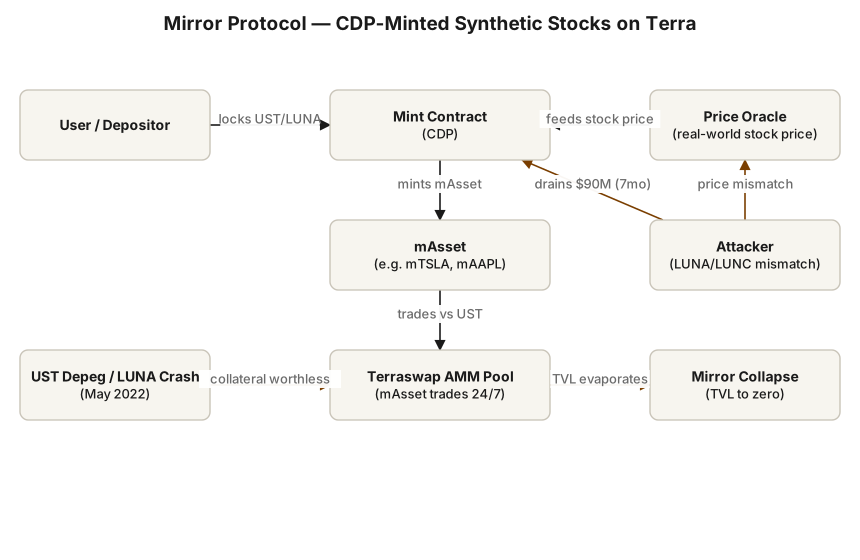 Open full-size diagram
Summary
Mirror Protocol was a synthetic-asset issuance and trading platform built by Terraform Labs on the Terra blockchain, launched December 3, 2020. It let users lock collateral (initially UST and other Terra assets) into collateralized debt positions to mint "mAssets" — on-chain tokens designed to track the price of real-world equities like Tesla (mTSLA), Apple (mAAPL), Amazon (mAMZN), and index products, using oracle price feeds. mAssets could be traded 24/7 on Terraswap AMM pools, giving anyone, anywhere, permissionless synthetic exposure to US stock prices without a brokerage account. The protocol was governed by holders of its MIR token, distributed via liquidity mining. Mirror grew rapidly through 2021, reaching well over $1 billion in total value locked at its peak, before being destroyed by the same May 2022 collapse of UST and LUNA that ended the broader Terra ecosystem, compounded by a separate, long-undetected $90M oracle exploit.
Design (Mechanism)
Mirror's core primitive was a CDP (collateralized debt position) system similar to MakerDAO's: a user deposited approved collateral (UST, LUNA, or other mAssets) at a required collateralization ratio and minted new mAsset tokens against it, which they could then sell into an AMM pool or hold. Position health was tracked against an on-chain price oracle reporting the real-world asset's price; positions falling below the minimum collateralization ratio could be liquidated by anyone, similar to other CDP-based lending/minting systems. mAssets traded on Terraswap pools paired against UST, with liquidity providers earning trading fees plus MIR liquidity-mining rewards. Because the underlying assets (stocks) traded only during market hours while Terra ran 24/7, Mirror used a "pre-open"/inactive trading mechanism outside market hours to limit oracle staleness risk, and later added short farming and other yield features. MIR governance let token holders vote on whitelisting new mAssets, adjusting collateral ratios, and protocol parameters, positioning Mirror as a decentralized, non-custodial alternative to synthetic-exposure products offered by traditional brokers.
Outcome
Mirror initially achieved significant product-market fit within the Terra/DeFi ecosystem, becoming one of the largest synthetic-asset protocols in crypto during 2021, with TVL reported in the hundreds of millions to over $1 billion at its height and dozens of mAssets listed. That success proved entirely dependent on the Terra ecosystem it was built on. When UST de-pegged and LUNA's price collapsed in May 2022, Terra-based collateral backing Mirror positions became worthless almost overnight, and TVL and trading activity evaporated. Separately, in May 2022 the community discovered that an attacker had been quietly draining the protocol since October 2021 by exploiting a price-oracle misconfiguration around the LUNA/LUNA Classic split, ultimately extracting roughly $90 million undetected for about seven months; a second, smaller ~$2 million exploit hit Mirror days later using the same oracle-mismatch class of bug. Mirror's official site (mirror.finance) is now a parked/for-sale domain, and the protocol is effectively abandoned/defunct.
Why it worked
- It offered a genuinely novel, permissionless product — 24/7, borderless synthetic exposure to US equities — that was unavailable elsewhere in crypto at the time and attracted real demand from traders outside US market hours and jurisdictions with limited brokerage access.
- Deep liquidity mining incentives (MIR emissions) bootstrapped fast TVL and trading volume, and integration with Terra's fast, cheap CosmWasm chain and UST stablecoin made minting and trading frictionless during Terra's growth phase.
- Being built and marketed by Terraform Labs gave Mirror instant ecosystem distribution, capital, and credibility while Terra/LUNA/UST were ascendant.
Why it failed or underperformed
- Total dependency on Terra's native stablecoin (UST) and LUNA as collateral meant Mirror had no insulation from Terra's own systemic collapse in May 2022; when UST de-pegged, Mirror's collateral base and mAsset pegs failed simultaneously.
- A critical oracle-configuration bug went undetected for roughly seven months, allowing an attacker to drain ~$90M — a severe operational security failure that undermined trust even before the Terra collapse.
- The synthetic-asset model relied on continuous, accurate oracle pricing during high volatility and chain-halt scenarios (Terra's chain was halted during the collapse), which the design had not robustly hardened against.
Lessons
- A DeFi protocol's risk is only as good as its collateral base; building an asset-tracking system entirely on a single ecosystem's native stablecoin/token creates correlated, non-diversifiable systemic risk.
- Oracle security is not a one-time audit item — Mirror's largest loss (~$90M) went unnoticed for months, showing that continuous monitoring and anomaly detection for oracle-derived exploits matter as much as initial code review.
- Rapid TVL growth driven primarily by token emissions (MIR liquidity mining) can mask fragile fundamentals that unwind just as fast once incentives and the underlying chain's health deteriorate.
Redesign (EDITORIAL)
EDITORIAL — hypothesis, not fact. A more resilient version of Mirror could have diversified collateral across multiple independent, non-correlated assets (e.g., major blue-chip crypto assets and multi-chain stablecoins) rather than relying almost exclusively on one chain's native stablecoin, reducing single-point-of-failure risk. It could also have used a redundant, multi-source oracle design with automated circuit breakers that halt minting/liquidation when price feeds diverge or go stale beyond a threshold, likely catching the LUNA/LUNC oracle mismatch far earlier than seven months. Finally, rather than tokenizing direct 1:1 price mirrors of named securities, a redesign might have offered synthetic index baskets or derivative payoffs structured explicitly as decentralized prediction-market-style instruments, preserving the core value proposition of permissionless, 24/7 exposure to traditional-market price movements.
Sources
- Terraform Labs Launches 'Mirror Protocol' for Synthetic Versions of US Equities (news)
- Terra Launches Mirror Protocol, the First Synthetic Asset Protocol — primary (press release)
- $90 Million Hack of Terra's Mirror Protocol Went Unnoticed for Seven Months (news)
- Terra's Mirror Protocol suffers new exploit and could be drained in hours (news)
- SEC.gov | Terraform Labs PTE, Ltd. and Do Kwon — primary (regulatory filing)
- What is Mirror Protocol? | Messari (reference)
Related experiments
Last verified: 2026-07-27 · Spot an error? Suggest a correction