NuBits
An early dual-token seigniorage stablecoin (NuBits/NuShares) that held a $1 peg via custodian sales, interest-bearing 'parking,' and voter governance — until it collapsed twice, in 2016 and 2018, when reserves ran out.
▶ Run interactive simulation animated mechanism with editable parameters
How it works onchain
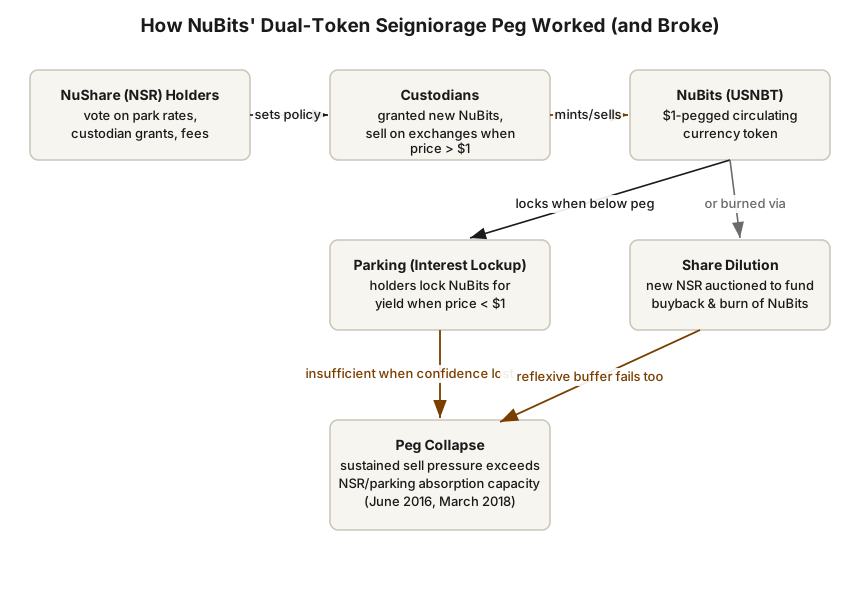 Open full-size diagram
Summary
NuBits (ticker USNBT) was one of the first "algorithmic" or seigniorage-style stablecoins, launched on September 24, 2014, roughly four years before Terra/UST and other more famous descendants of the model. It was built by the Nu network (a Peercoin-derived proof-of-stake chain) under lead developer "Jordan Lee," a pseudonymous figure. NuBits paired a $1-pegged currency token (NuBits) with a governance/equity token (NuShares, NSR) whose holders voted on monetary policy. The system held its peg for nearly two years before collapsing in 2016, briefly recovering, and collapsing again — terminally — in 2018.
Design (Mechanism)
NuBits used a dual-token seigniorage architecture:
- NuShares (NSR) were the governance/equity layer. Holders voted on custodian appointments, "park rates" (interest for locking up NuBits), transaction fees, and new share issuance.
- Custodian grants: when demand for NuBits exceeded $1 (price too high), NuShareholders could vote to grant newly minted NuBits to trusted custodians, who sold them on exchanges to push the price back down to peg.
- Parking (interest-bearing lockups): when demand fell (price under $1), the network offered "park rates" — interest paid to users who voluntarily removed NuBits from circulating supply for a fixed term, shrinking sell-side pressure without requiring an external buyer of last resort.
- Share dilution for buybacks: if parking alone couldn't defend the peg, NuShareholders could vote to auction newly created NuShares and use the proceeds to buy back and burn NuBits, permanently shrinking supply to match falling demand.
- Unlike later "algorithmic" stablecoins with large collateral reserves (e.g., MakerDAO's overcollateralized vaults), NuBits' backing was thin and largely reflexive: NuShares' market value was itself supposed to act as the loss-absorbing buffer, similar in spirit to Terra's LUNA/UST design that failed catastrophically years later.
Outcome
The peg held close to $1.00 from launch in September 2014 through most of 2015 and into early 2016 — a genuinely novel result for the time. In June 2016, sustained sell pressure combined with an inadequate/centralized custodian reserve broke the peg; USNBT fell to under $0.20. Circulating supply was slashed from roughly 700,000+ NBT to about 150,000 NBT as the network tried to shrink supply to match collapsed demand, and the peg was nominally restored by September 2016 at a much smaller scale. A speculative revival followed — NuBits' market cap reportedly grew roughly 1,500% between late 2017 and early 2018 amid the broader crypto bull run — but the underlying reserve mechanics were never fixed. In March 2018, the peg broke again, this time for good; NuBits never meaningfully recovered and the project is now effectively dormant/abandoned.
Why it worked
- For its first ~20 months, the combination of custodian-sold supply expansion and interest-bearing parking successfully absorbed both upward and downward demand shocks, proving (temporarily) that a purely incentive/game-theoretic peg — with no fiat or crypto collateral reserve — could function without a hard collateral backstop.
- The parking mechanism was a genuine innovation: paying interest to voluntarily remove tokens from circulation is a precursor to ideas later reused (in modified form) by protocols offering yield to shrink circulating stablecoin supply during demand troughs.
- Being one of the very first live seigniorage-style stablecoins gave NuBits a first-mover network of exchanges, holders, and NuShares governance participants for a period.
Where the design broke
- The system had no meaningful hard reserve: NuShares' market value was the only backstop, and NuShares itself had thin liquidity and a small market cap, so it could not absorb a sustained, large-scale sell-off of NuBits.
- Custodians controlling supply issuance were a centralization/trust bottleneck; the model depended on a small number of custodians (and their willingness/ability to sell/buy at the right times) rather than a transparent, automated mechanism.
- Park-rate incentives only work if enough capital is willing to lock up funds; during a genuine loss-of-confidence event, rational holders exit rather than park, which is exactly what happened in mid-2016 and again in 2018.
- The reflexive "governance token absorbs the loss" design is structurally the same flaw that later destroyed Terra/UST at far larger scale: when the peg-token and the loss-absorbing token both crash simultaneously, there is no external capital to defend the peg.
- A pseudonymous project structure and a small, forum-based governance community meant there was no formal channel to raise additional capital or credibility during the crises.
Lessons
- Seigniorage-style stablecoins backed only by a reflexively-priced governance token are structurally fragile; NuBits demonstrated (years before Terra/UST) that this design can hold under calm conditions but fails once a genuine bank-run dynamic starts.
- Interest/"parking" incentives to shrink circulating supply can work as a secondary stabilizer but are not a substitute for a hard, diversified collateral reserve during tail-risk sell-offs.
- Centralized custodians as the sole issuance/redemption channel reintroduce the trust assumptions that on-chain stablecoins are often trying to avoid.
- A peg recovering nominally after a crisis (as NuBits did in Sept 2016) does not mean the underlying mechanism was fixed — the same design flaw reappeared and killed the project for good less than two years later.
Redesign (EDITORIAL)
EDITORIAL / hypothesis, not fact. A redesigned NuBits could have required NuShares-collateral to be locked and marked-to-market as explicit over-collateralization for NuBits in circulation (rather than treating NuShares' floating market cap as an implicit backstop), with automatic, algorithmic liquidation of NuShares collateral rather than discretionary custodian sales. Diversifying reserves to include a real external asset (e.g., BTC or fiat held by a multi-custodian, auditable trust) alongside the NuShares buffer would have given the system a genuine circuit breaker during demand shocks instead of relying entirely on voluntary parking and thin secondary-market share sales. Finally, replacing pseudonymous custodian discretion with a transparent, permissionless, algorithmically-triggered issuance/redemption mechanism (closer to later overcollateralized designs) would have reduced the single-point-of-failure risk that compounded the 2016 and 2018 collapses.
Sources
- History of the Nu Network — primary (docs)
- NuBits — Price Stability (official) — primary (docs)
- The End of a Stablecoin — The Case of NuBits (Reserve) (article)
- NuBits: A Tumultuous Stablecoin (article)
- [WARNING] NuBits - The price stable currency... until it's NOT!! (forum)
- NuBits official site — primary (official)
Related experiments
Last verified: 2026-07-27 · Spot an error? Suggest a correction