OPCraft
Lattice's Minecraft-style fully onchain voxel world that ran for two weeks on a bespoke OP Stack rollup, battle-testing Optimism Bedrock and demonstrating the 'Autonomous World' thesis before being deliberately frozen on Halloween 2022.
▶ Run interactive simulation animated mechanism with editable parameters
How it works onchain
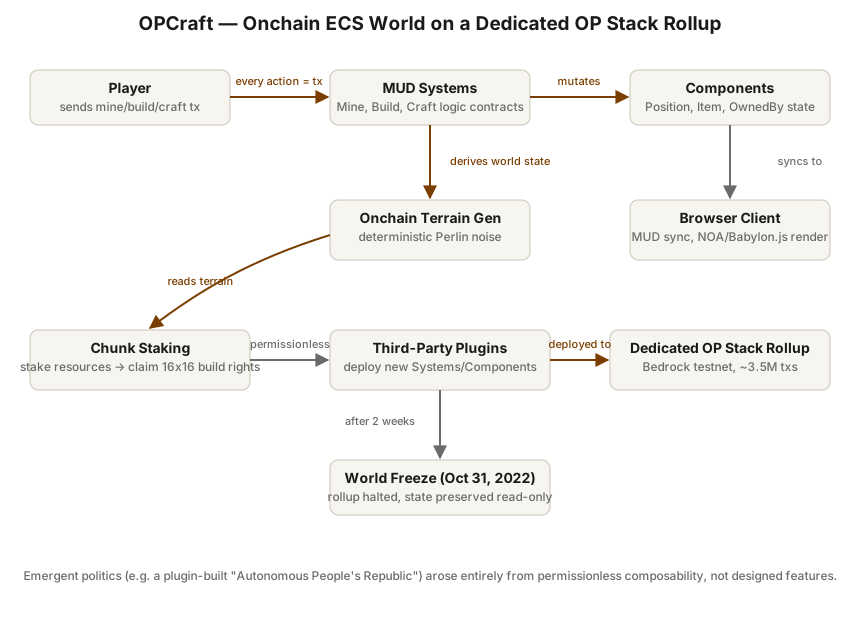 Open full-size diagram
Summary
OPCraft was a Minecraft-inspired, fully onchain 3D voxel world built by Lattice — the studio behind the MUD onchain game engine — and launched in October 2022 as the first application built on Optimism's then-new OP Stack. Every element of the world (terrain, blocks, inventories, crafting recipes) lived in smart contract state, and every action — mining a block, placing a block, crafting an item — was an Ethereum transaction on a bespoke OP Stack (Bedrock) rollup testnet. Lattice built the game in roughly two months as a proof of concept for "Autonomous Worlds": persistent, permissionless virtual spaces whose full logic and state are onchain. The experiment ran as a two-week open playtest ending at 23:59 UTC on October 31, 2022, after which the rollup was intentionally frozen, immortalizing player creations. In that window it processed roughly 3.5 million transactions — about twice the volume of Optimism's own Bedrock testnet — and surfaced multiple bugs in the pre-release OP Stack.
Design (Mechanism)
OPCraft's architecture rested on MUD's onchain Entity-Component-System (ECS) pattern. Components are contracts that assign typed data to entities (Position, Item, OwnedBy); Systems are logic contracts that mutate component data (Mine, Build, Craft); entities are plain numeric IDs. MUD synchronized contract state to clients without bespoke indexers, and the browser client rendered voxels using the open-source NOA engine (Babylon.js).
Key mechanisms:
- Onchain procedural terrain: the infinite world was generated deterministically from Perlin-noise functions evaluated onchain, so terrain was not stored but derived — any client could compute the same world from the contracts.
- Every action is a transaction: mining, placing, and crafting were contract calls on a dedicated rollup, made viable by running the game on its own OP Stack appchain rather than a shared L2.
- Land protection via chunk staking: the world was divided into 16x16 block chunks in which players could stake rare resources to claim build rights — a scarcity-based, permissionless property system rather than an admin allowlist.
- Permissionless extensibility: because all state and logic were public contracts, anyone could deploy plugins (new components/systems) or alternative clients with no API keys or approval. Players shipped chat, teleportation, automated diamond-mining drills, visual filters, and even governance systems as plugins during the playtest.
- Planned sunset: the world was announced as temporary; freezing the chain on Halloween turned the experiment into a bounded artifact rather than an unmaintained liability.
Outcome
OPCraft ran its full two-week arc (mid-October to October 31, 2022) and was then frozen as planned; a read-only world and the GPL-3.0 codebase remain public. Roughly 3.5 million transactions were processed, stress-testing Optimism Bedrock pre-release and uncovering several OP Stack bugs. The social outcomes became the headline: a player known as SupremeLeaderOP amassed 135,200 diamonds, then deployed custom MUD components to establish the "Autonomous People's Republic of OPCraft" — with land claims near spawn, a "comrade" system where players surrendered inventories to a communal treasury, and a social-credit mechanism against freeloading — entirely as a permissionless plugin, two days before the world ended. Dissidents led by player PhiMarHal built a breakaway sky city in protest. Lattice's work on OPCraft and MUD was later recognized in Optimism's RetroPGF round 3. OPCraft itself never had a token, revenue, or a commercial life — deliberately — and its direct lineage runs through MUD, which became the dominant framework for fully onchain games, and Lattice's later OP Stack chain Redstone.
Why it worked
- Appchain economics made "everything onchain" playable: a dedicated OP Stack rollup gave the game cheap, fast blockspace so every voxel interaction could be a real transaction without competing with DeFi for gas.
- ECS was the right abstraction: modeling the world as components and systems made state legible and extensible, which is what allowed third parties to bolt governments and teleporters onto a live world.
- Open state produced emergent politics: the most memorable outcomes (the People's Republic, the resistance sky city) were not designed features but consequences of permissionless composability — the core claim of the Autonomous World thesis, demonstrated rather than argued.
- A bounded run created urgency: the two-week deadline concentrated player creativity and let Lattice end on a high note instead of decaying retention.
- Aligned infrastructure partner: Optimism got Bedrock battle-tested at 2x its testnet volume; Lattice got free, novel blockspace and distribution.
Why it failed or underperformed
- It was never a product: no persistence beyond the freeze, no token, no economy bridging to mainnet value, and no ongoing player base — "commercially unsuccessful" by design rather than by miscalculation.
- Player location was not enforced onchain initially, an acknowledged shortcut that undermined the "fully onchain" claim at the margins and enabled some cheating vectors.
- The experience depended on a subsidized bespoke chain; the model as-run says little about who pays for blockspace in a sustained Autonomous World.
- Reach was limited to a crypto-native audience over two weeks; it proved feasibility, not demand.
Lessons
- Fully onchain worlds become interesting through what outsiders can add: the plugin-deployed government, not the mining loop, is what OPCraft is remembered for. Design for uninvited extension.
- Deterministic onchain generation (Perlin-noise terrain) lets you have an "infinite" world without infinite storage — derive state, don't store it.
- A time-boxed, subsidized appchain is a powerful demo format: it concentrates activity, bounds cost, and doubles as a load test for the underlying stack (3.5M transactions found real Bedrock bugs).
- Anything not enforced onchain (here, player position) will be exploited or disputed; the integrity boundary of an Autonomous World is exactly the set of rules in contracts.
- Infrastructure demos can outlive their worlds: OPCraft's real output was MUD adoption and OP Stack credibility, not the frozen map.
Redesign (EDITORIAL — hypothesis, not fact)
This section is editorial speculation. A revival could keep the time-boxed "seasons" format but let each frozen world settle a merkle root to a persistent registry chain, so artifacts, reputations, and resources verifiably carry into the next season — creating continuity without maintaining dead chains. Enforce player position and movement costs onchain from day one (Lattice's own MUD 2 tooling makes this cheaper) to close the cheating gap. Fund blockspace via a small protocol fee on chunk-staking claims rather than pure subsidy, testing whether players will pay for enforceable property rights. Finally, formalize the emergent-governance channel: reserve a component namespace where any player-deployed "law" system must be opt-in via signature, turning the People's Republic dynamic from a curiosity into a repeatable governance sandbox.
Sources
- Making of OPCraft (Part 1): Building an on-chain voxel game — primary (retrospective)
- Making of OPCraft (Part 2): On-chain procedural terrain generation — primary (retrospective)
- Making of OPCraft (Part 3): What happened in two weeks of OPCraft — primary (retrospective)
- latticexyz/opcraft (GitHub, GPL-3.0) — primary (contract)
- Lattice | About — primary (docs)
- Lattice (OPCraft & MUD): Optimism RetroPGF3 Awardee (governance)
- Optimistic on OPCraft (Bankless Metaversal, Oct 27, 2022) (analysis)
- Optimism Partners with Lattice to Launch OP Stack-based Voxel Game OPCraft (TokenInsight) (news)
Related experiments
Last verified: 2026-07-27 · Spot an error? Suggest a correction