Primodium
A fully onchain, Factorio-inspired space factory-building game built on MUD that ran open playtests from 2023 to 2024, pioneered signature-free burner-wallet gameplay and composable 'world extension' modding, then open-sourced its entire stack and wound down in February 2025.
▶ Run interactive simulation animated mechanism with editable parameters
How it works onchain
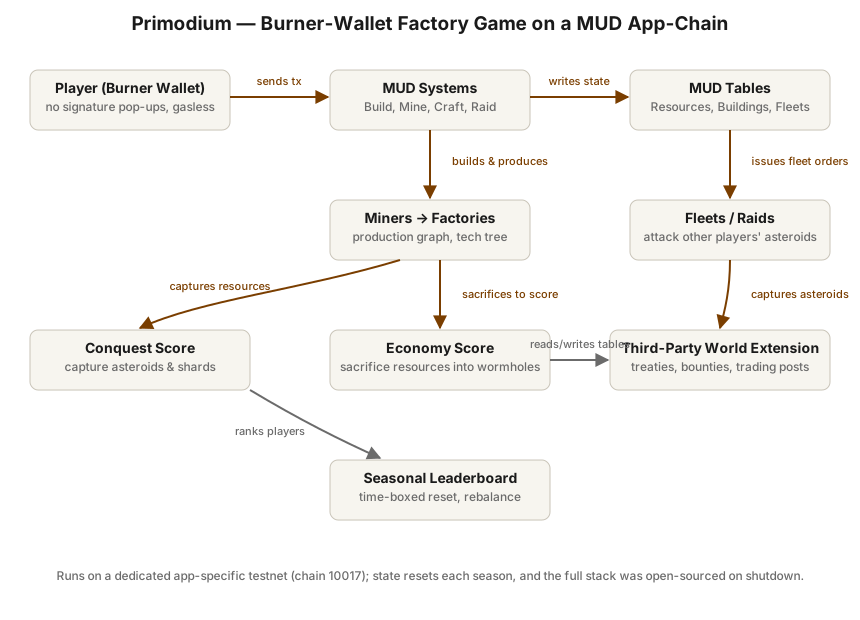 Open full-size diagram
Summary
Primodium was one of the flagship experiments of the "fully onchain game / autonomous world" movement of 2023–2024: a browser-based, space-themed factory-building game whose entire game state and logic lived in smart contracts built on Lattice's MUD framework, with a Phaser/React client on top. Founded in late 2022 by Morris Hsieh (CEO) and Emerson Hsieh — who by press accounts had previously experimented with NFTs in Minecraft before Microsoft's crypto crackdown pushed them toward fully onchain games — Primodium shipped its first public prototype on the Lattice testnet in April 2023 and iterated in public through at least eleven versions. The final release, v0.11.1 (June 27, 2024), ran on a dedicated app-specific testnet (chain ID 10017) with the World contract at 0xcdde8dc29bcb7a7b30e22318746dfd81f0510b43. The studio also shipped a second title, Primodium: Empires, a turn-based prediction-market game deployed on Base and audited by Pashov Audit Group. On February 10, 2025, the team open-sourced the entire stack (MIT-licensed code; artwork retained as Primodium Inc. IP) and announced it was transitioning to new opportunities, ending live operation of both games.
Design (Mechanism)
The core loop was explicitly Factorio-like, translated to onchain state. Players started with a main base on an asteroid, built miners for basic resources, connected factories to miners to synthesize more complex resources, and climbed a tech tree that unlocked further buildings — culminating in shipyards, fleets, orbital combat, raiding of other players' bases, alliances, and colonization of additional asteroids and resource-rich "motherlodes." Every action was a transaction against MUD tables and systems.
Key mechanism choices:
- Burner wallets / signature-free play. A session keypair stored in the browser signed transactions on the player's behalf, so gameplay required no wallet pop-ups, NFTs, or even login — progression was keyed to the browser. This was one of the earliest smooth implementations of session keys in an onchain game.
- App-specific chain. After starting on the shared Lattice testnet, Primodium moved to its own dedicated testnet (chain ID 10017; Primodium is listed among Caldera's rollup clients), isolating its heavy transaction load from other applications. Gas was free for players; there was no token.
- Seasonal, resettable worlds. Versions ran as time-boxed seasons (e.g., v0.7.1's four-week season launched October 5, 2023) with leaderboards, letting the team rebalance between rounds.
- Dual scoring (v0.11). Matches scored both conquest (capturing asteroids and volatile "shards" that explode after set durations) and economy (sacrificing resources into wormholes), with matches ending when a global unit-death counter hit its limit — an unusual, fully deterministic end condition. "Colony Slots" capped how many asteroids a player could hold, curbing snowballing.
- Composability via MUD world extensions. Third parties could deploy contracts extending the live game — the docs demonstrate player-written treaties, local trading posts, and player bounties that the original designers never built. The game's namespaced systems (e.g.,
Pri_11__) were a public API.
Outcome
Primodium succeeded as a running experiment and public good but not as a business. It was continuously playable from April 2023 through 2024, drew genuinely emergent PvP culture — WASD's firsthand account of v0.7.1 records 300+ players in the first six days of the season, coordinated overnight raid campaigns (one player was raided 18 times while asleep), suspected player-written automation bots, and alliance politics that played out on X — exactly the emergent behavior autonomous-world theorists predicted. The stack itself was robust enough to run Factorio-like production graphs onchain, and Empires shipped on Base with a professional audit. But no sustainable revenue model or token materialized, and in February 2025 the team open-sourced everything and moved on (subsequent work included Solana developer tooling and the Tub trading app). The v0.11 testnet is offline; the code, contracts, and documentation survive as reference material.
Why it worked
- MUD plus burner wallets removed almost all crypto friction: playable in a browser in seconds, no gas, no signatures, no NFT gate — rare for its era.
- Public iteration with seasonal resets let the team ship eleven major versions in ~18 months and rebalance aggressively without permanently punishing players.
- Real emergent gameplay: because state was open and permissionless, players built bots, formed alliances, and third parties could extend the game with treaties and bounties — validating the composability thesis better than most peers.
- App-specific chain kept a transaction-heavy game responsive and free without congesting or being congested by others.
Where the design broke
- No economic engine. Free-to-play on a gasless testnet with no token, no asset sales, and no clear monetization meant the studio burned capital with no revenue path; the pivot to Empires (prediction-market mechanics on Base) came late and did not change the trajectory.
- Niche audience. Factorio-like depth appealed to a small hardcore of onchain-gaming enthusiasts (hundreds, not tens of thousands of players); the broader autonomous-worlds wave receded through 2024 as funding and attention moved elsewhere.
- Browser-keyed progression and testnet deployments signaled impermanence — player investment could not translate into durable, owned assets, undercutting the core "onchain = persistent ownership" pitch.
- Bot asymmetry: open state made scripted raiding easy, which is thematically pure but punishing for casual human players.
Lessons
- Session keys/burner wallets solved onchain-game UX years before account abstraction went mainstream; frictionless onboarding is achievable but does not by itself create retention.
- A fully onchain game can prove its composability thesis (third-party treaties, bounties, bots) and still fail commercially — technical openness is not a business model, and monetization must be designed in from the start, not deferred.
- Transaction-heavy games need app-specific chains, but a private testnet undermines the persistence and asset-ownership promise that justifies being onchain at all.
- Open-sourcing on shutdown (MIT code, audited contracts, full docs) converts a dead product into public infrastructure — Primodium's exit is a model for winding down onchain experiments responsibly.
Redesign (EDITORIAL — hypothesis, not fact)
This section is editorial speculation. A revived Primodium might deploy on a persistent, cheap L2/L3 mainnet from day one so bases and resources are durable assets, and monetize via cosmetic NFTs plus a small fee on inter-player resource trades rather than a token. Seasonal competitive shards could coexist with one persistent world. Bot play could be embraced explicitly — a tiered ladder separating human-verified play from open "agent leagues," which in 2025-era agent-mania might itself have been the growth wedge. Finally, the world-extension API could be paired with a revenue share so third-party module authors (treaties, marketplaces, bounties) have incentives to grow the world, turning composability from a demo into a flywheel.
Sources
- Primodium monorepo (fully onchain game, MUD & Phaser) — primary (contract)
- Primodium Developer Documentation — primary (docs)
- Primodium v0.11.1 release notes (world address, chain 10017, June 27 2024) — primary (docs)
- Primodium: Empires (formerly deployed on Base, Pashov audit) — primary (docs)
- Primodium open-source announcement, Feb 10 2025 — primary (retrospective)
- Onchain Lore V: The Primodium Wars (WASD, v0.7.1 playtest account) (analysis)
- Onchain Lore III: Adventures in Primodium (WASD) (analysis)
- PlayToEarn: Primodium Brings Blockchain Strategy to Space-Based Gaming (news)
Related experiments
Last verified: 2026-07-27 · Spot an error? Suggest a correction