Zeitgeist
A Substrate-based appchain for prediction markets and futarchy in the Polkadot/Kusama ecosystem that shipped novel market-maker and court mechanisms but never found sustained trading volume.
▶ Run interactive simulation animated mechanism with editable parameters
How it works onchain
 Open full-size diagram
Summary
Zeitgeist is a purpose-built blockchain ("appchain") for prediction markets and futarchy in the Polkadot ecosystem, founded by Logan Saether (ex-Web3 Foundation) with a $1.5M seed round in March 2021 (D1 Ventures, Genblock, AU21, Acala co-founders, and others). Its thesis inverted the usual pattern: instead of deploying prediction markets as smart contracts on a general-purpose chain, build the entire chain around them — market creation, specialized AMMs, dispute resolution, and governance all as native Substrate runtime pallets. The ZTG token launched around November 1, 2021; the chain went live as a Kusama parachain, won Polkadot auction #32 in November 2022 with a self-funded 37,656 DOT bid, and completed one of the ecosystem's early Kusama-to-Polkadot parachain migrations in 2023. It renewed its slot for trivial cost (500 DOT, auction #78, 2024) and holds a leased core through 2028. The machinery works and the chain persists, but usage never materialized at scale: by 2026 ZTG's market cap had collapsed to roughly $300K, daily volumes sat under $50K, and the founder had moved on — a stark contrast to Polymarket's simultaneous breakout on the same product category.
Design (Mechanism)
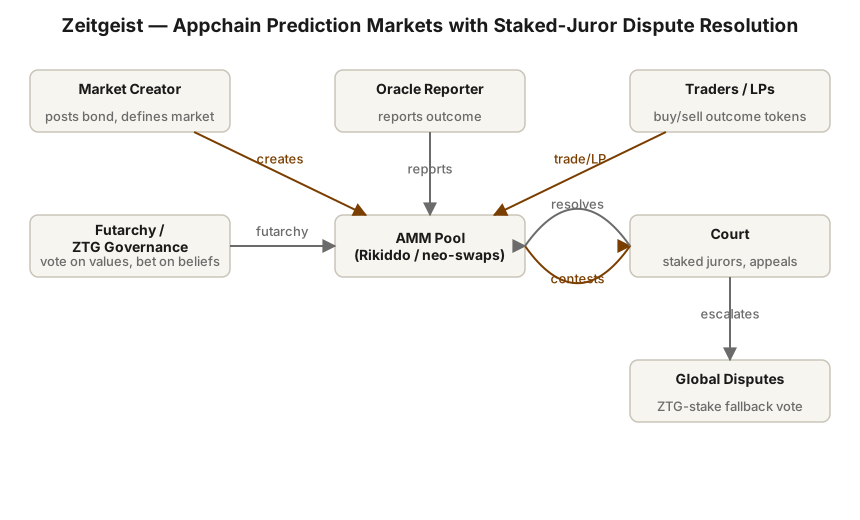
- Appchain architecture. Zeitgeist is a Substrate chain whose runtime pallets implement the whole prediction-market lifecycle: permissionless market creation (with bonds against spam/invalid markets), outcome tokenization, trading, oracle reporting, disputes, and resolution. As a parachain it inherits security from the relay chain and uses XCM to accept assets from other parachains (e.g., aUSD/kUSD stablecoins).
- Rikiddo scoring rule. Zeitgeist's signature research contribution: a "liquidity-sensitive dynamic LMSR" (named from the Japanese for "liquid"), combining Hanson's logarithmic market scoring rule with the Othman–Sandholm–Pennock–Reeves liquidity-sensitive market maker, adjusting fees/liquidity parameters dynamically with trading activity so a single AMM can serve both thin and deep markets.
- Multiple market-maker regimes. In practice the codebase evolved through Balancer-style CPMM pools, then "neo-swaps" (an LMSR implementation), plus parimutuel markets and an orderbook — reflecting iterative search for a structure that works at low liquidity. Combinatorial outcome tokens allow complex/conditional positions.
- Layered dispute resolution. Oracles report outcomes; contested reports escalate to a decentralized Court where jurors stake ZTG, are randomly drawn, vote on the true outcome, and face slashing for minority/incoherent votes, with appeal rounds. A "global dispute" fallback resolves the most contested markets by open ZTG-stake voting.
- Futarchy and token governance. ZTG holders govern the chain; a futarchy pallet enables "vote on values, bet on beliefs" decision markets, aiming for the chain to eventually steer its own evolution through its own prediction markets.
- Slot economics. The chain paid for blockspace via parachain auctions: an expensive 37,656 DOT bid in 2022, then effectively free renewal (500 DOT) in 2024 as parachain slot demand collapsed — later moving to Polkadot's coretime model.
Outcome
Technically, Zeitgeist shipped nearly everything it promised: a live chain, working markets, the Rikiddo/neo-swaps AMM research lineage, the staked-juror Court, and futarchy tooling — an unusually complete mechanism stack, open-sourced under GPL-3.0 and still maintained. Commercially, it failed to attract traders. ZTG (100M supply) fell to roughly $0.003 with a ~$309K market cap by mid-2026; third-party surveys of the prediction-market sector in 2026 note daily volume under $50K and observe that the Court "is rarely tested at scale" because so few markets are contested at meaningful stakes. Founder Logan Saether's X bio now reads "Ex @ZeitgeistPM." Meanwhile Polymarket — a centralized-operator UX over Polygon contracts, with USDC and mainstream event coverage — captured essentially the entire category during the 2024 US election cycle. The chain itself remains live with a core lease into 2028, so the experiment is not dead; it is a fully-built machine waiting for users. Outcome: technically successful, commercially unsuccessful.
Why it worked
- Appchain fit for the mechanism. Prediction markets need cheap, frequent, small transactions and custom logic (courts, bonds, market lifecycle). A dedicated runtime delivered all of this natively without gas-market competition or Solidity constraints.
- Genuine mechanism research. Rikiddo was a real contribution to AMM design for prediction markets (liquidity-sensitive LMSR), and the layered oracle→court→global-dispute resolution stack is one of the more thoughtful decentralized adjudication designs actually deployed.
- Cheap survival. Substrate/parachain economics let a small team keep a whole chain alive at trivial marginal cost (a 500 DOT slot renewal), so the protocol outlived its hype cycle instead of being switched off.
Where the design broke
- Wrong distribution channel. Prediction markets are demand-constrained, not infrastructure-constrained. Polkadot's user base was small and shrinking through 2022–2024, so the best mechanism stack in the category sat on a chain with almost no traders, while Polymarket won with worse decentralization but vastly better liquidity, UX, and mainstream reach.
- Liquidity cold-start unsolved by math. Rikiddo and neo-swaps mitigate thin-market pricing but cannot conjure counterparties; sparse, low-stakes markets made prices uninformative, which repelled the informed traders needed to make them informative.
- Mechanism complexity outran usage. Court, futarchy, combinatorial tokens, and four market-maker regimes were built before there was volume to exercise any of them; engineering effort went into breadth rather than acquiring users for one killer market type.
- Ecosystem beta. Tying fortunes to Kusama/Polkadot meant inheriting that ecosystem's drift; the costly migration from Kusama to Polkadot consumed roadmap time without adding demand.
Lessons
- Prediction markets are a demand business: distribution, event selection, and liquidity beat mechanism sophistication. Build where the bettors are, not where the architecture is cleanest.
- An appchain is a double-edged sword for niche verticals — you get perfect-fit infrastructure and cheap blockspace, but you also inherit your host ecosystem's user drought and must fund your own liquidity gravity.
- Dispute/court systems only earn credibility under load; a beautifully designed adjudication mechanism that is "rarely tested at scale" provides little more assurance than an untested one. Sequence: volume first, decentralized resolution second.
- Shipping the complete vision (courts, futarchy, multiple AMMs) before product-market fit spreads a small team thin; one well-liquid market type with a crude oracle would likely have taught more.
- Cheap chain survival is real optionality: because the chain costs almost nothing to keep alive, the mechanism stack remains available if futarchy or Polkadot-native demand ever arrives.
Redesign (EDITORIAL — hypothesis, not fact)
This section is a hypothesis, not a statement of fact. A redesigned Zeitgeist would treat its runtime as a B2B resolution-and-market engine rather than a consumer venue: keep the Substrate pallets (the genuinely good part) but ship the frontend and liquidity where users already are — e.g., settle markets on the appchain while exposing trading via XCM/bridges to high-traffic environments, or license the Court as a neutral resolution layer to other prediction-market frontends (the way UMA serves Polymarket). Concentrate on one liquidity flywheel: a small set of recurring, high-salience markets (crypto prices, Polkadot governance outcomes) with protocol-owned liquidity seeded from treasury, rather than permissionless long-tail creation that fragments a tiny user base. Defer futarchy until the chain's own referenda can be mirrored as decision markets with real stakes — using itself as the first futarchy customer — and publish court case throughput as the key credibility metric. Finally, denominate markets in a bridged, widely held stable asset from day one; requiring exposure to a micro-cap native token to bet is a tax on exactly the users a prediction market needs.
Sources
- Zeitgeist official site — primary (docs)
- zeitgeistpm/zeitgeist runtime (GPL-3.0) — prediction-markets, court, futarchy, neo-swaps pallets — primary (contract)
- Zeitgeist Documentation — Liquidity — primary (docs)
- Zeitgeist Will Migrate To The Polkadot Relay Chain (official blog) — primary (docs)
- Introducing Zeitgeist's Rikiddo Scoring Rule (docs)
- Zeitgeist — Polkadot Forum profile (governance)
- Parachains.info — Zeitgeist (auction #32 and #78, lease history, token stats) (analysis)
- Zeitgeist raises $1.5M seed (March 2021) (news)
- Zogby — Crypto & DeFi Prediction Markets survey (2026 activity snapshot) (analysis)
Related experiments
Last verified: 2026-07-26 · Spot an error? Suggest a correction