OpenRank (Karma3)
Karma3 Labs' decentralized reputation-compute protocol that ran EigenTrust over onchain and social graphs to power verifiable rankings, feeds, and sybil-resistant airdrops — technically validated but shut down in 2026 for lack of a business model.
▶ Run interactive simulation animated mechanism with editable parameters
How it works onchain
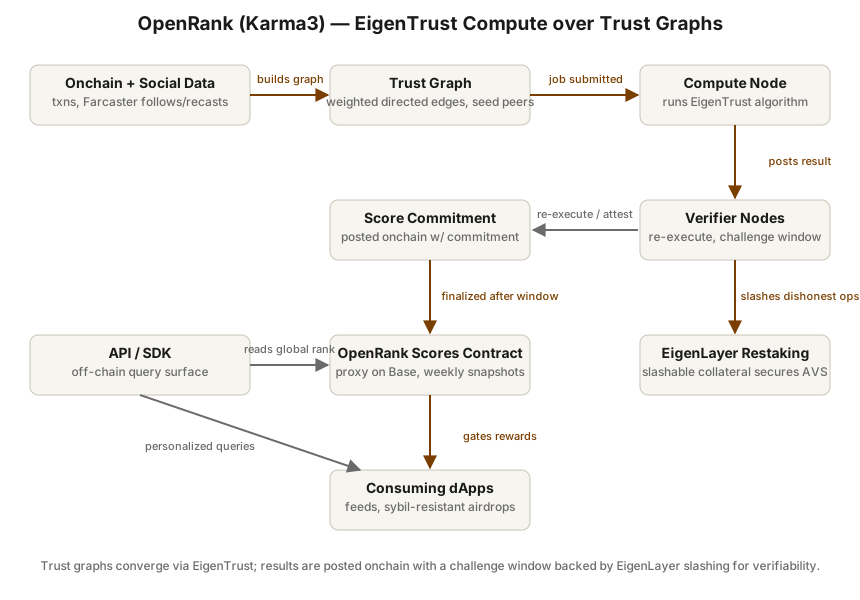 Open full-size diagram
Summary
OpenRank was a decentralized ranking-and-reputation protocol built by Karma3 Labs (founded 2022 in Palo Alto by Sahil Dewan, previously of Harmony Protocol, with Eugene Kim). Its bet: the open web needs a neutral, verifiable "reputation compute layer" — the equivalent of Google's PageRank or Twitter's recommendation engine, but permissionless, auditable, and not owned by any single company. The core engine ran EigenTrust — the 2003 Stanford algorithm originally designed to rank peers in P2P file-sharing networks — over reputation graphs built from onchain activity and open social data (follows, recasts, mentions, engagement). Developers queried the resulting scores via APIs and SDKs, or read them directly from a contract on Base, to power feeds, discovery, sybil-resistant airdrops, and trust badges.
Karma3 raised a $4.5M seed in March 2024 led by Galaxy and IDEO CoLab Ventures (with Spartan, SevenX, HashKey, Flybridge and others). OpenRank became best known for powering Farcaster ranking and feed curation, and later became an EigenLayer/EigenCloud-secured verifiable-compute service. By the end it had generated reputation scores for 10M+ onchain users across 50+ integrations and helped route over $50M in incentive distributions. On June 16, 2026, Dewan announced Karma3 Labs would wind down after 3.5 years, return remaining capital to investors, and permanently open-source and archive the code — stating the team had proven that onchain reputation signals move capital and behavior, but never found a sustainable, compounding business model.
Design (Mechanism)
Reputation graphs. OpenRank ingested open data — onchain transactions, attestations, and P2P social actions (Farcaster follows, recasts, replies, mentions) — and constructed weighted directed trust graphs: local, first-hand trust judgments between peers.
EigenTrust compute. EigenTrust aggregates local trust transitively: you trust whom your trusted peers trust, converging (via eigenvector iteration, like PageRank) to a global or personalized trust score per node. Pre-trusted "seed peers" anchor the computation, which is what gives the algorithm sybil resistance — an attacker can mint infinite accounts that vouch for each other, but without inbound trust from the honest region of the graph their scores stay near zero. OpenRank ran both global rankings (Farcaster global rank refreshed roughly every two hours) and on-demand personalized graphs seeded from an individual user's own trust neighborhood.
Verifiable compute layer. The 2024–2025 protocol design decentralized the computation itself: users submitted jobs (dataset + algorithm parameters); compute nodes executed the graph algorithm and posted results with commitments onchain, opening a challenge window; independent verifier nodes re-executed and attested or challenged, with dishonest operators slashable via EigenLayer restaked collateral (later folded into EigenCloud alongside TEEs and decentralized data availability). This made rankings auditable and economically enforced rather than "trust the API."
Distribution surfaces. Scores were consumed via REST APIs/SDKs, Farcaster frames and feed integrations, and an upgradeable proxy contract on Base (0xaC1E…6cd8) publishing weekly score snapshots that any contract could read — enabling reputation-gated airdrops, mints, and rewards fully onchain.
Outcome
Technically and in ecosystem terms, OpenRank worked. It became the de facto reputation layer for Farcaster (profile rankings, spam filtering, curated feeds), powered token-recommendation surfaces in wallets, contributor leaderboards in apps like Cura, and 500+ reputation-weighted airdrop campaigns; cumulative claims at shutdown were 10M+ users scored, 50+ integrations across DeFi, L1s/L2s, wallets, launchpads and social networks, and $50M+ in incentives distributed using its scores. Commercially, it never converted that footprint into durable revenue. No token was launched. On June 16, 2026, Karma3 Labs announced an orderly shutdown: funds returned to investors, code, docs, and research open-sourced and archived on GitHub. Outcome: technically successful, commercially unsuccessful.
Why it worked
- Right algorithm, right substrate. EigenTrust needs an open, portable trust graph to be useful — something Web2 platforms never expose. Farcaster's open social graph and public chains gave OpenRank exactly the data commons the 2003 algorithm had been waiting for.
- Real, immediate pain point. Farcaster clients and airdrop designers had acute spam/sybil problems and no in-house ranking teams; OpenRank was a drop-in answer, which drove genuine adoption rather than mercenary usage.
- Credible neutrality as a feature. Verifiable compute with challenge games and restaked collateral meant apps could outsource rankings without trusting Karma3 — a real differentiator versus centralized scoring APIs (and a genuine early AVS use case for EigenLayer).
- Clean developer ergonomics. Serving scores as simple APIs and a readable Base contract abstracted away all the graph-compute complexity.
Where the design broke
- Infrastructure with no capture. Reputation scores are a public good: once computed and published onchain, they are free to read and easy to fork. OpenRank's own openness undercut any pricing power.
- Market too small. Its flagship demand surface, Farcaster, plateaued well below mainstream scale; 50 crypto-native integrations was impressive breadth but thin aggregate spend.
- Airdrop demand was cyclical. Sybil-resistant distribution was the clearest willingness-to-pay, but it tracked the incentive-campaign cycle, which cooled sharply into 2026's shutdown wave.
- No token, no flywheel. Without a token, OpenRank couldn't subsidize its two-sided compute network; the honest alternative — SaaS revenue — never compounded, and the team chose to return capital rather than force a token on a public-good protocol.
- By the founder's own account: the thesis (reputation signals move funds and behavior) was validated; the business model was never found.
Lessons
- Public-good infrastructure needs a capture mechanism designed in from day one. If your output is free-to-read scores on a public chain, monetization must live somewhere else in the stack (compute markets, private/personalized queries, enterprise SLAs) — or be socialized via a token/protocol fee — before venture money runs out.
- Verifiability is necessary but not sufficient. Making rankings auditable answered "why trust you?" but not "why pay you?" — cryptographic guarantees don't create demand on their own.
- Reputation is only as valuable as the economy it gates. Anchoring to one emergent social graph (Farcaster) capped the ceiling; reputation layers inherit the TAM of their substrate.
- Seed-peer selection is the hidden governance surface. EigenTrust's sybil resistance flows from who counts as pre-trusted; any "neutral" ranking protocol quietly concentrates power in whoever picks the seeds and the graph-weighting strategy.
- An honest shutdown is a mechanism too. Returning funds and permanently open-sourcing the stack preserved the research commons — several projects can (and do) fork the ranking pipelines.
Redesign (EDITORIAL — hypothesis, not fact)
This section is editorial hypothesis, not established fact. A revived OpenRank would invert the revenue model: keep global scores free (they're unenforceable anyway) but charge for personalized, low-latency, private reputation queries — the on-demand per-user EigenTrust runs that are expensive to replicate and where the real product value (feeds, credit, agent trust) lives. Second, it would target a substrate with intrinsic willingness-to-pay rather than social feeds: AI-agent reputation (which the team itself flagged late) and undercollateralized-lending risk scoring both attach reputation directly to capital at risk, so a basis-point fee on reputation-gated volume is chargeable. Third, distribution-side capture: instead of selling scores to airdrop teams, run the distribution itself and take a percentage of sybil-spend saved — pricing against demonstrable counterfactual loss. Finally, decentralize seed-peer selection via a stake-and-challenge registry so the neutrality claim is structural rather than reputational; that neutrality is precisely what would let competing wallets and clients all standardize on one scoring layer, which is the network effect the original never quite locked in.
Sources
- OpenRank official site — primary (docs)
- OpenRank documentation — primary (docs)
- OpenRank Scores Onchain (Base contracts) — primary (docs)
- Ranking Strategies on Farcaster — primary (docs)
- OpenRank protocol GitHub — primary (contract)
- Unlocking Verifiable Reputation with OpenRank and EigenCloud (Sep 12, 2025) — primary (docs)
- Karma3 Labs Raises a $4.5M Seed Round Led By Galaxy and IDEO CoLab (Mar 1, 2024) (news)
- Karma3 Labs raises $4.5M to improve trust in web3 (TechCrunch) (news)
- Karma3 Labs announces shutdown of OpenRank, returning funds and open-sourcing code (Wu Blockchain, Jun 16, 2026) (news)
- Founder shutdown announcement (X post, as cited by Wu Blockchain) — primary (retrospective)
Related experiments
Last verified: 2026-07-26 · Spot an error? Suggest a correction