Colorado Quadratic Voting
The Colorado House Democratic caucus used quadratic voting from 2019–2023 to prioritize budget bills — the first use of QV inside a US legislature — before the anonymous-ballot format was discontinued in 2024 over conflict with open-meetings transparency requirements.
▶ Run interactive simulation animated mechanism with editable parameters
How it works onchain
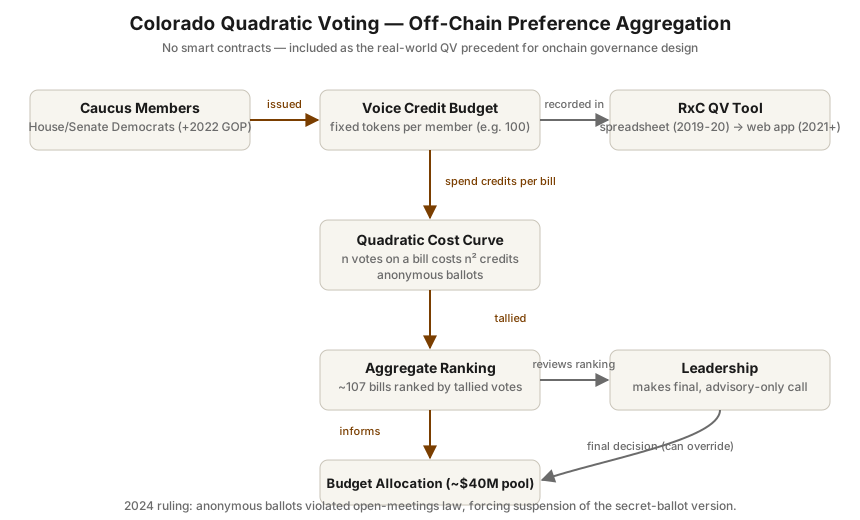 Open full-size diagram
Summary
In mid-April 2019 the Democratic caucus of the Colorado House of Representatives became the first legislative body in the United States to use quadratic voting (QV) for a real decision: prioritizing which of roughly 107 spending bills should receive funding from a limited end-of-session budget pool (about $40 million against roughly $120 million in requests, per the Colorado Sun). The experiment was initiated by Rep. Chris Hansen, then chair of the House Appropriations Committee and an Oxford-trained energy economist with an interest in game theory, working with the RadicalxChange Foundation and the Democracy Earth Foundation. Nothing ran on a blockchain — the 2019–2020 rounds used spreadsheet tooling and by 2021 a purpose-built RxC QV web application — but the experiment is the most-cited real-world validation of QV, the mechanism underpinning onchain systems like Gitcoin's quadratic funding and clr.fund. QV became a recurring caucus tool through 2023 (spreading to the Senate Democrats, executive-branch working groups, and even some Senate Republicans in 2022) before the secret-ballot format was discontinued in 2024, citing conflict with Colorado's open-meetings transparency requirements.
Design (Mechanism)
- Voice credits: each caucus member received a fixed budget of tokens (100 tokens in the April 2019 caucus poll per Wired/RadicalxChange; the Colorado Sun reported 25 tokens for a later round — figures varied across rounds).
- Quadratic cost curve: casting n votes on a single bill cost n² tokens — 1 vote = 1 token, 10 votes = 100 tokens. A member could go all-in on one bill or spread votes (e.g., 5 votes on each of four bills for 100 tokens).
- Intensity revelation: the quadratic price makes it exponentially expensive to pile votes on one item, so the aggregate tally reveals both breadth and intensity of preference rather than just majority direction.
- Anonymity and non-bindingness: ballots were anonymous, and results were formally advisory — leadership still made final funding calls — though in practice the ranking heavily shaped outcomes.
- Tooling evolution: spreadsheet-based (2019–2020) → dedicated RxC QV web app (2021) → improved interface with animated voice-credit blocks (2022) → navigation refinements (2023). No smart contracts, sybil resistance, or cryptographic tallying: eligibility was simply caucus membership.
Outcome
The 2019 poll produced what Hansen called "a better signal with less noise... able to capture people's intensity." Senate Bill 85, the Equal Pay for Equal Work Act, topped the ranking with 60 votes; health-care measures took five of the top ten slots, with climate, criminal-justice, and cost-of-living bills filling out the top twenty. The method was repeated in 2020 by the Governor's Office of Operations (where a QV poll surfaced support for creating Colorado's Behavioral Health Administration, later endorsed by the governor), by both House and Senate Democratic caucuses in 2021 (80+ proposals against a ~$50 million pool), and expanded in 2022 to include Senate Republicans. In 2024 the anonymous-ballot format was discontinued over conflict with the legislature's open-meetings transparency requirements; subsequent use of QV has required individual allocations to be made public.
Why it worked
- Right-sized problem: allocating a scarce budget across many competing bills is exactly the cardinal-preference-aggregation problem QV is designed for; one-person-one-vote had previously produced opaque leadership horse-trading.
- Low stakes, advisory framing: because the poll was non-binding, participants could experiment without constitutional or procedural risk, which got a real legislature to actually try it.
- Credible champions: an appropriations chair with formal economics training plus RadicalxChange/Democracy Earth support gave the mechanism internal legitimacy, and repeated annual use (2019–2023) shows participants found the signal genuinely useful, not a stunt.
Where the design broke
- Transparency clash: the anonymity that made honest intensity-signaling possible conflicted with open-meetings requirements for public officials, ending the mechanism in its original secret-ballot form in 2024.
- Advisory ≠ binding: the Colorado Sun found leadership still overrode results — some top-ranked bills went unfunded while lower-ranked ones were funded anyway, diluting the mechanism's authority.
- No strategic safeguards: with a small, coordinated electorate (a caucus), QV's assumptions about independent voters are weak; collusion and vote-trading were unaddressed (though never documented as a problem).
- Fragile tooling adoption: the Senate initially declined QV in 2019 partly over fears of "computer glitches," choosing ranked voting instead — a reminder that mechanism adoption is bottlenecked by trust in tooling.
Lessons
- QV demonstrably produces clearer prioritization signals than 1p1v in real institutions, not just lab settings — this experiment is the strongest empirical citation available to onchain QV/QF designers.
- Anonymity and public accountability are in direct tension for elected representatives; onchain designs get to choose their point on that spectrum explicitly (e.g., MACI-style private-but-verifiable tallying), whereas legislatures may have it chosen for them by statute.
- Advisory mechanisms earn adoption cheaply but can be quietly overridden; binding execution (which smart contracts provide natively) is what converts a signal into an allocation.
- Institutional environment is part of the mechanism: a design that works technically for five years can still be discontinued when it conflicts with pre-existing transparency rules.
Redesign (EDITORIAL — hypothesis, not fact)
This section is editorial speculation, not historical fact. A compliant successor could use MACI-style zero-knowledge tallying inverted for the public-official context: each legislator's full allocation is published and signed (satisfying open-meetings law), while the deliberation-phase drafts remain private until a simultaneous reveal, reducing bandwagon and leadership-pressure effects that anonymity was protecting against. Voice-credit budgets could roll over across sessions to let members bank intensity for issues they care most about, and the poll could be made semi-binding — e.g., leadership must fund the top-N ranked bills or publish a written justification for each deviation — converting the signal into accountable allocation without removing human discretion. An onchain or verifiable off-chain audit trail would have also made the anonymity/transparency tradeoff easier to resolve without discarding the mechanism entirely.
Sources
- Quadratic Voting in Colorado (RadicalxChange wiki) — primary (docs)
- Quadratic Voting in Colorado: 2020 (RadicalxChange blog) — primary (docs)
- Plural Voting in the Colorado State Legislature (RadicalxChange project page) — primary (docs)
- Colorado's experiment in quadratic voting tried to remove politics from budget decisions. But did it work? (Colorado Sun, May 2019) (news)
- Judge orders Democrats at the Colorado Capitol to stop using secret voting system to allocate state budget (Colorado Sun, Jan 2024) (news)
- A secret ballot system at Colorado's statehouse is quietly killing bills and raising transparency concerns (KUNC, Oct 2022) (news)
- Quadratic Voting in the Field (Marginal Revolution, Apr 2019, summarizing Wired's coverage) (analysis)
- Colorado Tried A New Way To Vote: Make People Pay, Quadratically (Wired, republished by Democracy Chronicles) (news)
Related experiments
Last verified: 2026-07-27 · Spot an error? Suggest a correction