Galxe
A web3 'credential data network' that turned marketing quests into onchain primitives — gasless NFT badges (OATs), soulbound Passports, and a token (GAL, later G) — becoming crypto's dominant growth/quest platform.
▶ Run interactive simulation animated mechanism with editable parameters
How it works onchain
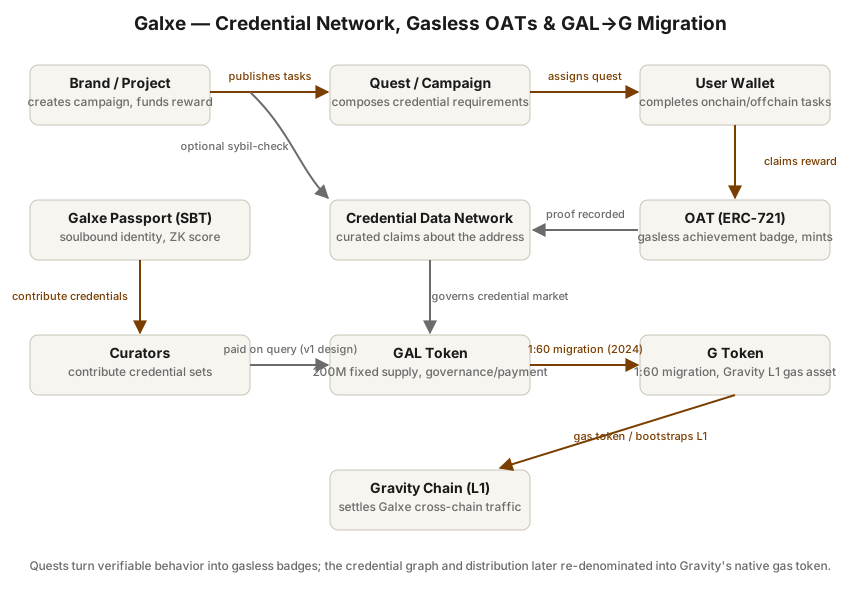 Open full-size diagram
Summary
Galxe (founded 2021 as Project Galaxy by Charles Wayn and Harry Zhang, both previously of DLive/Lino Network) set out to build a "web3 credential data network": a shared, open database of what wallets and identities have actually done — traded on a DEX, held an NFT, voted in a DAO, attended an event — packaged so that projects could target, reward, and grow communities using verifiable behavior instead of self-reported marketing lists. In practice it became crypto's dominant quest/campaign platform: projects publish task lists ("quests"), users complete them, and rewards are issued as gasless NFT badges (OATs), whitelist spots, points, or tokens. The GAL token launched via CoinList sale (February 2022) and Binance Launchpool (April 2022); the project rebranded to Galxe in September 2022. In July 2024, DAO proposals GP-25/GP-30 approved migrating GAL to G at 1:60 (12B initial supply), making G the gas token of Galxe's own Layer 1, Gravity. The company claims 30M+ users and 7,000+ partner brands. It remains live and central to web3 growth marketing — while also being the canonical case study in incentivized-quest "mercenary engagement" and sybil farming.
Design (Mechanism)
- Credential data network. The core primitive is a credential: a claim about an address or identity (onchain behavior, offchain actions like Twitter follows/Discord joins, or curated lists). Credentials are contributed by projects and community "curators"; in the original GAL design, curators were to be paid in GAL when applications queried their credential sets, creating a two-sided data market with GAL as governance and payment token (200M fixed supply).
- Campaigns/Quests. Brands compose credentials into gated campaigns: "do X, Y, Z, prove it, claim a reward." This turned user-acquisition funnels into onchain-verifiable pipelines and made airdrop/whitelist targeting programmatic.
- OATs (On-chain Achievement Tokens). Lightweight, effectively gasless ERC-721 badges minted as proof of participation — a commercialized descendant of POAP that let campaigns issue millions of cheap credentials across many chains.
- Galxe Passport. A soulbound (non-transferable) identity token backed by KYC-style verification, intended as sybil resistance: one human, one Passport. Later extended by the Galxe Identity Protocol (zero-knowledge proofs over credentials, so users can prove attributes without doxxing) and Galxe Score (wallet reputation scoring).
- Token migration and vertical integration. The 2024 GAL→G migration (1:60; portal for self-custody users with GAL burned on migration; automatic conversion on CEXs and for stakers) converted an application token into the native gas asset of Gravity, an L1 purpose-built to settle Galxe's cross-chain quest/identity traffic — a rare example of a marketing platform bootstrapping its own chain from accumulated distribution.
Outcome
Status: ongoing. Galxe became the category leader in web3 quests/credentials: multi-chain support, integration by thousands of projects (from L2 launches like Base and testnet campaigns like Berachain's to DeFi protocols), and self-reported figures of 30M+ users, 7,000+ brands, and ~1M daily active users. GAL traded on major exchanges from 2022; the 2024 G migration and Gravity chain launch (Alpha Mainnet 2024, full mainnet slated later) repositioned it as an infrastructure play. The notable security failure was not a smart-contract exploit but a DNS hijack: on October 6, 2023, an attacker socially engineered registrar Dynadot into transferring control of galxe.com, serving a wallet-drainer to visitors for ~5 hours; roughly 1,120 users lost ~$270k. Galxe reimbursed affected users ~$396k (losses plus 10%) in USDT. Persistent criticisms: quest incentives attract airdrop farmers and bots at industrial scale, Passport uptake is a small fraction of the user base, and "engagement" bought via quests often evaporates after rewards end.
Why it worked
- It sold picks and shovels for the airdrop meta. From 2021–2024, nearly every token launch needed provable "community activity"; Galxe standardized that demand into a self-serve product with cross-chain reach.
- Gasless OATs removed friction. Making participation badges free to claim let campaigns scale to millions of mints, seeding a huge credential graph that made the network more valuable to the next brand.
- Two-sided network effects. More brands → more rewards → more users → better credential data → more brands. Galxe reached this flywheel before competitors (Layer3, Zealy, QuestN).
- Credible crisis response. Reimbursing 110% of DNS-attack losses within days preserved trust after the platform's worst incident.
Limitations and criticisms
- Incentivized attention is adversarial. The same mechanism that generates verifiable engagement invites sybils and mercenary farmers; projects repeatedly found that quest-acquired "users" churned once rewards stopped, degrading the value of the credential data itself.
- Sybil resistance stayed optional. Passport (KYC/SBT) and Galxe Score exist, but most campaigns didn't require them, so the platform's core data remained polluted by farm wallets.
- Token value capture was weak in v1. GAL's curator-payment data-market vision largely didn't materialize as designed; the 1:60 migration into a gas token for a proprietary L1 was, in part, a response to the application token needing a stronger sink.
Lessons
- Verifiable ≠ valuable: a credential proves an action occurred, not that the actor was a genuine user. Mechanism designers must price in that any rewarded, cheaply-repeatable action will be industrially farmed.
- Distribution can be bootstrapped into infrastructure. Accumulating tens of millions of wallets through quests gave Galxe enough gravity (literally) to launch its own chain and re-denominate its token — sequencing app → network → chain rather than the reverse.
- The weakest link is often offchain. Galxe's only major user-loss event came through a domain registrar's support desk, not its contracts; DNS/registrar security and signing hygiene deserve audit-level attention.
- Sybil resistance must be default-on to matter. Optional identity layers get adopted by exactly the users who least need screening; the farmers route around them.
- Fast, over-full restitution (110%) is cheap insurance relative to the reputational cost of a drawn-out compensation fight.
Redesign (EDITORIAL — hypothesis, not fact)
This section is editorial analysis — a hypothesis, not established fact. A redesigned Galxe would invert the incentive gradient: instead of paying for task completion (which selects for farmers), campaigns would stake rewards against retention curves — escrowed payouts that vest only if the wallet exhibits organic post-campaign behavior (repeat usage without further rewards), verified by the credential graph itself. Second, make sybil-weighting mandatory and continuous rather than binary KYC: every reward is multiplied by a ZK-proven uniqueness/reputation score (Passport + Score by default), so farming remains possible but unprofitable at the margin. Third, fix data-market value capture from day one: charge querying applications in-protocol fees that stream to the curators and to the users whose credentials are queried (consented via the identity protocol), aligning the people generating the data with its monetization instead of routing all value to the platform token. Finally, treat frontend/DNS infrastructure as consensus-critical: multi-registrar redundancy, signed frontends (e.g., IPFS + ENS with wallet-side verification), and transaction simulation warnings by default would have prevented the October 2023 loss entirely.
Sources
- Introducing Project Galaxy Token (GAL) and its Public Sale on CoinList — primary (docs)
- Introducing G: One Token, Two Ecosystems (GAL→G migration announcement) — primary (governance)
- October 6th DNS Security Incident Statement & Guide (Galxe Help Center) — primary (retrospective)
- G Token — Gravity Docs (contract address, supply) — primary (docs)
- GAL Token Tracker — Etherscan — primary (contract)
- How to Migrate GAL to G — Galxe Help Center — primary (docs)
- Project Galaxy has a new name — Introducing Galxe — primary (archive)
- Galxe announces $396,000 refund to affected users following DNS attack — The Block (news)
- Galxe platform experiences DNS attack, losses top $150K — Cointelegraph (news)
- Galxe: The Web3 Growth Engine — Messari (analysis)
- What is Project Galxe? — CoinGecko Learn (analysis)
Related experiments
Last verified: 2026-07-26 · Spot an error? Suggest a correction